Learning from the best email marketing examples can give you many insights into creating successful email marketing campaigns.
From a simple welcome message to a promotional campaign, every example of email marketing has a story to tell about connecting with audiences.
By analyzing them, we can uncover the ideas that went into making them and offer unique insights into how brands engage, inform, and convert their email subscribers.
We are going to do the same in this blog.
Listed the 15 best email marketing examples and analyzed why those templates stand out. We have also included a step-by-step guide on how to create an email marketing campaign.
Let’s dive right in.
Types of marketing emails
In email marketing, there are different types of campaigns you can send and they are determined based on where the customers are in their buying journey or the email marketing funnel. Some have just known your product and some might already be thinking about purchasing from you.
Each of those customers requires a different type of email campaign from you that prompts them to take the next step.
Here are those stages and corresponding marketing emails to send at each one.
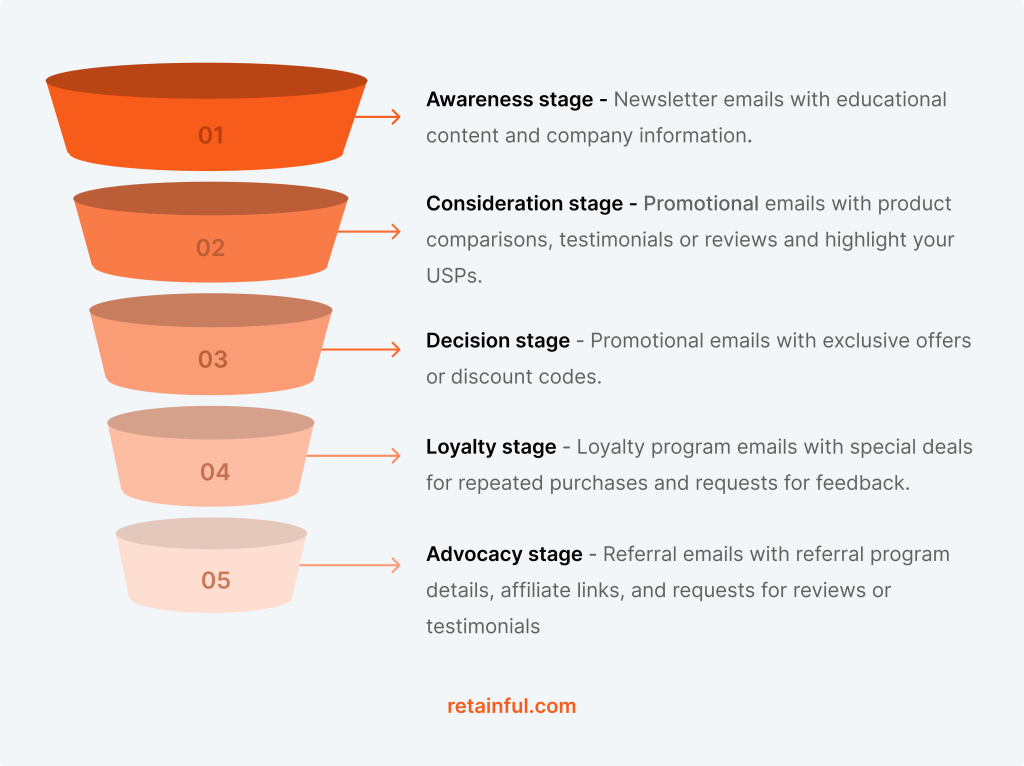
- Lead nurturing email campaign – Focus on educating and building trust with leads who have shown interest in your brand but haven’t yet made a purchase.
- Promotional email campaign – Spotlight offers, discounts, or new products to grab attention and focus on converting recipients into buyers.
- Informational email campaign – Provide valuable content to educate and inform subscribers about your industry, products, or services.
- Transactional email campaign – Automated messages sent after specific actions or transactions, such as purchases, account updates, password resets, and order cancellations, providing relevant information or confirmations related to their activity.
- Reengagement email campaign – Target existing customers to encourage repeat purchases, foster loyalty, and turn them into brand advocates.
- Seasonal email campaign – Marketing messages sent during specific times of the year, like Halloween, or sale days like Black Friday. They aim to engage subscribers by offering relevant promotions, content, or greetings that resonate with the season’s spirit.
Now that we know which emails would be perfect to send at every stage of the customer lifecycle, we will move on to see some of the successful email marketing examples.
30 Best email marketing examples
Successful examples of email marketing do something right to successfully engage customers and bring in conversions. By analyzing them, we can pick apart the best elements and emulate them in ours.
So, we listed the best email marketing examples, analyzed what they got right, and what you can do better while designing your ecommerce email templates.
The 30 best email marketing examples are:
- Moku – Lead nurturing email campaign example
- Brooks – Customer onboarding email example
- Crocs – Order confirmation email example
- Kizik – Abandoned cart email example
- Dollar Shave Club – Upsell/cross-sell email campaign example
- SightGlass – Feedback request email example
- Lumina – Referral email marketing example
- Huel – Thank you email marketing example
- Native – Loyalty email campaign example
- ATG Stores – Re-engagement email marketing example
- Cometeer – First-purchase offer email
- Pulp and Press – Social proof email marketing example
- Recess – Double opt-in email marketing example
- Mill – Comparison email marketing example
- Nike – Birthday email marketing example
- Pompeii – Browse abandonment email marketing example
- Lenovo – Price drop alert email marketing example
- SPLITS59 – Back in stock email marketing example
- Neiman Marcus – Wishlist reminder marketing email example
- Telegraph – Subscription promotion email marketing example
- Squarespace – Trial expiration email marketing example
- Rodd & Gunn – Content curation email marketing example
- Centric – Early access Black Friday email marketing example
- Timbuk2 – Year-round recap email marketing example
- MontBlanc – Product Pre-launch email marketing example
- FullScript – Replenishment reminder email marketing example
- Saas B2B product update email marketing example
- Headspace – Mother’s Day email marketing example
- RAREFORM – Brandstory email marketing example
- Atoms – Back to school email marketing example
Let’s pick apart these best email marketing examples in detail.
Customize all your email campaign templates effortlessly with Retainful’s drag-and-drop email editor and pre-designed templates.
Customize all your email campaign templates effortlessly with Retainful’s drag-and-drop email editor and pre-designed templates.
1. Moku – Lead nurturing email marketing example
When to send: After a welcome email (or as part of the welcome email series)
A well-crafted newsletter should balance promotional content with valuable information that subscribers find interesting, useful, or entertaining.
Newsletter emails are versatile and can be effectively utilized at multiple stages of the email marketing funnel. However, they are particularly impactful at the Top of the Funnel (TOFU) and Middle of the Funnel (MOFU) stages.
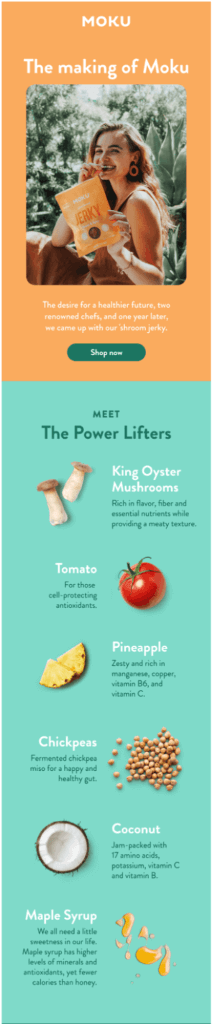
Here is a professional email marketing example for lead nurturing by Moku.
Key takeaways:
- This example of email marketing perfectly balances the informational and promotional tone. The template subtly introduces the CTA ‘Shop now’ and moves on to explain the product.
- It gives a peek into what goes into making the product, informing the customers about its quality it.
- Apart from including information about your products, you can also send how-to guides, tips, and industry news as part of your newsletter email marketing campaign.
2. Brooks – Customer onboarding email example
When to send: Right after someone signs up for your email list
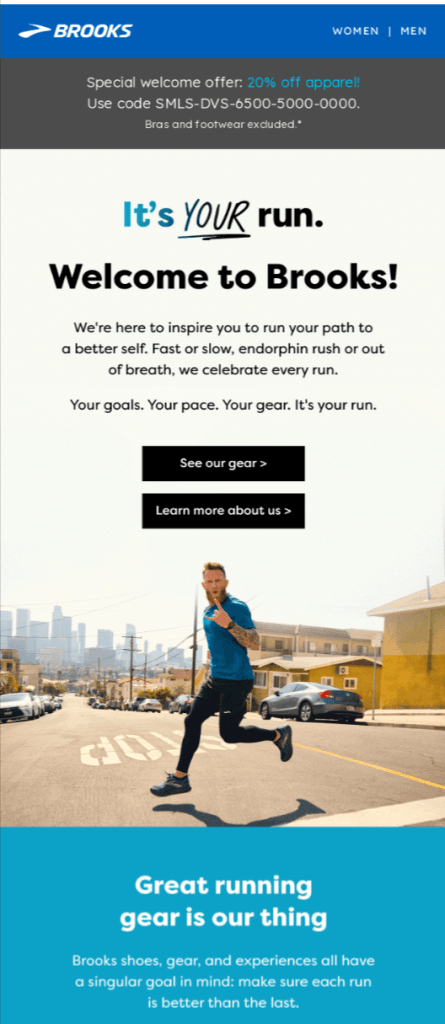
Welcome emails are like a first handshake with your customer. It should create a great first impression and set the stage for future interactions.
These best email marketing examples offer a great opportunity to introduce your brand and tell its story.
Here is how GoopKitchen does it in one of their email marketing examples.
Key takeaways:
- Start with brand storytelling to welcome subscribers and introduce your mission before pushing a sale.
- Set expectations clearly and pair the message with strong product visuals and a prominent CTA for a memorable first impression.|
- Build trust and connection by showing how your products genuinely make a difference in the customer’s life.
Learn more: Learn how to create a welcome email series to bag repeat purchases: Welcome Email Series – Examples + How to create
3. Crocs – Order confirmation email example
When to send: Immediately after the purchase
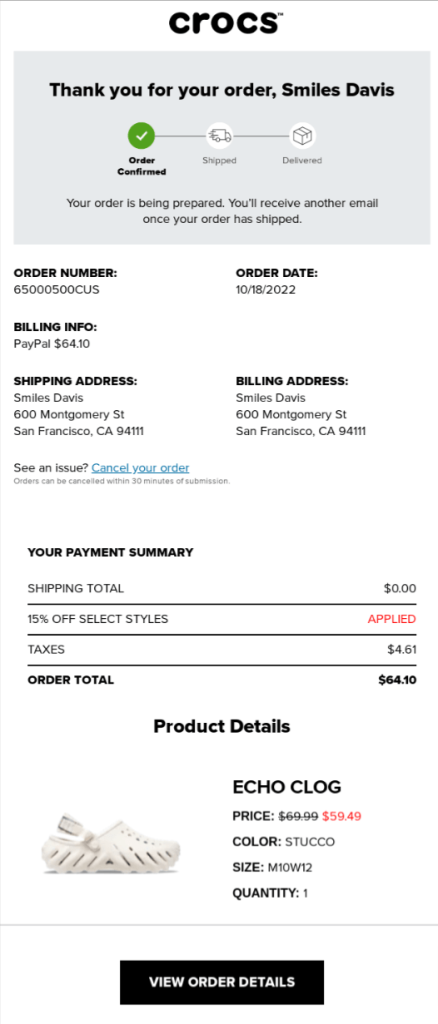
Beyond serving as mere notifications, transactional emails like order confirmation emails enhance the customer experience, build trust, and create opportunities for further engagement and sales.
These best email marketing examples are the first email in the sequence of post-purchase follow-up emails you would send to customers.
So, it is imperative to get them right.
Key takeaways:
- Give full order details upfront to build trust and eliminate confusion (address, payment, items).
- Tell customers what happens next so they know when to expect shipping updates.
- Add helpful cross-sells and clear support contacts to drive extra revenue and reassure customers.
4. Kizik – Abandoned cart email example
When to send: Within 1-2 hrs after cart abandonment
Abandoned cart emails are a staple in e-commerce email marketing, as they are the best in recovering abandoned carts.
These e-commerce email marketing campaigns effectively remind customers about the abandoned cart and nudge them to finish the purchase.
You can provide an incentive and social proof and evoke urgency in the abandoned cart emails to persuade the customer.

Key takeaways
- Use a clear reminder + product visual to reconnect the customer with what they left behind.
- Add urgency (low stock, expiring offer) to push immediate action and reduce hesitation.
- Strengthen the CTA by tying it to the urgency—e.g., “Complete Your Order Before It’s Gone.”
Related Reading: Learn more about abandoned cart emails in our blogs:
5. Dollar Shave Club – Upsell/cross-sell email marketing example
When to send: A day after the order confirmation email
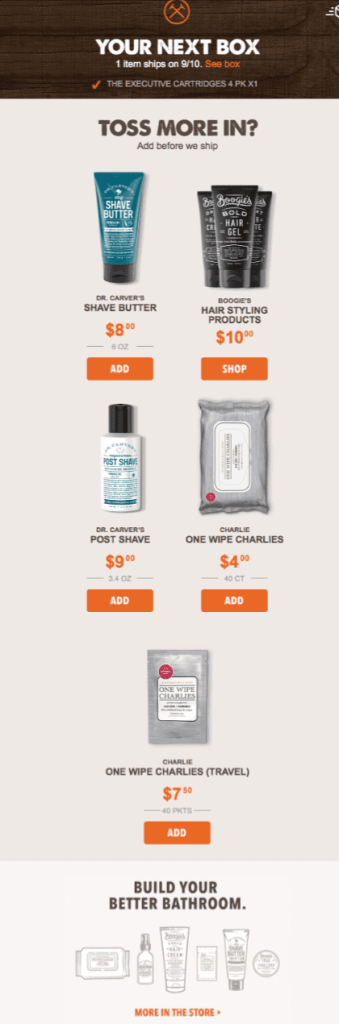
Upsell and cross-sell email marketing examples are about recommending products that complement their initial buys, prompting the customer to spend a bit more.
For upsells, suggest higher-end products or upgrades that enhance the value of their initial purchase. For cross-sells, recommend complementary products that are closely related to the original item. This way, you can increase the AOV average order value of the purchase.
Key takeaways:
- Recommend multiple add-on products to instantly boost AOV and maximize the follow-up opportunity.
- Highlight clearly added value so customers understand how each recommended item solves another need.
- Add a secondary upsell section to further nudge shoppers toward exploring even more products.
6. SightGlass – Feedback request email marketing example
When to send: A week after order delivery
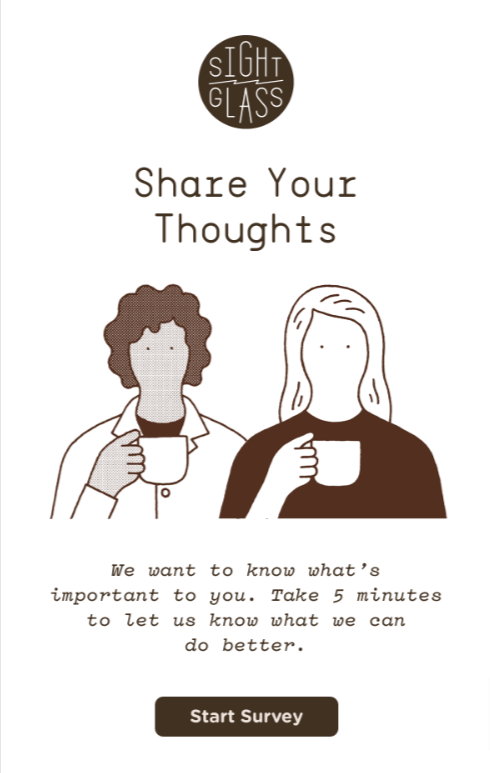
These best email marketing examples are designed to collect feedback from customers about their recent purchase experience, product satisfaction, or service interaction.
A feedback request email keeps the conversation going after the purchase and gives you valuable insight. It is a good reality check.
Here is an email marketing example by SightGlass.
Key takeaways:
- Show appreciation and purpose to make the customer feel valued and clearly state why their feedback matters.
- Be upfront about time, mention exactly how long the survey takes to boost completion rates.
- Use one clear CTA, keep the action focused with a single, prominent “Take the Survey” button.
7. Lumina – Referral email marketing example
When to send: After a customer has made repeated purchases
Now, your customer has made repeat purchases and provided you with positive feedback. It is time to turn them into your brand advocates and spread the word about your brand to their friends.
Referral email programs utilize existing satisfied customers to attract new customers, fostering a cycle of positive experiences and growth for the brand.
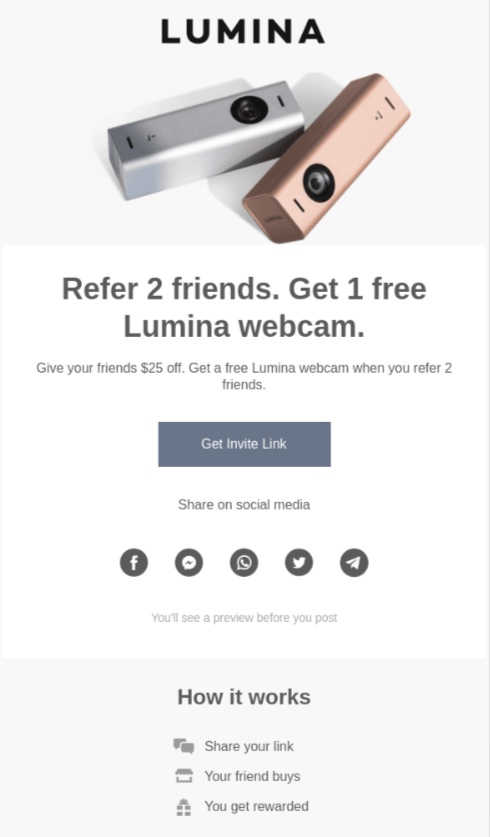
Here is a great email marketing example by Lumina.
Key takeaways:
- Make sharing effortless, use a bold, direct CTA that takes users straight to their referral link or dashboard.
- Explain rewards clearly, show exactly what both the referrer and their friend will receive to encourage quick action.
- Offer multiple share options, provide social buttons, and link-based sharing to maximize reach and participation.
8. Huel – Thank you email marketing example
When to send: After the first purchase or sign-up
A simple thank you email goes a long way in making customers feel appreciated and valued, which is important to provide a positive post-purchase experience to the customers.
This example of email marketing can also be a touchpoint for further engagement, offering an opportunity to introduce customers to additional products, services, or content.
Here is how Huel does it while also giving a thank-you discount.

Key takeaways:
- Lead with the reward, highlight the exclusive offer immediately to trigger instant gratification and motivate action.
- Set clear expectations, tell subscribers exactly what type of content they’ll receive next, so they know the value ahead.
- Acknowledge their action, confirm the purchase or participation, and express genuine appreciation to strengthen trust.
9. Native – Loyalty email campaign example
When to send: If your loyalty program has a sign-up process, trigger the first loyalty email as soon as they join or post-welcome email series.
What to offer those customers who have been stuck with your brand for long time? Loyalty rewards or a simple appreciation message will do the job for you.
By sending these marketing email examples, you can retain customers for a long time and encourage them periodically to make repeat purchases.
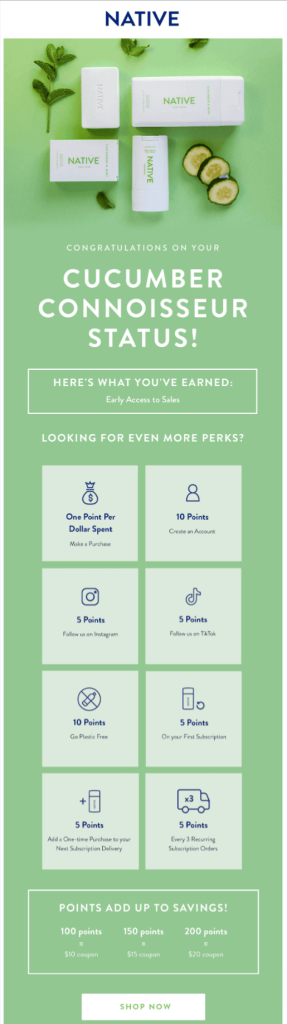
Here is one of the good email marketing examples by Native.
Key takeaways:
- Celebrate loyalty + show the next reward, acknowledge their progress, and highlight the next tier to motivate continued engagement.
- Make the value crystal clear, explain how points work, what they earn, and the exact savings.
- Use member-only perks to drive action, offer exclusive discounts, or early access to reinforce the value of being in the program.
10. ATG Stores – Re-engagement email marketing example
When to send: After customer inactivity of 45 days
Not every customer sticks with you forever. Some drift off. But they are not a lost cause yet. Not when you present them enough reasons to come back through a re-engagement email or win-back email.
You should send a win-back email to a customer after a period of 60 days of inactivity.
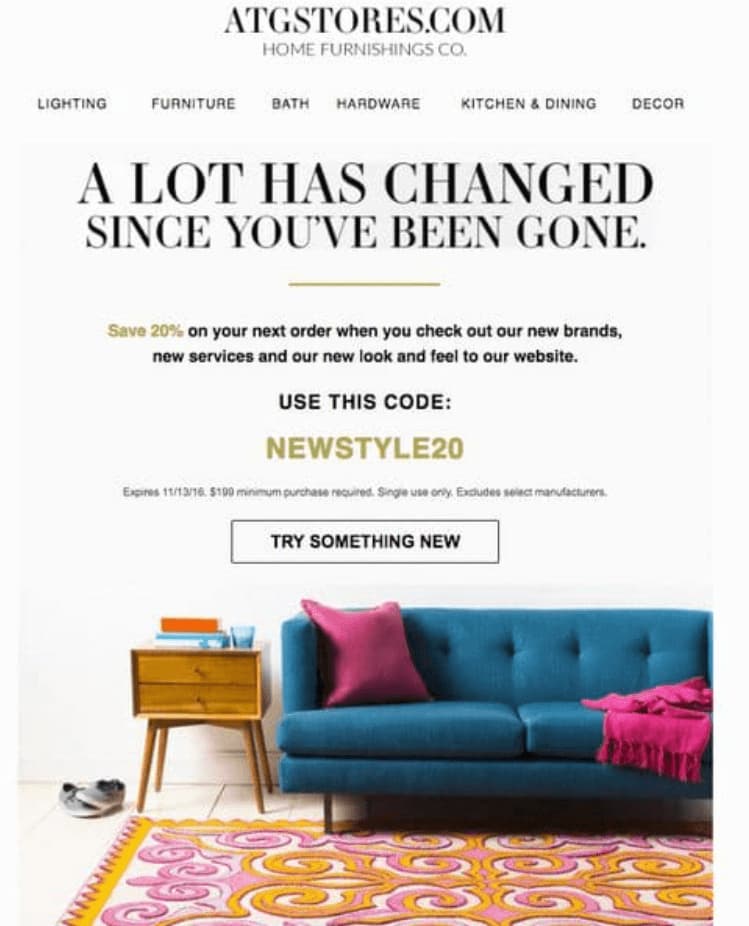
Here is one of the great email marketing examples that does it right.
Key takeaways:
- Show what’s new + add an incentive spotlight new features/products and pair them with a strong offer to re-spark interest.
- Remind them why you’re worth it reinforce your core value and what originally made the customer choose you.
- Give a low-pressure feedback option offer an easy way for them to share why they disengaged, creating another pathway to re-engagement.
11. Cometeer – First-purchase offer email
When to send: After sign-up welcome email
A first-purchase offer is an investment in the customer’s lifetime value. It reduces risk, offers immediate value, and converts hesitant buyers into purchasing ones.
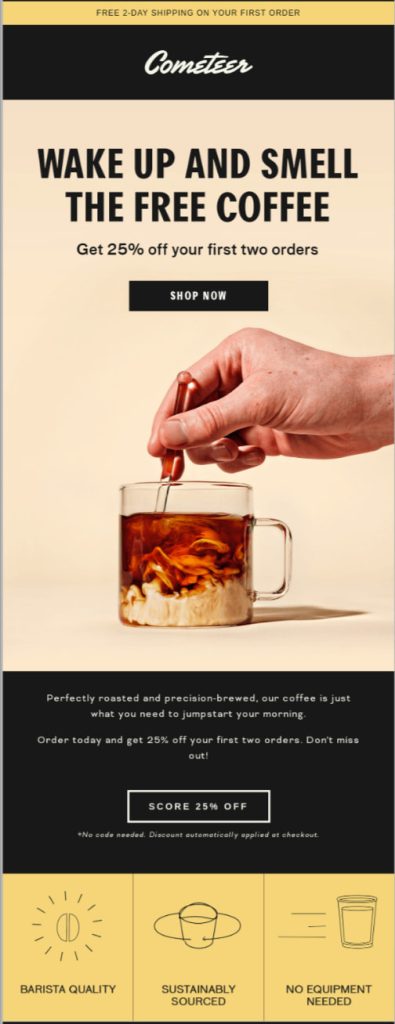
What makes a banging first-purchase offer email even more compelling? Handling customer objections in the same email.
Key takeaways:
- Remove all buying friction, clarify common concerns upfront and apply discounts automatically so customers don’t need a code.
- Show a clear, high-value benefit in the discount email. Make the offer simple, tangible, and instantly understandable.
- Add urgency or exclusivity, use a short validity window to trigger fast action through FOMO.
12. Pulp and Press – Social proof email marketing example
When to send: As part of the lead nurturing email series
Social proof is one of the most powerful tools in persuasion. If others are doing it, it reduces the feeling of risk for the recipient.
It’s no longer just the brand saying “we’re great” – it’s other users backing it up.
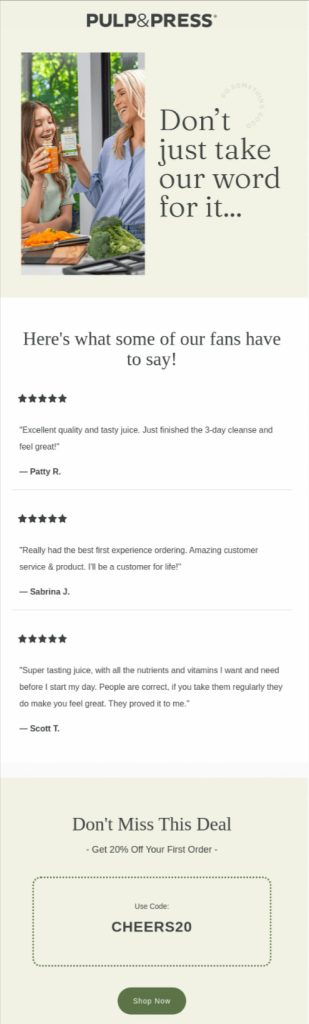
Key takeaways:
- Highlight real-life benefits, focus on how the product improves the customer’s life, not technical specs.
- Place the offer after social proof, let reviews and validation warm the customer before showing the deal.
- Use strong credibility markers, testimonials, and digital badges to make the purchase feel safe and trustworthy.
13. Recess – Double opt-in email marketing example
When to send: A user submits their email address through an email sign-up form on a website or e-commerce store.
Sending double opt-in emails confirms that subscribers genuinely want to receive your emails, significantly lowering the likelihood of your emails being marked as spam.
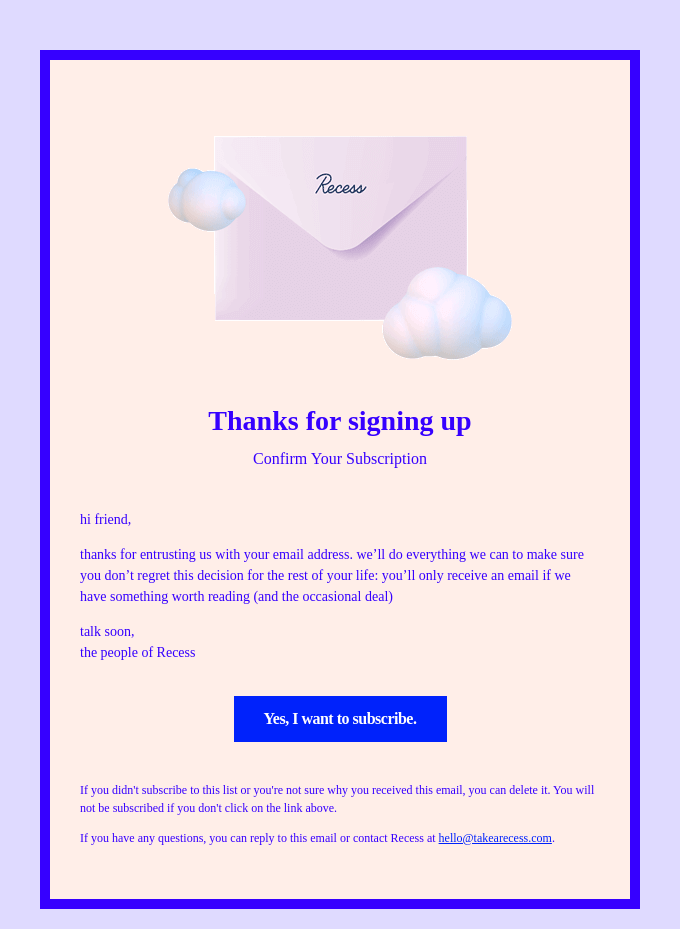
Key takeaways:
- Keep the email focused on one task verifying the subscriber’s email with zero distractions.
- Make the action effortless use a bold, clear confirmation button that’s impossible to miss.
- Explain the ‘why’ reassure users that confirming their email protects privacy and ensures security.
14. Mill – Comparison email marketing example
A comparison email in email marketing lets you hammer home the features or benefits that set you apart. Whether it’s price, quality, or convenience, it’s your chance to voice them out.
The faster a customer understands why you’re better, the faster they’ll buy. Comparison emails reduce hesitation, eliminate doubts, and nudge customers toward hitting “Buy now.”
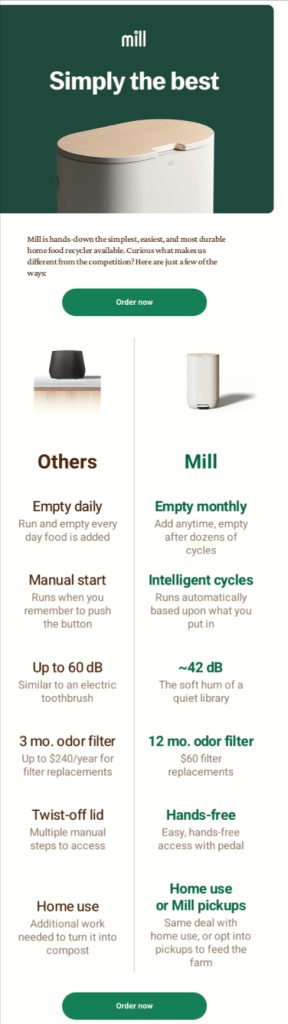
Key takeaways:
- Use clear, numeric benefits so customers instantly see why your product is better.
- Refer to competitors only as “Others” to avoid boosting them while still addressing key pain points.
- Place conversion buttons strategically so customers can act the moment they’re convinced.
15. Nike – Birthday email marketing example
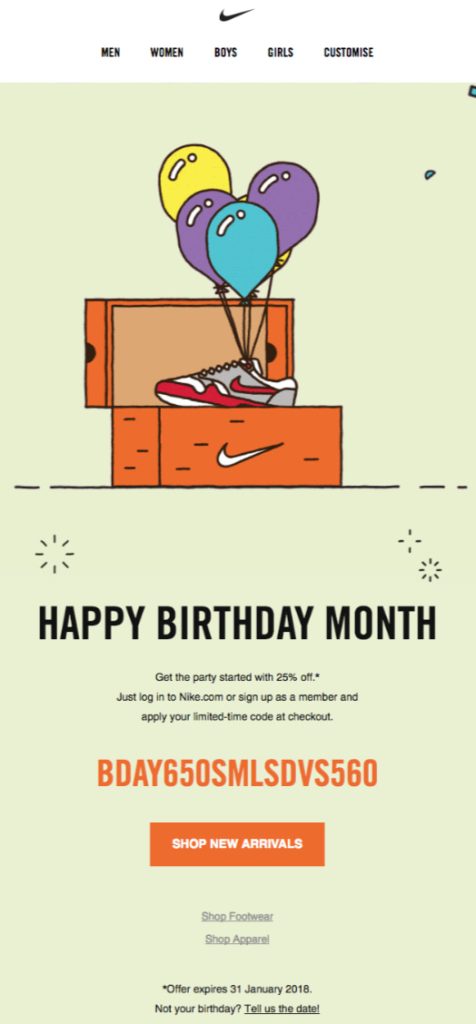
Key takeaways:
- Extend the discount window (e.g., a full month) so customers can redeem it when it suits them.
- Show a bold, clear discount code so there’s zero confusion.
- Include a “Not your birthday?” prompt to let customers correct their info and keep future targeting accurate.
16. Pompeii – Browse abandonment email marketing example
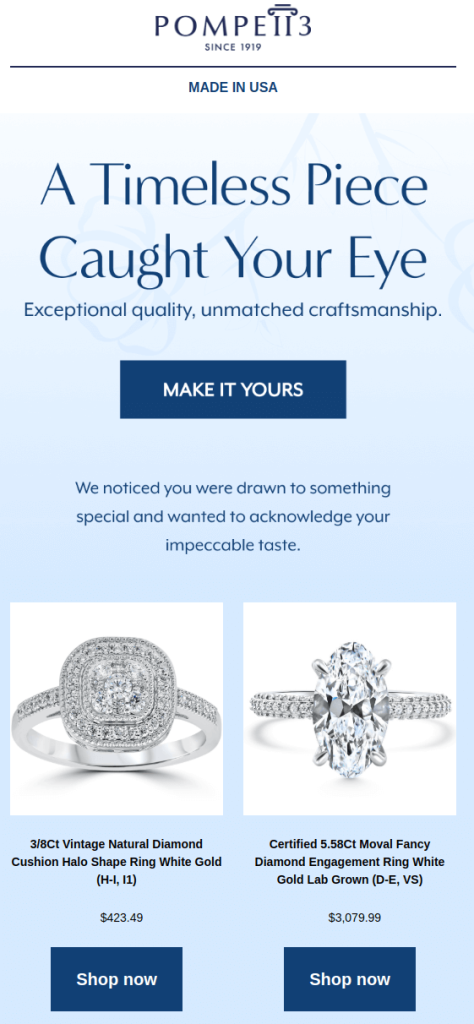
This browse abandonment email from the jeweler POMPEII3 doesn’t just remind the customer; it validates their desire.
It employs sophisticated, aspirational language that cuts through sales resistance, appealing directly to the customer’s inherent sense of taste.
Key takeaways:
- Make the customer feel special. Use flattering, aspirational language to reinforce their great taste and spark desire.
- Add gentle urgency with soft FOMO cues like “Low Stock Alert” to nudge quick action without being pushy.
- Offer safe alternatives and include a few related items so there’s always another option if the main product isn’t chosen.
17. Lenovo – Price drop alert email marketing example
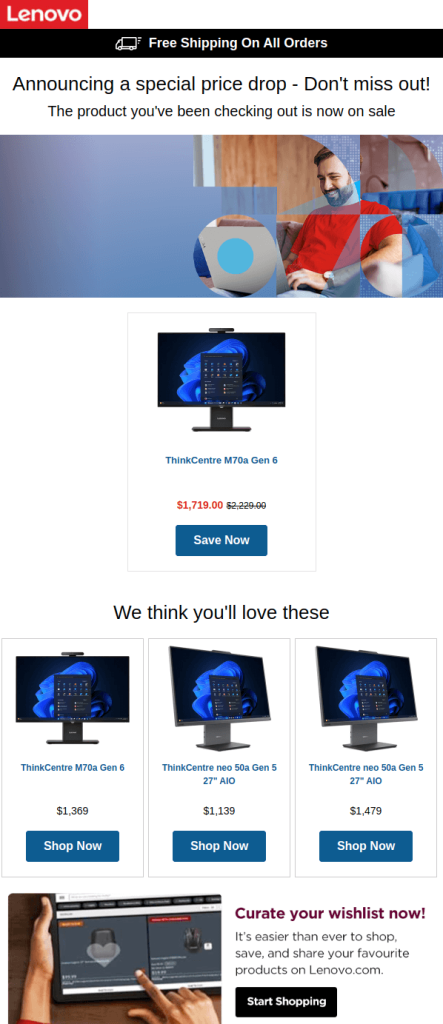
This is an excellent email marketing example of a high-value, urgency-driven price drop alert. It capitalizes on the customer’s prior interest to drive an immediate sale.
Additionally, it gives the exact incentive needed.
Key takeaways:
- Show the savings clearly. Use a strong FOMO trigger like “Price Alert” and highlight the discount with original vs. sale price.
- Force quick action. Add urgency with a deadline and reduce friction using perks like free shipping.
- Improve conversion odds. Include cross-sell options so shoppers still buy even if the main item isn’t the right fit.
18. SPLITS59 – Back in stock email marketing example
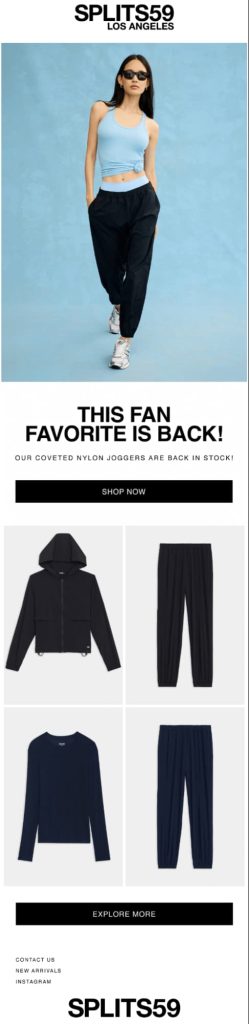
The email marketing example from SPLITS59 directly addresses customer anticipation by announcing the return of a popular, previously sold-out product.
It expertly uses the psychology of exclusivity and social proof to drive immediate clicks and maximize sales velocity.
Key takeaways:
- Use social proof upfront—make the item instantly desirable with headlines like “Fan Favorite Is Back!”
- Keep the message focused—highlight only the returned item with a clear, singular call-to-action.
- Make it feel exclusive—speak directly to interested shoppers with personalized lines like “Just for you—It’s back!”
19. Neiman Marcus – Wishlist reminder marketing email example
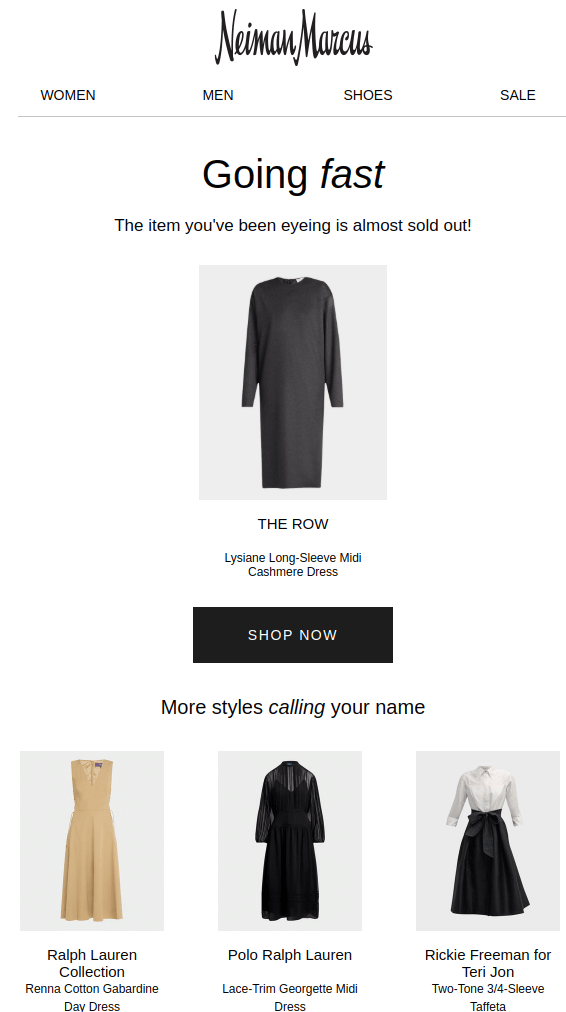
Wishlist reminder email marketing example from Neiman Marcus cuts through browsing indecision.
It notifies the customer that their “eyed” item is almost sold out, transforming a passive interest into a mandatory, time-sensitive action.
Key takeaways:
- Use urgent, FOMO-driven headlines with clear numbers (“Only 3 left!”) to trigger immediate action.
- Make the email fully personalized around the exact product the customer viewed or wishlisted.
- Lead with the strongest incentive — highlight a price drop first; if none, push the low-stock alert as the main hook.
20. Telegraph – Subscription promotion email marketing example
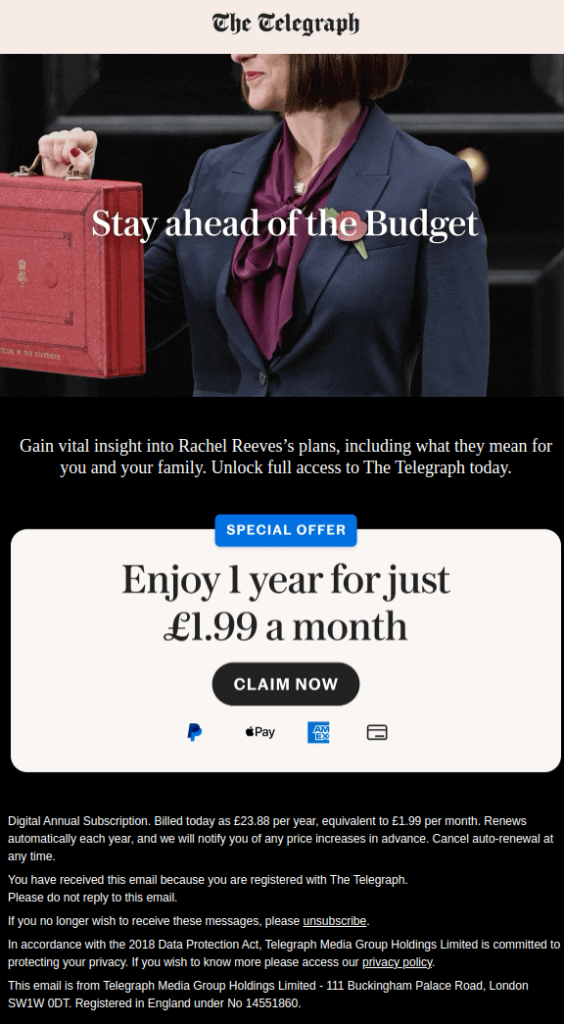
This email from The Telegraph is a prime email marketing example of a subscription promotion. It expertly uses timely, high-stakes current events to drive paid conversion.
Key takeaways:
- Tie the message to a timely external event so customers feel an immediate reason to act.
- Lead with the benefit and show how the subscription solves a real need before mentioning price.
- Present pricing in a clear, low-commitment format (like monthly) to make the decision feel easy.
21. Squarespace – Trial expiration email marketing example
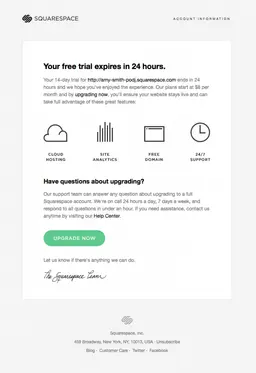
This email from Squarespace is a textbook email marketing example of a SaaS trial expiration alert.
Key takeaways:
- Create urgency with a clear deadline and highlight what the user will lose if they don’t upgrade.
- Use visuals like icons or short lists to quickly show the value of the paid features.
- Include one strong CTA so the user knows exactly what action to take next.
22. Rodd & Gunn – Content curation email marketing example
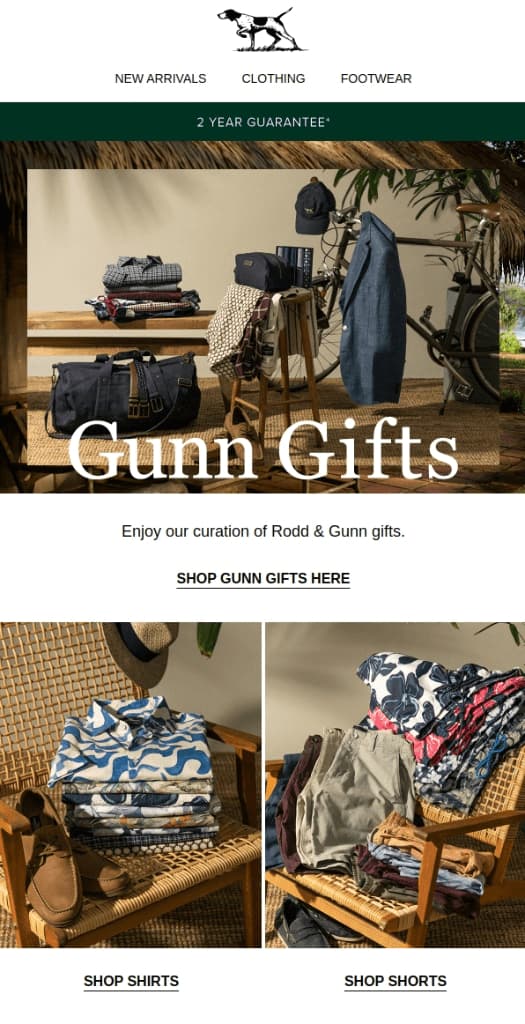
This marketing example email from Rodd & Gunn transforms a basic product listing into an aspirational lifestyle guide.
It frames the offerings as “Gunn Gifts,” and utilizing rich, ambient photography, it sells the experience and convenience of gifting.
Key takeaways:
- Make shopping effortless by grouping items into a few simple, clickable gift categories.
- Use a strong trust signal—like a visible guarantee—to reassure customers about quality.
- Keep the email tied to a specific purpose or season so the recommendations feel immediately relevant.
23. Centric – Early access Black Friday email marketing example
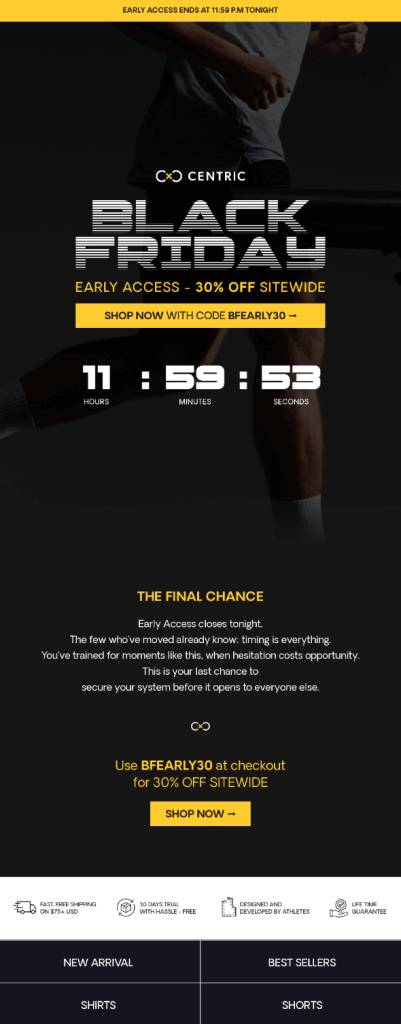
The BFCM email marketing example from Centric is an exclusive early access promotion. It leverages urgency and scarcity to drive immediate, high-volume sales for BFCM.
Key takeaways:
- Use a bold countdown timer and a clear deadline in your BFCM email structure to create strong urgency and push immediate purchases.
- Make the customer feel special with VIP-style language so they see the offer as exclusive and worth acting on.
- Add simple category links to help shoppers jump straight to what they want and buy faster.
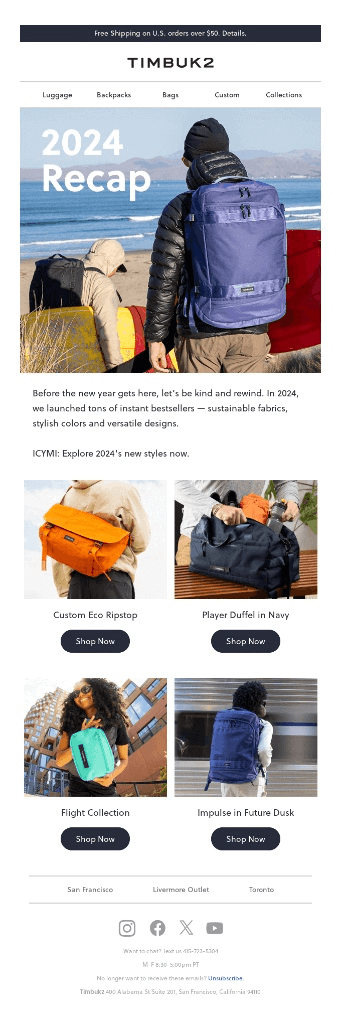
24. Timbuk2 – Year-round recap email marketing example
This email marketing example from Timbuk2 masters nostalgia, social proof, and seamless cross-selling.
Key takeaways:
- Use a nostalgic or year-in-review theme to create an emotional, engaging experience.
- Organize the recap into clear sections with strong CTAs so customers can browse effortlessly.
- Start with a simple intro that tells customers exactly why they should scroll and explore.
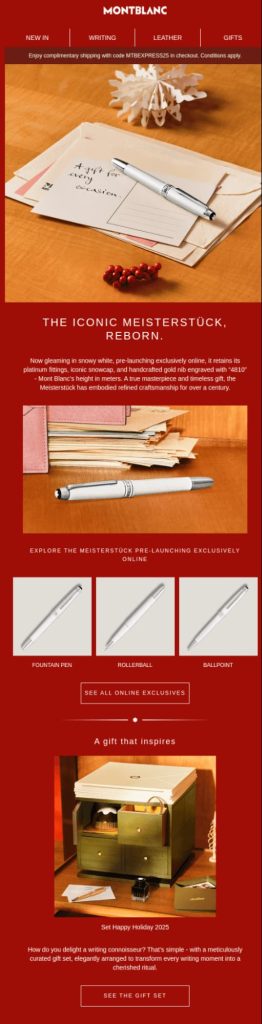
25. MontBlanc – Product Pre-launch email marketing example
This product pre-launch email marketing example from MontBlanc uses aspirational language, storytelling and heritage to drive immediate sales.
Key takeaways:
- Make customers feel special by highlighting exclusivity, early access, or “online only” availability.
- Justify the price by connecting the product to your brand’s heritage or long-standing reputation.
- Organize the product options clearly (by type or format) so high-intent shoppers can choose quickly and purchase without confusion.
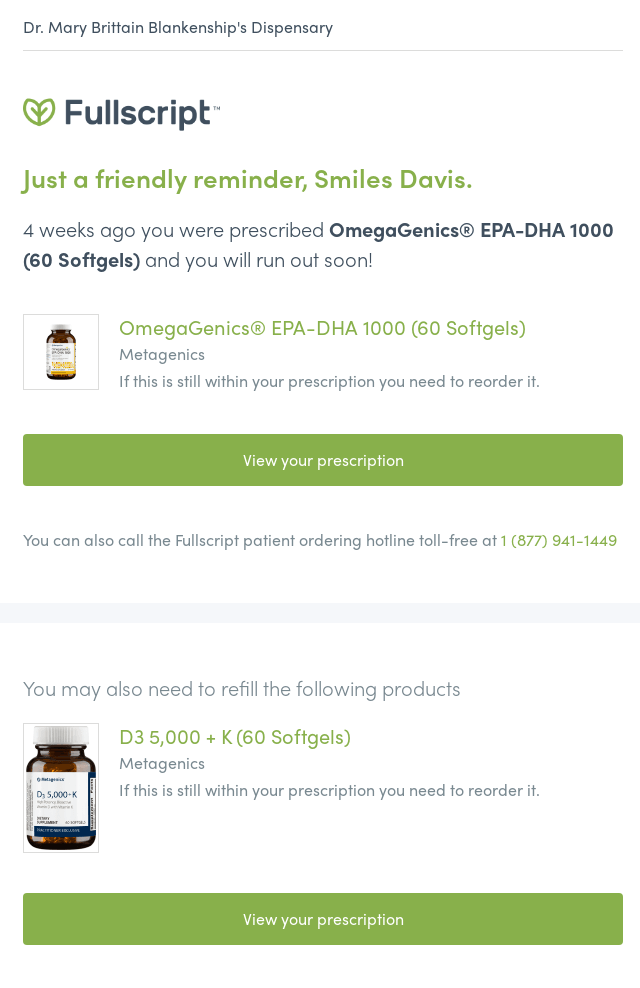
26. FullScript – Replenishment reminder email marketing example
This campaign from Fullscript is a highly personalized reminder that excels in trust validation.
It includes the doctor’s name and anticipates the user’s need, creating a high-stakes utility that compels the immediate re-ordering.
Key takeaways:
- Build trust by referencing the physician or original context and send the reminder exactly when the customer is likely running low.
- Use a clear, dominant CTA like “Reorder Now” to make the repeat purchase effortless.
- Add quick reassurance—such as authenticity or fast shipping—to confirm the customer is making the right choice.
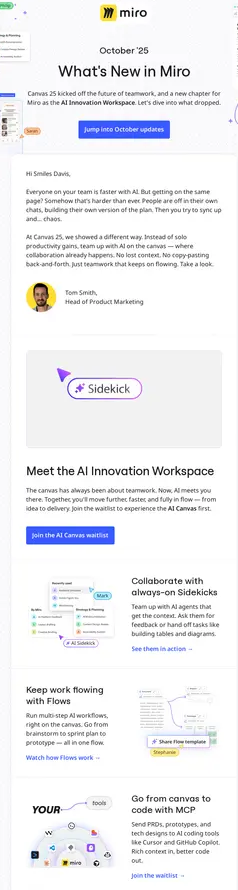
27. Miro – Saas B2B product update email marketing example
This email from Miro is a prime example of a product updates/release email for a SaaS platform.
Key takeaways:
- Present the update as a big, future-focused improvement and emphasize how it directly benefits the user.
- Highlight the most impressive feature first and use exclusivity—like a waitlist—to create excitement.
- Give a clear reason to act now and include one strong CTA that leads straight to the update or tutorial.
28. Headspace – Mother’s Day email marketing example
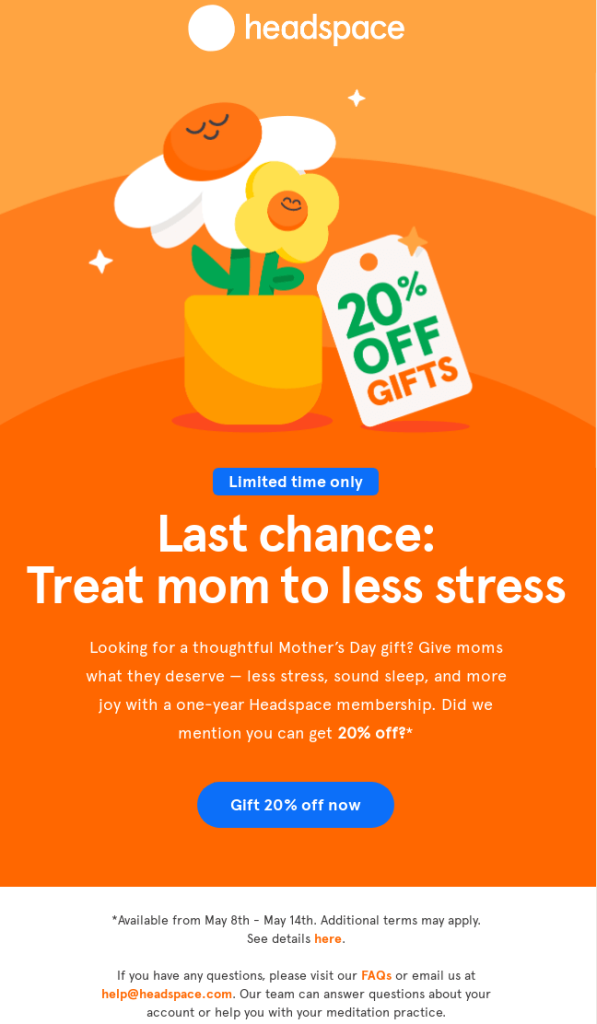
This email from Headspace is an excellent example of a Mother’s Day promotional email.
Key takeaways:
- Focus on the emotional value of the gift and use clear deadlines to create urgency.
- Use gift-focused CTAs so shoppers instantly know they’re buying something meant to be gifted.
- Provide easy access to support links to build trust and reduce any worries before purchasing.
29. RAREFORM – Brandstory email marketing example
RAREFORM’s email marketing example leverages the brand’s unique sustainability story to drive high-intent customers back to the site.

Key takeaways:
- Highlight your brand’s mission up front so shoppers feel their purchase supports a meaningful purpose.
- Use strong visuals and simple explanations to show what makes the product unique and worth the price.
- Make it easy to return and buy with one clear CTA and subtle trust signals that reassure customers.
30. Atoms – Back to school email marketing example
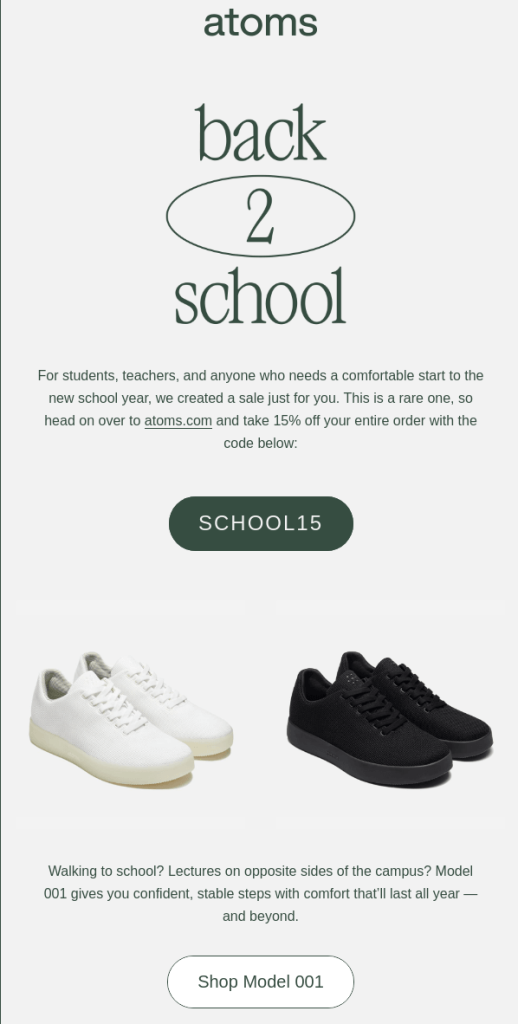
This email marketing example from Atoms frames its products not as fashion items, but as essential utility for students and workers starting a new routine.
Key takeaways:
- Use a clear discount code and directly address the target group so shoppers immediately feel the offer is meant for them.
- Highlight practical, long-lasting benefits to justify the purchase and reduce hesitation.
- Present products in a clear, step-by-step order so customers can browse easily and take action with focused CTAs.
There you have it. The 30 successful email marketing examples and what you can learn from them.
Now, it is time to put the learning into action and create a successful email marketing campaign.
How to create a successful email marketing campaign?
Creating an email marketing campaign requires a structured approach with a goal to engage them in a way that retains customers and drives sales..
Here are the steps to creating an email marketing campaign.
- Define your objectives: Start by clearly defining what you want to achieve with your marketing emails. Clear goals will guide your email marketing strategy and help measure success.
- Research your audience: Gather data on customers’ preferences, behaviors, and demographics. These personas should reflect different segments of your audience, capturing their interests, pain points, and behavior patterns.
- Segment your email list: It lets you send personalized emails by grouping customers based on their interests, behavior, and purchase history. With tools like Retainful, you can create these segments to make targeted email campaigns.
- Email marketing software:Modern email automation tools let you create, schedule, and run campaigns automatically, saving you time.
- Email design and content: Design responsive email marketing templates that are both optimized for desktop and mobile experience. Use a compelling subject line to increase open rate and ensure the email content delivers real value.
- Test and optimize: Before launching your email marketing campaign, test different elements such as subject lines, designs, email frequency, and CTAs. To determine what works best, track key email marketing metrics, and refine your approach based on the results.
Create targeted email campaigns that convert more with Retainful’s easy-to-use email segmentation and automation features.
Wrap up!
Email marketing examples we’ve explored showcase the power of email to connect with audiences on a personal level, drive engagement, and increase conversions.
So, take inspiration from these successful email marketing campaign examples, apply the strategies that resonate with your brand, and watch as your email marketing campaigns transform from mere communications into meaningful conversations with your customers.
Learn more about platform-specific email marketing:
- Shopify Email Marketing: A Complete Guide to Create Successful Campaigns.
- WooCommerce Email Marketing: An Ultimate Beginner’s Guide
- How Much Does Email Marketing Cost in 2025?
- How to insert a GIF into an Email in 2025 (Gmail + Outlook)
Frequently asked questions
Create good email marketing by personalizing content, ensuring mobile-friendliness, including clear calls-to-action, and regularly testing and refining your strategy based on performance metrics.
An email marketing strategy outlines how to use emails to achieve specific marketing goals, such as increasing sales or increasing subscriber engagement.
The most common form of email marketing is promotional email, which focuses on direct sales pitches, special offers, and product announcements to drive immediate sales and conversions.
The optimal number of emails varies by industry and audience, but a good starting point is 1-2 emails per week. Monitor engagement to adjust frequency for your audience’s preferences.
The best day to send email marketing varies by audience and industry, but Tuesdays and Thursdays often see higher open rates, making them popular choices for maximizing engagement and response rates.
The ideal wait time between marketing emails varies, but generally, sending one email per week is effective.
Adjust the frequency based on audience engagement, campaign type, and specific goals to avoid overwhelming subscribers.
The 3 main steps are: building an email list, creating engaging content, and analyzing the campaign’s performance.
The biggest challenge in email marketing is cutting through the noise to reach and engage the audience effectively amidst an overflowing inbox.
The optimal number of emails in a campaign varies, but generally, 3 to 5 emails are effective for engaging your audience without overwhelming them.