Losing just 5% of your customer base monthly means you must grow by 60% annually just to maintain zero net growth. Churn prevention isn’t just a metric; it is the difference between a scaling business and a dying one.
Many brands struggle with “leaky bucket”, where expensive customer acquisition is wiped out by customer churn, fragmented communication, and reactive support.
This article provides a comprehensive solution, revealing 10 data-backed strategies and the best software to stabilize your MRR.
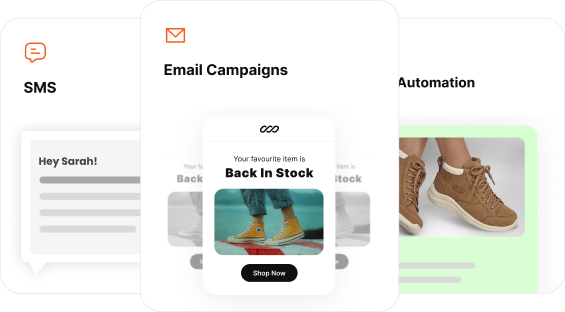
Prevent customer churn with timely communication via Retainful’s email, SMS & WhatsApp automation.
What is customer churn, and why is it important?
Customer churn is the percentage of your customers who have stopped purchasing your product or service in a specific time period.
Keeping track of your customer churn is important because it directly affects your revenue churn. In simple terms, the more your customers leave your business, the more revenue is lost.
How to calculate churn rate?
To manage churn, you first have to measure it. The standard formula for calculating your churn rate over a specific period (usually monthly or annually).

Related reading: E-commerce Infrastructure Checklist: Speed, Security, and Stability
Why should you focus on preventing customer churn?
If you have a 5% monthly churn rate, it doesn’t just mean you lost 5% of your customers. It means:
- You have to grow by at least 5% every month just to stay at zero growth.
- If your Average Order Value (AOV) is $100, losing 25 customers this month isn’t just a $2,500 loss today. If those customers usually buy 4 times a year, you just lost $10,000 in projected annual revenue.
- You likely spent $20–$50 to acquire each of those 25 customers. When they churn, CAC investment is completely wiped out before it can turn a profit.
When a customer churns, you don’t just lose their current subscription or order. You lose their Customer Lifetime Value (CLV).
- Repeat Customer: Buys today, buys again in 3 months, refers a friend, and responds to your email, SMS, and WhatsApp messages.
- Churned Customer: Stops at step one.
Retain customers effectively with Retainful’s omnichannel churn prevention campaigns
How to identify at-risk customers early? – 5 simplest ways to predict customer churn
Most customers don’t just wake up and decide to cancel. They “drift” away slowly, leaving a trail of digital breadcrumbs.
Identifying these signals early allows you to intervene before they hit the exit button.
Here are the 5 simplest, data-backed ways to predict customer churn:
- Declining engagement: This is the single biggest predictor. Look for customers who have stopped opening your emails or haven’t logged into their accounts in 30 days. Try to engage inactive customers again using a win back email sequence.
- Involuntary churn: A failed transaction is a “red alert.” Whether due to expired cards or insufficient funds. These customers will churn involuntarily if not nudged immediately via a high-visibility channel like WhatsApp or SMS messages.
- Frequent support tickets: A sudden spike in support requests regarding bugs or confusion can signal frustration. Conversely, a customer who stops complaining after a long period of activity may have already given up.
- Downgrades or reduced usage: If a subscriber moves from a “Pro” plan to a “Basic” plan, or an e-commerce customer’s AOV drops significantly, their perceived value of your brand is shrinking.
- Low NPS or feedback scores: A Net Promoter Score (NPS) of 6 or below (“Detractors”) indicates a customer is actively unhappy.
By monitoring these five signals, you can move from reactive “damage control” to proactive retention.
10 Proven churn prevention strategies
Here are the 10 best customer churn prevention strategies:
- Analyze why churn happens using the customer feedback loop
- Sync customer engagement in every channel
- Identify valuable customers who are at risk of churning early
- Offer strategic and competitive discounts
- Find your VIP customer segment for tiered retention
- Provide proactive services & support to increase customer satisfaction
- Educate and nurture your customers
- Instead of subscription cancellation, provide an option to pause the subscription
- Provide long-term contracts
- Automatic sequences to recover involuntary churn
1. Analyze why churn happens using the customer feedback loop
You can’t fix what you don’t measure. Too many brands guess why customers leave, but the only way to truly stop the “leak” is to hear it from the source. A customer feedback loop is a structured process of gathering, analyzing, and acting on user sentiment to improve retention.
To build an effective loop, you must capture feedback at three critical stages:
- Proactive feedback: Use automated Net Promoter Score (NPS) or Customer Satisfaction (CSAT) surveys while the customer is still active. If a customer gives a score of 6 or below, they are a “detractor”; trigger an immediate internal alert for your support team to intervene.
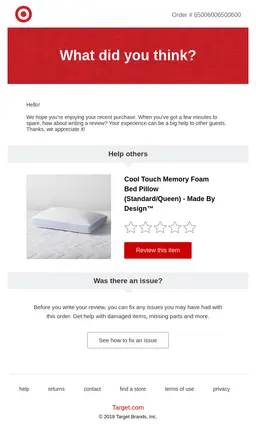
- Transactional feedback (Post-purchase flow): Trigger a simple, one-question survey via post purchase email, SMS or WhatsApp messages. This identifies friction points in real-time before they fester into reasons to cancel.
- Exit feedback:
- Was it the price?
- Technical issues?
- did they move to a competitor?
The strategy: Don’t just collect data; close the loop. If multiple customers complain about a specific feature through these channels, share that data with your product team. Showing a customer that their feedback resulted in a real change is one of the most powerful ways to win back their trust
2. Sync customer engagement in every channel
Presence is not the same as synchronization. In a multichannel world, sending the same “Please stay” message across five different platforms is just spam.
According to recent data, brands with strong omnichannel engagement achieve 89% customer retention, compared to just 33% for those with fragmented communications.
Here is how to effectively sync your engagement:
- Assign a specific role to each channel. Email is for deep value and long-form education. SMS is for high-urgency alerts (like a flash sale or a billing issue). WhatsApp is for conversational support and real-time re-engagement.
- Sequential Logic: Don’t blast all channels at once. If a customer doesn’t open a critical “Account Update” email within 24 hours, trigger a follow-up via WhatsApp. If they still don’t engage, send a final SMS nudge. This ensures your message is seen without overwhelming the user.
- Shared Context: There is nothing more frustrating for a customer than repeating their issue. Ensure your support team, sales team, and automated bots all see the same “Customer Timeline.” If a user complains on Twitter, your next automated email should acknowledge their frustration rather than sending a generic “Everything is great!” newsletter.
The strategy: Use a centralized platform to act as the “brain” of your operations, by syncing engagement based on behavioral triggers.
Create a seamless experience that makes the customer feel remembered and valued, significantly reducing the urge to churn.
3. Identify valuable customers who are at risk of churning early
Not all churn is equal. Losing a one-time discount shopper is a minor setback. However, losing a high-value, repeat customer is a major blow to your Customer Lifetime Value (CLV).
The gold standard for predicting customer churn is RFM Analysis (Recency, Frequency, Monetary).
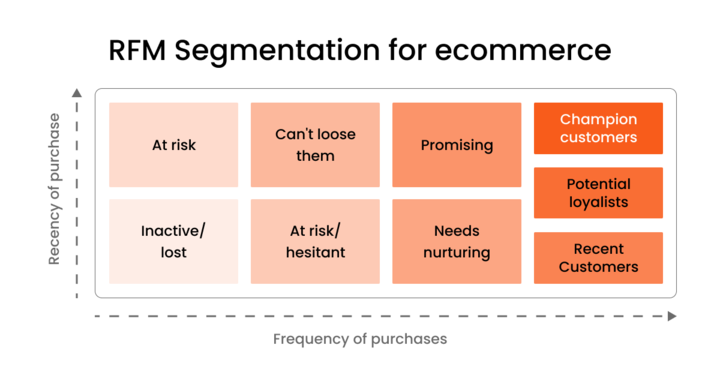
- Recency (R): How long has it been since their last purchase or login? A high R-score means they are active; a low R-score is your first churn warning.
- Frequency (F): How often do they buy or engage? Loyal customers have a high F-score. If this drops, they are losing interest.
- Monetary (M): How much have they spent in total? This identifies your high-value “Whales” vs. low-value shoppers.
The strategy: Look for customers with a High Monetary score but a Low Recency score. These are users who have spent significant money with you in the past but haven’t returned recently.
Instead of a generic “We miss you” email, trigger a high-priority WhatsApp outreach or a personalized offer specifically for this segment.
Because these customers have already proven their value, your Return on Investment (ROI) for “saving” them is significantly higher than the cost of acquiring a brand-new lead.
Related reading: Email Marketing ROI: Calculation, Metrics & Strategies to Increase Returns
4. Offer strategic and competitive discounts
If you offer 20% off to everyone, you are just cutting into your margins and training your customers to never pay full price.
To reduce churn, discounts must be strategic, time-sensitive, and behavioral.
The goal is to use incentives as a “nudge” to restore a habit, not as a permanent price drop. Here is how to apply them competitively:
- The “Next-Order” Bridge: One of the most common churn points is the gap between the first and second purchase. Automate a Next-Order Coupon inside the first order’s confirmation email. This creates an immediate “habit loop” and secures the second sale.
- Tiered Win-Back Offers: Don’t lead with your biggest discount. If a customer hasn’t purchased in 30 days, send a “Value-Add” incentive first (like free shipping or a small gift). If they still don’t convert after 60 days, then escalate to a higher percentage discount.
- Price-Match Protection: In a competitive market, customers often churn because they found a cheaper alternative. If your data shows a customer is comparing prices trigger an automated, one-time “Loyalty Price” to match or beat the competitor’s offer.
The strategy: Use dynamic coupons that are unique to each customer. Generic codes like “SAVE20” get leaked to coupon-hunting sites, whereas unique, single-use codes link via SMS or WhatsApp feel like a personal reward.
5. Find your VIP customer segment for tiered retention
The Pareto Principle (80/20 rule) is the backbone of retention: roughly 20% of your customers generate 80% of your revenue.
Tiered retention ensures you aren’t spending the same resources on a “one-and-done” shopper as you are on a high-value advocate.
To move beyond basic segmentation, implement a Value-Based Tiering system:
- The VIP “Inner Circle”: Identify customers with the highest Lifetime Value (LTV). Instead of standard discounts, offer them “Emotional Incentives” early access to new product drops or members-only events.
- The Growth Potential: These are consistent buyers with mid-range spend. Use tiered rewards to nudge them into the VIP bracket (e.g., “Spend $50 more this month to reach Gold Status”).
- Threshold-Based Triggers: Set up automated emails for when a customer moves between tiers.
The strategy: Use Tiered Retention to create “switching costs.” When a customer reaches a high tier, they aren’t just buying a product; they are maintaining a status. The fear of losing their “VIP perks” becomes a powerful psychological barrier against churning to a competitor.
Related reading: Email Segmentation: Complete Guide for 70% More Revenue
6. Provide proactive services & support to increase customer satisfaction
The best support is the one a customer never has to ask for. Reactive support (waiting for a ticket) only begins after the customer is already frustrated.
In contrast, proactive support anticipates friction and removes it before the customer even notices it, which research shows can improve customer loyalty by up to 20%.
In 2026, e-commerce proactive service is driven by behavioral data and automated nudges:
- Preemptive problem solving:
- Send an automated WhatsApp or SMS alert immediately: “We’re aware of the delay, and we’re on it. Here’s a $5 credit for the inconvenience.” This turns a potential “churn moment” into a “loyalty moment.”
- “Stuck” triggers: Monitor customer behavior for signs of struggle. If a user is rage-clicking on a checkout page or spending an unusually long time on a complex feature, trigger a proactive Live Chat nudge or an automated “Need help?” email with a 30-second tutorial video.
- Post purchase call: High-value customers shouldn’t be left alone after the sale. Automate a “Success Check-in” message 7 days after delivery: “How are you liking [Product]? Here is a quick tip to get the most out of it.”
The strategy: Use your support data to identify the top 5 recurring complaints and build automated, proactive solutions for each. By reducing the customer effort score, you make your brand “sticky” and significantly harder to leave.
7. Educate and nurture your customers
Churn often happens because of a “value gap”. It is the distance between what your product can do and what the customer actually knows how to do.
If a customer doesn’t see results quickly, they view your subscription as a cost rather than an investment.
Customer education closes this gap. Research shows that companies with formalized education programs see an increase 7.4% in retention and a 24% in Customer Lifetime Value (CLV).
- The “micro-learning” approach: Avoid sending 30-minute training videos. In 2026, customers prefer “just-in-time” learning. Trigger short, 60-second video tutorials or “How-To” WhatsApp tips based on the customer’s specific stage (e.g., sending an “Advanced Features” guide only after they’ve mastered the basics).
- Lifecycle nurturing: Onboarding isn’t a one-time event; it’s a continuous cycle. Use an automated Lifecycle Nurture Flow that sends relevant content every 30 days. This could be industry trends, a “Did you know?” feature highlight, or a success story from a similar user.
- Interactive onboarding: 75% of customers find interactive tutorials more effective than static articles. Use in-app checklists and progress bars to gamify the learning experience. When a customer sees they are “80% complete” with their setup, the psychological urge to finish prevents early-stage churn.
The strategy: Transition from “selling” to “teaching.” Position your brand as an expert resource, and you build a relationship based on authority and trust.
Customers who feel “empowered” by your product are more loyal because they’ve invested time in learning your ecosystem. This way, you can create a natural barrier to switching to a competitor.
8. Instead of subscription cancellation, provide an option to pause the subscription
When a customer hits the “cancel” button, it is often a cry for flexibility, not a total rejection of your brand. Forcing a “binary” choice: pay full price or leave forever, is a major retention mistake.
Offer a subscription pause.
- The churn buffer: Research shows that companies offering a “pause” option can reduce immediate cancellations by up to 18%.
- Consumer preference: According to 2026 industry reports, 58% of people have opted to pause a subscription instead of canceling in the past year.
- The “pause dividend”: Platforms like Recurly have seen a 337% increase in pause usage as merchants realize that paused subscribers are significantly easier (and cheaper) to reactivate than cold leads.
9. Provide long-term contracts
Every monthly billing cycle is a “re-decision point” where a customer might question the value of your service.
Long-term contracts (annual or multi-year) eliminate these 12 monthly hurdles and replace them with a single, high-commitment renewal.
- The retention gap: Annual plans typically retain 92% of customers, whereas monthly plans often struggle with retention rates as low as 68%.
- Churn reduction: Monthly billing leads to significantly higher churn rates, averaging 8.5% to 12% per month. In contrast, annual subscriptions see yearly churn as low as 3% to 7%.
- Involuntary churn protection: Annual billing reduces the number of payment transactions by 92%, which can lower involuntary churn (failed credit cards) by up to 95%.
The strategy: Incentivize the “Switch.” You don’t have to force customers into long-term deals, but you should make them the obvious financial choice. Offer a “2 Months Free” discount for annual billing, or lock in a specific price point for two years to protect them against future inflation.
By moving your customers to a longer cycle, you stabilize your Monthly Recurring Revenue (MRR) and give your team a full year to prove the product’s value before the next renewal.
10. Automatic sequences to recover involuntary churn
Not all customers who leave your store do so by choice.
Involuntary churn: revenue lost due to technical issues like expired credit cards, insufficient funds, or bank declines accounts for nearly 20% to 40% of total churn.
An effective automatic recovery system works in three layers:
- Smart retry logic: Don’t just retry the card immediately. Advanced systems use machine learning to retry the transaction at optimal times (e.g., on typical paydays or during business hours when banks are most responsive).
- Email flow:
- Day 0: A gentle, branded “heads-up” about the payment issue.
- Day 3: A slightly more urgent reminder with a direct link to a secure payment update portal.
- Day 7: A final notice before service is paused or canceled.
- Card updaters: Modern billing platforms often sync directly with card networks to automatically refresh expired or replaced card details in the background. Companies using these services see up to a 5x improvement in recovery rates.
The strategy: Treat involuntary churn as a “customer service” opportunity, not a “debt collection” task. Use an empathetic tone: “We had trouble processing your renewal, and we don’t want you to lose access to your perks!”
Related reading: Email Automation: An Ultimate Guide for Beginners 2025
Churn prevention campaign to retain customers
Here is a churn prevention flow sequence to communicate with your customers effectively without overwhelming them.
| Day | Communication channel | Content preview | Goal |
| Day 1 | “We’ve missed you! Here is what’s new since you’ve been away…” (Curated product grid). | Re-establish Value: Remind the customer why they liked your brand without being pushy. | |
| Day 3 | WhatsApp (Triggered if Email not opened) | “Hey [Name], we noticed you haven’t been around! Here’s 15% OFF to welcome you back: [Link].” | High Visibility: Move to a high-open-rate channel with a tangible incentive to return. |
| Day 5 | 2-Way SMS or WhatsApp | “Quick check-in: Is there anything we can help you find? Reply here and we’ll jump in!” | Human Touch: Identify and overcome specific friction points or technical issues. |
| Day 7 | SMS | “FINAL HOURS: Your 15% discount expires at midnight. Don’t miss out! [Link]” | Urgency: Drive an immediate “re-decision” before the lead goes completely cold. |
5 Best churn prevention software
| Software | Best for | Free plan | Best feature |
| Retainful | Ecommerce & DTC | ✅ | Omnichannel Automation: Syncs Email, SMS, and WhatsApp into unified recovery flows. |
| ChurnZero | B2B SaaS Teams | ❌(Free Demo) | Real-Time Health Scoring: Predicts churn by tracking exactly how users interact with your software. |
| Churn Buster | Payment Recovery | ❌ (Free Trial) | Involuntary Churn Protection: High-performance dunning sequences to recover failed credit card payments. |
| Baremetrics | Startups & SMEs | ✅ | Cancellation Insights: Automates exit surveys and provides “one-click” revenue recovery tools. |
| Gainsight | Enterprise Corporations | ❌ (Free Demo) | Customer Journey Orchestrator: Enterprise-grade AI that maps every touchpoint in the customer lifecycle. |
Stop customer churn with the best tool in the industry for retention – Retainful
Wrap up!
Customer churn doesn’t happen overnight; it builds quietly through missed signals, broken experiences, and delayed responses.
The brands that win aren’t the ones chasing new customers harder; they’re the ones systematically protecting the customers they already paid to acquire.
Churn prevention is not a single tactic. It’s a connected system:
- Early detection of risk signals before customers disengage
- Relevant, timely communication across email, SMS, and WhatsApp
- Value reinforcement through education, support, and smart incentives
- Operational safeguards that recover revenue lost to involuntary churn
When these elements work together, retention stops being reactive damage control and becomes a predictable lever for stabilizing MRR, improving CLV, and compounding long-term growth.
Also read:
- What is Targeted Email Marketing? Beginner’s Guide & Examples
- Omnichannel vs multichannel marketing (differences + examples)
- Email Marketing Funnel: How to Create + Examples
Churn prevention frequently asked questions
Creators should prioritize tools that bridge community and commerce. Retainful is the leader for those selling digital products or merch via Email/SMS. For membership-specific churn, MemberPress or Patreon’s built-in exit surveys are the standard for 2026.
Use Predictive Send-Time Optimization to land win-back emails exactly when a user is most active. Additionally, use AI-driven Sentiment Analysis on support tickets to identify “frustrated” customers and intervene before they hit the cancel button.
Use 2-way conversational SMS to turn alerts into support. Instead of a generic code, ask: “Need help with your order?” Follow 2026 compliance by keeping hooks under 160 characters and using loss-aversion triggers like: “Your VIP points expire in 4 hours.”
Beyond Churn Rate, track Customer Lifetime Value (CLV) and Repeat Purchase Ratio. For SaaS, monitor Contraction MRR (revenue lost to downgrades) to see if users are losing interest in your premium features.
Benchmarks depend on your model: B2B SaaS targets 1–2% monthly, B2C Ecommerce averages 4–6%, and Subscription Boxes often see 7–9%. Anything above 10% signals a critical need for automated dunning and onboarding flows.
Use curiosity or urgency: “Is it something we said? ☹️”, “Your account perks expire tomorrow”, or “Wait! You’re leaving $20 on the table.”