If you’re not using BFCM customer segmentation in your campaigns, you’re simply leaving money on the table.
Studies show that properly segmented campaigns increase conversions by 29% compared to generic broadcasts.
And that’s a costly mistake.
BFCM is the biggest sales weekend of the year, but it’s also the noisiest. Inboxes flood with back-to-back offers, discounts start to look identical, and brands end up slashing margins just to stay visible.
That’s why in this article, we’ve broken down BFCM customer segmentation completely.
- How to create BFCM customer segments?
- Strategies to persuade different customer segments
- Omnichannel BFCM customer segmentation strategy
- Metrics to analyze for different customer segments post BFCM
Build Real-Time BFCM Segments and trigger perfectly timed emails & SMS across channels using Retainful
What is BFCM customer segmentation?
BFCM customer segmentation involves grouping your customer list based on their behavior, lifestyle, past purchases, and interactions. This helps you send personalized, targeted messages and offers for BFCM sales.
These offers feel more relevant and valuable to each customer.
The essential data points to analyze for Black Friday customer segmentation are:
- Purchase history
- Viewed product/category (browsing habits)
- Cart activity and wishlist
- email engagement
BFCM customer segmentation vs. standard segmentation
| Feature | Standard segmentation | BFCM customer segmentation |
| Goal | Long-term growth, loyalty, and brand building. The focus is on nurturing leads and driving incremental purchases. | Immediate revenue and profit protection. Focus is on maximizing conversion, AOV, and managing margin erosion. |
| Segmentation period | Broad and fluid.Segments are based on behaviors over 6-12 months. | Hyper-focused and short-term. Segments often track and target behavior over 7-30 days or in real-time during the sale. |
| Messaging & offer strategy | Nurturing/Educational.Discount emails are often standard (10% off sign-up, free shipping, birthday discount). | Urgency & exclusivity. Offers are tiered and exclusive (Early access, Spend More/Save More, Free Gift with Purchase, Flash Sales). |
| Targeting intensity | Consistent and gentle. Focus on moving customers gently through the marketing funnel. | Laser-focused and aggressive. Messaging is designed to drive immediate action. Often uses low-stock alerts and countdown timers via SMS and email marketing. |
| Post-sale focus | Re-engagement flows for general retention. | Focus shifts immediately to identifying “Gift-Buyers” vs. “Bargain Hunters” to prevent low Customer Lifetime Value (CLV). |
| Exclusion rules | Primarily excludes unsubscribed or hard bounces. | Actively excludes segments to protect margin (e.g., excluding Recent Purchasers to prevent buyer’s remorse). |
4 Steps to create BFCM customer segmentation
Here are the 4 steps to creating BFCM customer segmentation:
- Gather data: What are the important data points to collect for Black Friday segmentation?
- Turn data points into segmentation rules
- Use dynamic, real-time segmentation
- Apply segments to your campaigns
1. Gather data: What are the important data points to collect for Black Friday segmentation?
The most important data points to collect for BFCM customer segmentation are those that allow you to calculate profitability and predict purchase intent and loyalty.
Monetary & value data (The “profit protection” metrics)
These metrics are essential for segmenting customers for tiered offers and managing your overall profit margin.
- Customer Lifetime Value (CLV/LTV): The total revenue a customer is predicted to generate.
- Segment the Top 5-10% CLV customers (VIPs) and offer them early access or a gift, rather than just the deepest discount.
- This way, use early access to prevent sellouts for your best customers.
- Average Order Value (AOV): The average amount spent per order.
- Segment customers by AOV to create “Spend More, Save More” tiers (e.g., “Spend $150, get 25% off” for your standard AOV segment).
- Coupon/discount usage patterns: The percentage of orders where the customer used a coupon.
- Identify price-sensitive buyers (those who always use coupons). Ensure they are prioritized for the largest discount tiers. Conversely, identify full-price purchasers and exclude them from heavy promotions.
Recency & purchase history
These are used to define the core BFCM segments that drive the majority of holiday revenue.
- RFM data: A composite score used to define the health and value of a customer.
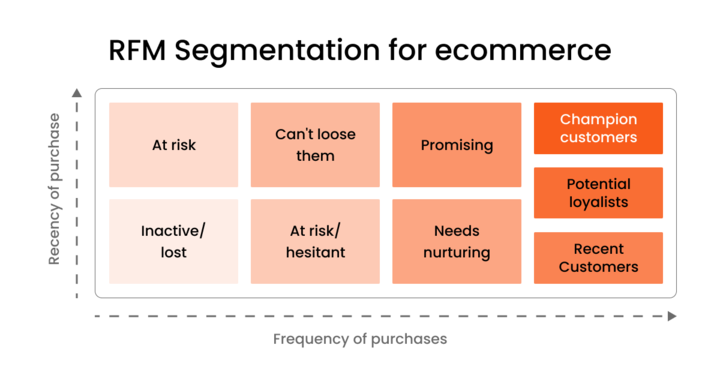
- Date of last purchase (Recency): Identify Recent Purchasers (last 30 days) for exclusion from general discount blasts (to prevent buyer’s remorse). Target Lapsing Customers (last 90-180 days) with a high-value win-back offer.
- Create a segment of “Previous Holiday Shoppers” who are proven to buy during this specific time window, and message them specifically about the return of the annual sale.
- Target the new BFCM one-time buyers with a specific post-purchase subscription incentive flow.
Real-Time Behavioral Data
This is data collected within days or hours of the sale and is critical for real-time marketing channels like SMS and pop-ups.
- Browse and Cart Activity:
- Identify cart abandoners and send real-time reminders. Also, segment shoppers who viewed a specific Product Category (e.g., “Sweaters”) to send personalized, product-specific messaging.
- Email/SMS engagement recency: The last time a customer opened or clicked an email/text.
- Target engaged non-buyers (those clicking often but not yet purchasing) with an extra incentive or early access. Add dormant subscribers to a suppression list to maintain good sending reputation.
- Wishlist activity: Items added to a wishlist.
- Send a notification when items on their wishlist go on sale or are low in stock, creating powerful urgency.
BFCM segment list hygiene
To ensure your audience list’s readiness, we’ve prepared a checklist.
| Checklist | Purpose |
| Audit and clean RFM/LTV fields | Ensure your LTV and AOV calculations are accurate and current across your CRM/ESP. A flawed LTV means you misidentify your VIPs. |
| Verify loyalty/referral integration | Confirm that data from your loyalty app is flowing correctly into your SMS/ email platform to enable VIP early access segmentation. |
| Tag product categories | All products should be clearly tagged (e.g., “High-Margin,” “Clearance,” “Subscription”) to allow you to segment offers. |
| Confirm time zone/geographic Data | Ensure you can segment customers by time zone to send automated SMS/emails to land at an appropriate local time. |
| Test dynamic segmentation | Run a final test to ensure customers who purchase immediately exit the “Cart Abandoner” or “Engaged Non-Buyer” segments in real-time. |
2. Turn data points into segmentation rules
- Create clear rules for each segment (VIP, lapsing, price-sensitive, etc.).
- Example: VIP = top 5% LTV + purchased 3+ times in the last year.
- Set exclusion rules to protect profit.
- Example: Exclude anyone who purchased in the last 72 hours.
- Decide segment priority (VIP should override other labels).
Retainful has pre-built segmentation templates that are dynamically updated in real-time based on customer behavior.

3. Use dynamic, real-time segmentation
- Make sure segments update automatically as customer behavior changes in your marketing software.
- Example: If someone adds to the cart, move them from “Browser” to “Cart Abandoner.”
4. Apply segments to your campaigns
- Connect segments to all your automated flows.
- Example: Standard cart flow for regular shoppers; stronger incentives for price-sensitive customers.
- Use segments across channels:
- Email: For early access and discount-tier sends.
- Paid ads: Use lapsing customers as custom audiences.
- SMS: Send urgent reminders only to engaged subscribers.
- Track performance for each segment (conversion, AOV, unsubscribes).
- Reduce the email frequency of a segment that is getting too many unsubscribes.
Apply Retainful’s pre-built segmentation templates and launch advanced targeting in minutes
Strategies to persuade the 6 important BFCM customer segments
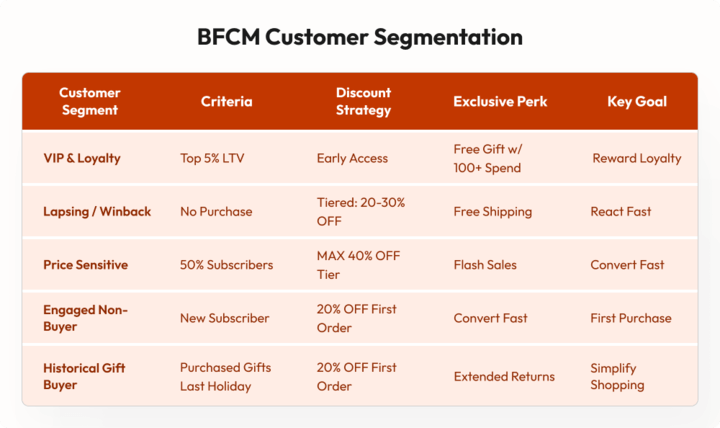
Here are the 6 important customer segments for Black Friday marketing.
- VIP & loyalty segment (early access group)
- Lapsing/winback segment
- Price-sensitive browser
- Engaged non-buyer (The nurture group)
- The historical gift-buyer
- Cart abandoners
1. The VIP & loyalty segment (early access group)
This segment includes your most valuable customers, who should be rewarded with exclusivity rather than just the deepest discount.
The goal is to drive sales early to flatten the traffic spike, reward loyalty, and protect margins by offering non-discount incentives.
- Criteria for defining the segment:
- High LTV/AOV: Top 5-10% of customers by Lifetime Value (LTV) or Average Order Value (AOV).
- High frequency: Placed 3+ orders in the last 12 months.
- Loyalty integration: Enrolled in your loyalty program and/or possess a high-tier status.
- Strategy:
- Offer: Give early access (24–48 hours before the public sale). Add a small perk like a gift, free shipping upgrade, or an exclusive bundle.
- Messaging tone: Keep it exclusive and personal. Use a password-protected page or a private early-access link to create a VIP feel.
- Loyalty tactic: Show customers their points balance and how close they are to the next reward. Encourage them to redeem points during the sale for extra value.
2. The lapsing/winback segment
These are past buyers who have gone quiet. The goal is to prevent customer churn and recapturing customer acquisition costs from past investments.
- Criteria for defining the segment:
- Past purchaser: Has purchased at least once.
- Recency: Not engaged (opened/clicked an email) in 60 days, and has not purchased in 90–180 days.
- Strategy:
- Offer: Send a win-back email that matches your main BFCM discount. Add something extra, like a free gift or a bold, eye-catching dollar-off deal, to make it more appealing.
- Messaging tone: Curious and value-driven. “We miss you,” or “It’s been a while, here’s a deal just for coming back.”
3. The price-sensitive browser
This segment consists of customers motivated primarily by price. The goal is to convert high-intent, discount-seeking traffic into a purchase immediately.
- Criteria for defining the segment:
- Behavioral: Have used a coupon code in 50% or more of their historical orders.
- Browsing: Frequent View Content events but rare purchases, indicating they are comparison shopping.
- Strategy:
- Offer: Be transparent about the biggest deal, the maximum percentage discount. Use urgency triggers like countdown timers.
- Messaging tone: Clear, value-focused, and urgent. Focus on the final price and the savings achieved.
- Create a browse abandonment email sequence with discounts on High-Margin/Low-Volume products or use bundle deals (Buy X Get Y)
4. The engaged non-buyer (The nurture group)
These are subscribers who are highly engaged with your content but have never made a purchase. They are the most likely to convert with the right first-time incentive or welcome email.
- Criteria for defining the segment:
- New subscriber: Has never placed an order.
- Engagement: Opened/Clicked an email in the last 30–90 days. Has a high View Content (VC) history without an Add-to-Cart (ATC) event.
- Strategy:
- Offer: A special first-time purchase incentive, often a tiered discount or an added-value perk like a gift-with-purchase.
- Messaging tone: Focus on clarity and trust. Highlight bestsellers, fit guides, social proof, and FAQs like shipping details to address purchasing hesitation.
5. The historical gift-buyer
This segment allows you to target customers with product ideas relevant to their past holiday behavior, making the shopping process easy.
- Criteria for defining the segment:
- Purchase history: Customer purchased a product that is commonly gifted during the last holiday season and has not since purchased that item for themselves.
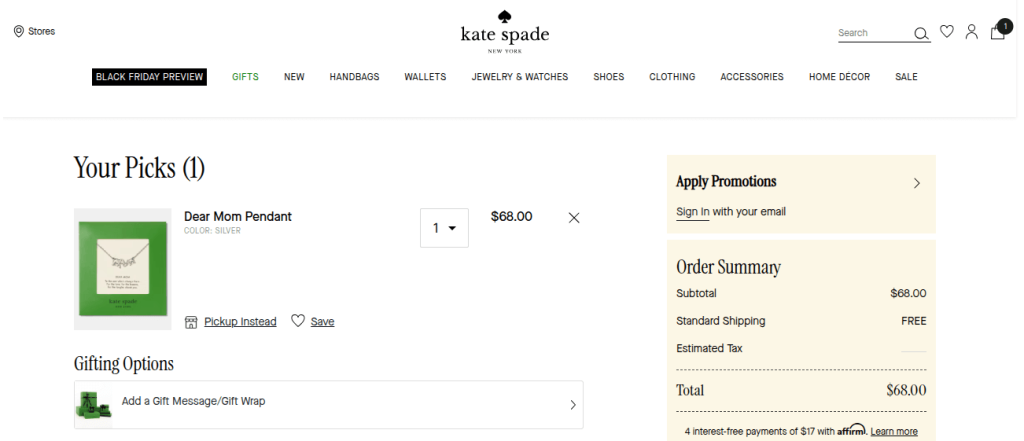
- Intent data: Tagged at checkout as “Buying a Gift” or purchased multiple units of the same item.
Here is an example of identifying gift shoppers during checkout using the gift options section.
- Strategy:
- Offer: Gift-focused content, not necessarily a discount. Offer gift guides, pre-wrapped bundles, and extended return periods.
- Messaging tone: Helpful and suggestive. “Need a gift idea? We curated one for you.”
- Post-sale prep: Segmenting them now allows you to run a highly personalized post-BFCM flow.
6. Cart abandoners
These are the customers who have shown the highest intent short of purchasing. The goal is simple: close the sale quickly by overcoming the final hurdle (price, shipping cost, or timing) and immediately recapture revenue.
Criteria for Defining the Segment:
- Behavioral: Has added an item to their cart and initiated the checkout process, but did not complete the purchase.
- Recency: Abandonment event occurred within the last 1–24 hours. (Note: BFCM timing requires immediate follow-up.)
Strategy:
- Offer: Your cart recovery sequence should be aggressive during BFCM.
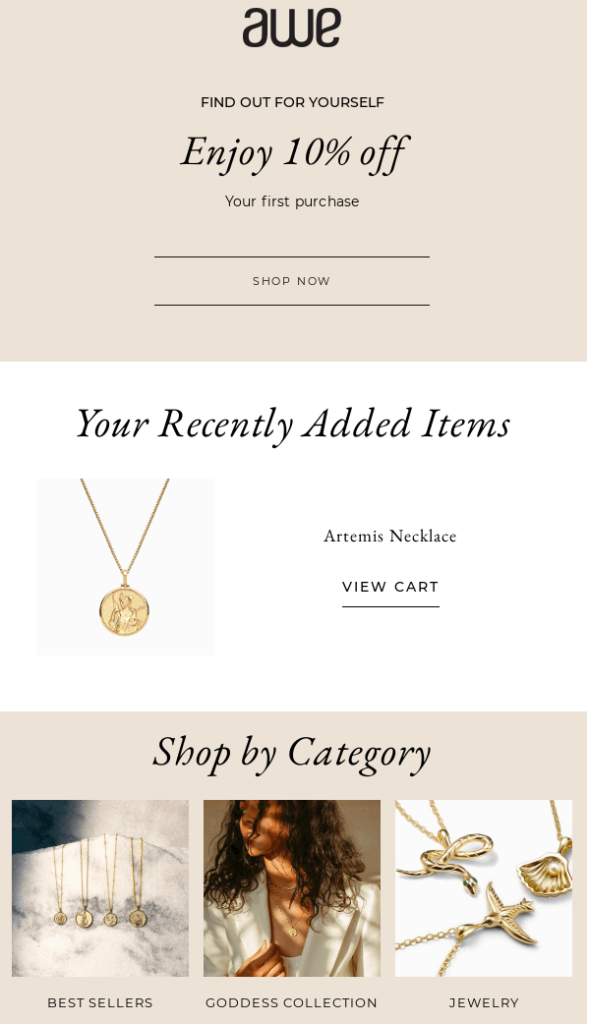
- First email (Immediate, 30 min): Focus on a helpful reminder and social proof (e.g., “Your items are waiting! Don’t miss out on the BFCM deal.”). Do not offer a discount yet.
- Second email (4–6 hours): Introduce a small incentive to close the sale, such as a free shipping upgrade or a small dollar-off incentive ($5 or $10 off). Avoid giving away the full BFCM discount again unless necessary.
Here is an example of a cart abandonment email.
- Messaging tone: Urgent, helpful, and value-driven. Focus on the scarcity of the deal and the speed of purchase.
- Use strong subject lines that emphasize the items in the cart or the urgency of the BFCM offer expiring.
- Show high-quality images of the abandoned products.
- Urgency tactic: Use copy that highlights the scarcity or low stock of the specific item(s) in their abandoned cart, especially if true. Reinforce that the main BFCM discount will expire soon.
The Omnichannel BFCM segmentation blueprint
Successful BFCM campaigns coordinate messaging across all customer touchpoints.
Segmentation is key to ensuring a customer sees a coherent, tailored message, whether they are on email, social media, or your website.
| Channel | Role during BFCM | Segmentation strategies |
| Email (ESP) | Core Revenue Driver. Handles high-volume and detailed communication. | Essential for Tiered Discounting (sending Segment A a 20% code, Segment B a 30% code) and Early Access flows to VIPs. |
| SMS | Urgency & Real-Time Alerts. Best for time-sensitive, high-impact messages that cut through inbox noise. | Target only Engaged Subscribers Use for Flash Sales, Low Stock Alerts, and Cart Abandonment reminders. |
| Paid social Ads (Meta) | Retargeting & acquisition. Drives cold traffic acquisition and converts high-intent browsers. | Sync Cart Abandoners and Engaged Non-Buyers from your ESP to Meta for high-conversion retargeting. |
| On-Site personalization | Conversion Rate Optimization (CRO). | Display different website pop-ups/banners for segments (e.g., showing a “VIP Early Access” banner to logged-in loyalty members vs. a “New Customer 10% Off” banner to anonymous visitors). |
Post BFCM customer segmentation strategies for different segments
The key to a profitable post-BFCM strategy is recognizing that not all new buyers have the same motivation. You must segment buyers into groups like “Gift-Purchaser” to send relevant retention messaging.
Retaining strategies for the gift purchasing segment
This segment is motivated by the recipient’s happiness and stress-free shopping.
Your post-BFCM communication should focus on goodwill and advocacy, rather than pressure to buy for themselves.
| Strategy | Retention message | Next conversion |
| Verify Satisfaction & Build Goodwill | “How did the gift go?” Email sent 3-5 days after delivery date. Include extended exchange instructions to show excellent service. | Referral. Turn the buyer into an advocate who shares your brand with their friends (the recipient). |
| Acquire the recipient | Send a “Welcome email” with a personalized message. | Recipient Opt-in. Convert the product user into a direct subscriber and potential customer. |
| Pre-sell for next holiday | Send a soft nudge in late Q1/early Q2 asking them to save their favorite products to a “Future Gift List” to make next year easier. | Wishlist creation. Gather data for future personalized product suggestions. |
Retention strategies for self-purchasers
This segment is motivated by getting a deal on something they wanted.
The strategy is to move them quickly past the discount mindset toward product education, loyalty rewards, and cross-selling at full price.
| Strategy | Retention message | Next conversion |
| Product education & value | “How to make the most of your purchase.” Email sent 7-10 days after delivery. Focus on tips, and tutorials. Do not mention sales. | Product Review. Ask for a review and offer a small reward (e.g., 50 loyalty points) to increase their investment in the brand. |
| Cross-sell/upsell | Use their purchase history (e.g., bought a camera) to recommend complementary, full-price accessories (e.g., lenses, tripod, cleaning kit). | High AOV (Full-Price). Drive a second purchase where the margin is protected. |
| Loyalty program conversion | Highlight their current earned points balance from the BFCM order. “You have enough points for $5 off! Join our Loyalty Club to redeem now.” | Loyalty Enrollment. Convert them from a discount shopper to a rewards-motivated shopper. |
Email flow to retain the low-CLV and One-Time-Buyer
The low-CLV (Customer Lifetime Value) buyer is the classic “discount hunter.” This 3-email sequence is designed to move them toward a second, profitable purchase using value and rewards, not another discount.
1. Welcome (Day 1–3 post-order)
- Thank customers with a message from the founder/team.
- Share usage guides or helpful content.
- Softly introduce the loyalty program.
- Goal: Build trust and reduce buyer’s remorse.
2.Value add & review (Day 7–10 post-delivery)
- Ask for a product review (reward with points instead of discounts).
- Showcase UGC or testimonials.
- Goal: Build social proof and deepen brand connection.
3. CLV nudge (Day 20–30 post-purchase)
- Show their loyalty points balance.
- Offer a time-limited, non-discount incentive (e.g., Triple Points Week).
- Goal: Encourage the second purchase while protecting margin.
What metrics should I analyze by segment post-BFCM?
Here are the 6 metrics that need to be analyzed by segment post-BFCM
- Repeat Purchase Rate (RPR): The percentage of BFCM customers who bought again within 30, 60, or 90 days. Tells you whether your post-purchase email flows are working.
- CAC: LTV Ratio (by Segment): Customer acquisition cost divided by lifetime value (ideal is 1:3). Shows which customer segments are profitable and which ones cost too much to acquire.
- Incremental Repeat Rate (IRR): Repeat purchase rate of customers who got your retention flow minus those who didn’t. It proves whether your retention emails actually caused customers to buy again.
- Return Rate (by Product / Segment): Percentage of orders returned, broken down by product and customer type. Helps you spot product problems or misuse—especially from discount-heavy segments.
- Recipient Opt-In Rate: Percentage of gift recipients who joined your email list. Shows how well you turn gift buyers into long-term customers.
- Loyalty Enrollment Rate: Percentage of BFCM customers who joined your rewards program within 30 days. Measures how well you convert deal-seekers into loyal buyers.
Offer the right incentive to the right customer without hurting margins using Retainful
Wrap up!
BFCM isn’t about blasting discounts — it’s about targeting the right customers with the right message at the right moment.
With smart customer segmentation, you protect margins, move VIPs early, convert price-sensitive browsers faster, and set yourself up for repeat revenue long after Black Friday ends.
When you combine segmentation + real-time behavioral data + retention flows, your BFCM campaigns become predictable revenue engines – not chaotic sales sprints.
And with Retainful, implementing advanced segmentation takes minutes, not months.
You can build dynamic segments, trigger real-time flows, and personalize offers automatically — all without complex setups.
Also Read:
5 Best Shopify WhatsApp Apps to Increase Sales in 2025
10 Best WhatsApp marketing software for 2025 (comparison chart)
How to reduce email bounce rate? (10 proven ways)
Frequently asked questions
Because segmented BFCM campaigns convert significantly higher and protect profit margins.
LTV, AOV, discount usage, browsing behavior, cart events, and email/SMS engagement.
VIPs, lapsing customers, price-sensitive shoppers, engaged non-buyers, gift-buyers, and cart abandoners.
Use real-time dynamic segmentation inside your ESP—Retainful automates this instantly.
Repeat purchase rate, CAC:LTV ratio, incremental repeat rate, returns, opt-ins, and loyalty enrollments.