You launch a solid product, price it competitively, and pour money into ads—yet customers still choose a brand that looks eerily similar to yours. When everything in the market feels interchangeable, growth stalls, margins shrink, and loyalty becomes fragile. This is the reality many e-commerce businesses face today.
With endless options just a click away, customers no longer buy just products; they buy reasons. That’s where product differentiation in marketing becomes critical. It’s not about adding random features or shouting louder than competitors—it’s about clearly communicating what makes your product worth choosing and returning to.
In this guide, we’ll break down what product differentiation in marketing really means, why it matters more than ever for ecommerce brands, and how to use it to stand out, attract the right customers, and keep them coming back.
Make your emails unmistakably yours—with Retainful.
What is product differentiation in marketing?
Product differentiation in marketing is the process of clearly positioning your product as the better choice by communicating unique value that customers actually care about. It goes beyond features to include pricing strategy, customer experience, brand perception, and post-purchase engagement.
Effective differentiation answers one question consistently across every touchpoint: why choose this over alternatives? When done right, it reduces price sensitivity and builds loyalty.
According to Bain & Company’s Elements of Value research, brands with strong differentiation can command meaningful price premiums. Apple is a classic example—selling similar hardware at higher prices by marketing simplicity, design, and ecosystem, not specs.
Importance of product differentiation
Product differentiation is essential for survival and growth in today’s e-commerce landscape, especially as markets become more crowded and competitive.
- Crowded markets demand clear positioning: When customers see dozens of similar products, they default to the brand that communicates value most clearly. Differentiation helps your product stand out instantly and reduces decision fatigue, making it easier for customers to choose you.
- It protects your brand from copycat products: Features can be copied quickly, but differentiation built around experience, trust, and brand promise is harder to replicate. When customers associate your product with a specific outcome or feeling, competitors struggle to replace you.
- It helps you avoid destructive price wars: Without differentiation, price becomes the only lever. This leads to shrinking margins and unsustainable growth. Differentiated brands compete on value instead of discounts, allowing them to maintain healthier profit margins.
- It attracts higher-quality customers: Clear differentiation draws customers who align with your value proposition, not bargain hunters. These customers are more likely to convert, stay loyal, and purchase again.
- It drives long-term retention and brand loyalty: When customers understand what makes you different, they remember you. This recognition fuels repeat purchases, referrals, and long-term brand equity.
Related reading: How to Create Flash-Sale Emails with AI Chat That Convert
4 Types of product differentiation
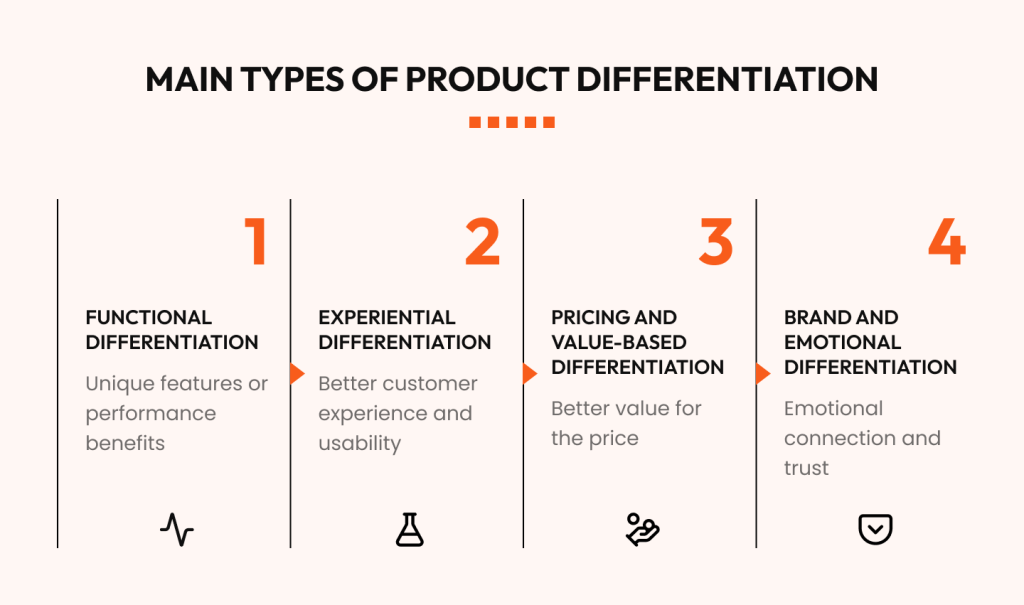
Product differentiation can take many forms, but the strongest brands focus on one or two types they can consistently deliver and communicate.
1. Functional differentiation
This type focuses on what the product does better than competitors, such as performance, reliability, or unique features.
It works best in industries where outcomes matter, like SaaS, electronics, fintech, and tools.
Functional differentiation is strongest when the benefit is tangible and repeatable for customers.
Brands must clearly market why the feature matters, not just what it does.
Example: Apple differentiates the iPhone through performance, security, and ecosystem integration. Apple captured over 55% of global smartphone profits by focusing on functional advantages.
2. Experiential differentiation
Experiential differentiation is about how easy, pleasant, or seamless it feels to use the product.
It’s common in e-commerce, SaaS, marketplaces, and DTC brands.
This includes onboarding, checkout, delivery, customer support, and post-purchase experience.
A smoother experience reduces friction and increases repeat purchases.
Example: Amazon differentiates through fast delivery, easy returns, and one-click checkout.
Prime members spend nearly 2× more annually than non-members.
3. Pricing and value-based differentiation
This approach emphasizes perceived value rather than simply being the cheapest option.
It suits subscription businesses, retail, and brands with strong supply chain control.
Value can come from bundles, memberships, or long-term savings. Clear communication of value is critical to avoid price comparisons.
Example: Costco limits markups and monetizes through memberships instead of margins.
Costco reports over 90% membership renewal rates globally.
4. Brand and emotional differentiation
This type relies on emotional connection, identity, and trust rather than product features. It works well in fashion, lifestyle, fitness, and consumer brands.
Storytelling, community, and brand values play a major role here. Customers stay loyal because they resonate with what the brand represents.
Example: Nike differentiates through inspiration, community, and purpose-driven marketing.
Nike consistently ranks among the world’s most valuable brands (Source: Interbrand).
Product differentiation vs competitive advantage: What’s the difference?
While often used interchangeably, product differentiation and competitive advantage serve different strategic roles in marketing and growth.
| Aspect | Product differentiation | Competitive advantage |
| Focus | How a product is perceived by customers | Why does a business consistently outperforms competitors |
| Scope | Centered on product features, experience, or brand | Includes operations, pricing power, scale, and strategy |
| Timeframe | Can be short- to mid-term and evolve frequently | Built over time and harder for competitors to copy |
| Marketing role | Drives positioning, messaging, and customer choice | Supports long-term profitability and market leadership |
| Example | Apple differentiates iPhones through design and ecosystem | Apple’s supply chain scale and ecosystem lock-in create a lasting advantage |
5 Product differentiation mistakes ecommerce brands make
Many ecommerce brands struggle with differentiation not because they lack value, but because they make avoidable strategic mistakes that weaken their positioning.
- Copying competitors instead of customers: Many brands mirror competitor features rather than solving real customer pain points, making their products feel interchangeable.
- Relying only on price discounts: Competing on price alone trains customers to wait for sales and erodes long-term margins.
- Overloading differentiation claims: Trying to stand out on too many fronts at once weakens the core message and confuses buyers.
- Ignoring post-purchase experience: Differentiation doesn’t stop at checkout—poor onboarding, support, or follow-up breaks trust and loyalty.
- Failing to communicate value clearly: Even strong differentiation fails if it’s not obvious within seconds on product and landing pages.
Related reading: What is a Bounce Back Email? A Complete Guide
Product differentiation strategies to increase sales
Product differentiation strategies help businesses stand out from competitors by offering unique features, benefits, or experiences that appeal to target customers.
1. Quality differentiation
Quality differentiation focuses on creating a product that exceeds the standard performance, durability, or reliability in its category.
- This strategy emphasizes superior materials, craftsmanship, or design.
- Companies like Apple or Mercedes-Benz use this to justify premium pricing.
- It can be applied to the electronics, automotive, or luxury goods markets.
- Marketing highlights product longevity, safety, or exceptional performance.
- It works well in competitive markets where customers value reliability over cost.
- Businesses often pair this with warranties or service guarantees to reinforce value.
2. Feature differentiation
Feature differentiation involves adding unique functionalities or enhancements that competitors don’t offer.
- Products stand out by offering additional benefits, tools, or integrations.
- Examples include smartphones with high-end cameras or software with exclusive features.
- It’s commonly used in tech, appliances, and software industries.
- Marketing focuses on convenience, innovation, or efficiency for users.
- Customers are attracted to the uniqueness and problem-solving capabilities.
- Frequent updates or upgrades can reinforce differentiation over time.
3. Branding differentiation
Branding differentiation uses a company’s image, reputation, or story to distinguish its products.
- Strong branding creates emotional connections with customers.
- Luxury brands like Louis Vuitton or lifestyle brands like Nike rely heavily on this.
- It can be used in consumer goods, fashion, and services.
- Marketing emphasizes identity, status, or lifestyle association.
- Brand loyalty often allows companies to charge premium prices.
- Storytelling and consistent messaging across touchpoints strengthen this strategy.
Identify what truly sets your product apart
4. Price differentiation
Price differentiation offers a product at a unique price point, either lower or higher, to appeal to specific customer segments.
- It can signal affordability, exclusivity, or value for money.
- Retailers often use this in fast-moving consumer goods or budget electronics.
- Premium pricing can also differentiate through perceived quality.
- Marketing communicates value, savings, or status depending on the pricing strategy.
- Dynamic pricing and discounts can further attract price-sensitive customers.
- It works best when the price aligns with customer expectations and product perception.
5. Service differentiation
Service differentiation focuses on superior customer support, experience, or added services that complement the product.
- Examples include free installation, 24/7 support, or personalized consultations.
Used in sectors like hospitality, electronics, and B2B solutions. - Marketing highlights convenience, responsiveness, and customer satisfaction.
- Differentiation can reduce customer churn and increase loyalty.
- Companies may train staff extensively or implement loyalty programs.
- It’s effective where products are similar, but customer experience can set a brand apart.
Related reading: Top 5 Solid Yotpo Alternatives for e-Commerce Marketing
How Retainful helps ecommerce brands strengthen product differentiation
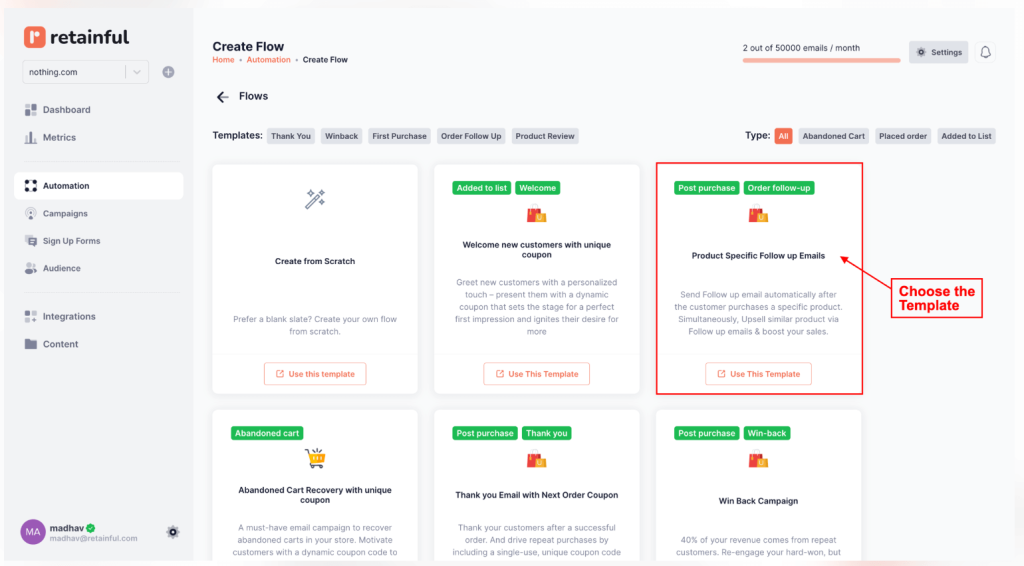
Retainful empowers ecommerce brands to stand out by enhancing customer experience, boosting engagement, and driving repeat purchases.
- Personalized cart recovery – Sends targeted reminders that increase conversion and loyalty.
- Automated follow-ups – Keep customers engaged with timely, relevant messages.
- Loyalty & rewards integration – Encourages repeat purchases and brand preference.
- Data-driven insights – Helps optimize marketing strategies and product offerings.
Wrap up
Product differentiation is crucial for e-commerce brands to stand out in a crowded market, attract loyal customers, and justify premium pricing. By offering unique features, superior quality, or exceptional service, businesses can create a competitive edge that drives growth and strengthens brand identity. Effective differentiation also enhances customer experience and builds trust over time.
Tools like Retainful further support this strategy by enabling personalized engagement, automated follow-ups, and loyalty programs that reinforce a brand’s unique value proposition.
Also read:
- 3 effective ways to increase your Shopify conversion rate
- How Shopify ChatGPT integration is transforming online stores
- Color psychology marketing: The Silent language driving sales
Frequently Asked Questions:
Product differentiation is the process of making a product stand out from competitors through unique features, quality, pricing, branding, or service. It’s important because it attracts loyal customers, increases perceived value, and gives brands a competitive edge in a crowded market.
Retainful helps ecommerce brands differentiate by offering personalized cart recovery, automated follow-ups, loyalty programs, and data-driven insights. These features enhance customer engagement, repeat purchases, and overall brand experience.
Small e-commerce stores often benefit from service differentiation and feature differentiation. Providing excellent support, personalized experiences, and unique product features can help them stand out without heavy investment in branding or large-scale campaigns.
Yes, pricing differentiation involves offering products at unique price points—either premium to signal quality or lower to attract cost-sensitive customers. It should align with the brand image and target audience expectations.
Retainful boosts loyalty through automated follow-ups, reward programs, and personalized communication. By keeping customers engaged and incentivizing repeat purchases, it strengthens brand preference and encourages long-term relationships.