In 2026, the global average cart abandonment rate is 70.19%, but for mobile users, that figure jumps to a staggering 80.2%.
Most shoppers walk away at the last minute because of unexpected shipping costs, payment friction, or delivery times. The solution is absolute transparency. Provide the total ‘landed cost’, including shipping and taxes, from the very first click.
However, abandonment isn’t always about the product or the price. Sometimes, it has nothing to do with your shop at all.
If you feel discouraged by your cart abandonment rates, look at what Sylvie, owner of Eclair Lips, has to say:
‘Abandoned carts are just part of e-commerce. We are glad you came this far, and we’re hoping to win you back.’
– Sylvie, owner of Eclair Lips.
If you’ve read this far, this article is definitely for you. We’re diving into:
- The psychology of why shoppers abandon carts.
- How to calculate cart abandonment rate for your store?
- 12 proven strategies to reduce cart abandonment in 2026.
- How to recover abandoned carts?
- How to automate abandoned cart recovery?
- Industry benchmarks to help you measure your success.
Stop losing revenue to abandoned carts with Retainful’s email, SMS, and WhatsApp cart recovery workflows.
Why does shopping cart abandonment happen? 6 Key reasons explained
Shopping cart abandonment in e-commerce occurs when customers encounter friction while shopping for products. Understanding the reasons for cart abandonment is the first step to reducing cart abandonment effectively.
Baymard Institute has listed the top reasons for cart abandonment along with their respective percentages.
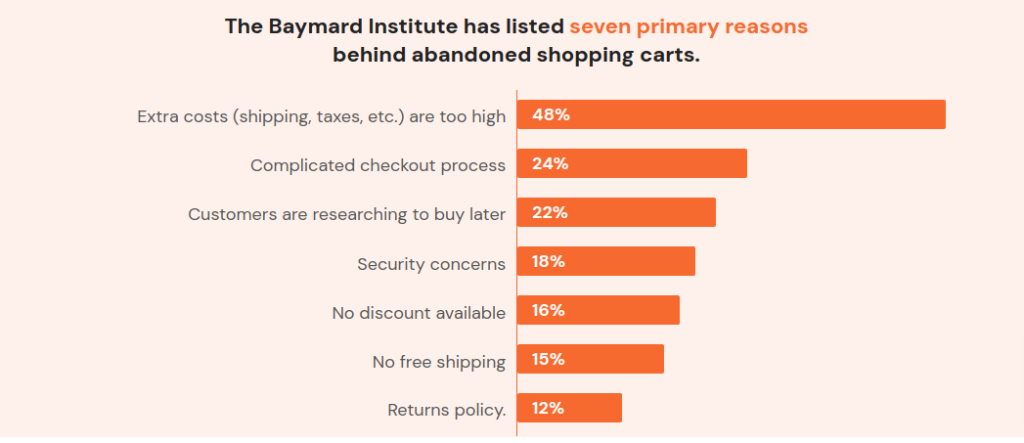
Here are the 6 key reasons for shopping cart abandonment:
- Hidden costs and high shipping fees
- Slow delivery timelines
- Forced account creation
- A lengthy checkout process
- Trust gaps and security concerns
1. Hidden costs and high shipping fees
Transparency is the foundation of trust. 48% of shoppers abandon carts because extra costs (shipping, taxes, fees) were too high or weren't disclosed upfront.
When a customer sees a price jump of 20% at the final step, they feel misled.
2. Slow delivery timelines
Slow delivery speed is now a top-3 abandonment reason. 21% of customers will leave a cart if the estimated delivery date is too far out.
Shoppers no longer just compare your price; they compare your "time-to-door" against industry giants.
3. Forced account creation
25% of shoppers abandon their purchase specifically because the site forced them to create an account.
"Guest Checkout" is no longer an optional feature; it is the expected default.
If you make a first-time buyer fill out a password and verify an email before they can give you money, you are handing them a reason to leave.
4. A lengthy checkout process
If your checkout takes more than 1.5 minutes, you’ve already lost a significant portion of your mobile audience.
Friction in the checkout process usually looks like:
- Too many form fields (keep it under 8).
- Lack of a progress indicator (customers want to know how close they are to the finish).
- No auto-fill for addresses. (Customers don’t want to type all the information manually)
5. Trust gaps and security concerns
With the rise of cyber-attacks, shoppers are more wary than ever.
If your site lacks "Trust Signals" such as familiar payment logos or a professional design, customers won't risk entering their credit card data.
An unfamiliar payment gateway is often enough to trigger an exit.
6. Lack of payment diversity
Shoppers have a "preferred way to pay." Whether it's Apple Pay, Google Pay, PayPal, or Buy Now, Pay Later (BNPL) options like Klarna.
The absence of their preferred method creates immediate friction. If they have to get up to find their physical wallet, the sale is likely lost.
How to calculate cart abandonment rate?
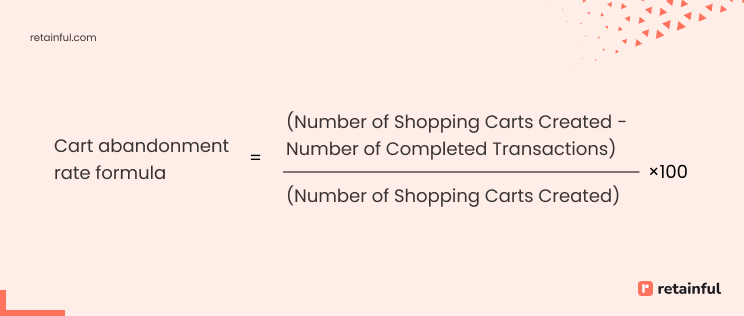
Cart Abandonment Rate = (Number of Carts Created – Number of Completed Purchases) / Number of Carts Created ×100
Let’s look at how this plays out for a typical e-commerce store over 30 days:
- Traffic: 1,000 Visitors
- Intent: 500 Visitors add items to their carts (Carts Created)
- Success: 100 Visitors finish the checkout (Completed Purchases)
- The gap: 400 potential customers left without buying. (Abandoned cart)
The Math:
$(500 - 100) / 500 X 100 = 80% Cart Abandonment Rate
The Financial Impact:
If your Average Order Value (AOV) is $10, those 400 abandoned carts represent $4,000 in lost revenue every single month.
When to take action?
- A bad cart abandonment rate is typically above 75%.
- Rates exceeding 80% indicate significant issues in the checkout process and user experience.
Cart abandonment rate optimization becomes essential at this point.
12 Tested strategies to reduce cart abandonment
Here are 12 proven strategies to reduce cart abandonment in your e-commerce store:
- Enable guest checkout
- Display clear pricing upfront
- Offer multiple payment options
- Improve mobile experience
- Optimize your checkout process
- Add progress indicators
- Include product thumbnails in the cart
- Offer free shipping
- Provide clear return policies
- Use trust badges and social proof
- Provide live chat
- Exit-Intent popups
Send high-impact cart recovery messages without any hassle using Retainful’s omnichannel workflows.
1. Enable guest checkout
Guest checkout eliminates the #1 technical barrier when a customer is purchasing from you. It reduces the pressure on them to commit.
Even at this thigh purchase intent stage in the marketing funnel, customers are unsure. Expecting them to create an account to complete the purchase is simply handing them a reason to abandon their carts.
Instead, provide options to create an account after they’ve completed their purchase.
You can use a discount pop-up displaying a percentage off on the next purchase if they sign in to capture their email ID. Be sure to use a double opt-in method to ensure the email ID is valid and is free of typos.
Related reading: 10 Best Discount Email Templates + Examples
2. Display clear pricing upfront
Customers feel more confident in the purchase process when they see the total cost from the beginning.
Shoppers expect to see the final price (including duties for international) on the Product Detail Page (PDP), not just the cart.
The cart abandonment solution involves displaying transparent pricing.
Shopify recommends using geolocation tools to estimate shipping costs and display them as early as possible in the shopping process.
Calculate and display applicable taxes and any additional fees early in the checkout process. Clearly label these costs to avoid confusion and reduce abandoned carts.
Related reading: 6 Proven strategies to beat Black Friday shipping delays
3. Offer multiple payment options
The absence of digital wallets isn't just an inconvenience. It’s a primary friction point. Offering "One-Tap Checkout" (Apple Pay, PayPal, Shop Pay, Stripe) is the most effective way to capture the mobile-first shopper.
Moreover, diversified payment options can increase conversion rates by 20%.
These integrations bypass the need for manual data entry. You can leverage biometric data (FaceID or TouchID), and the entire checkout process shrinks from minutes to seconds.
Implementation strategy:
- Upfront visibility: Show digital wallet icons at the very first checkout step.
- PDP shortcuts: Place "Buy it Now" buttons directly on product pages to skip the cart entirely.
- BNPL options: Include Klarna or Afterpay for one-tap installment payments on high-ticket items.
4. Improve mobile experience
According to Google, 53% of mobile site visits are abandoned if a page takes longer than three seconds to load.
Make sure your website is responsive, loads fast, and functions properly on all screen sizes, including mobile devices.
Related reading: How to Create Mobile Popups that Generate Leads
5. Optimize your checkout process
Every input field is a cognitive load. In 2026, the goal is Form Field Compression. Reducing the process to fewer than 8 fields. If a form looks long, customers will quit before they start.
Streamline your data entry:
- Auto-formatting: Use input masks for phone numbers and emails to guide the user.
- Drop-downs vs. text: Use dropdowns for finite options (like states or countries) to eliminate manual typing errors and speed up the process.
- Smart checkboxes: Use clear checkboxes for optional services, such as "Add Sustainable Packaging" or "Gift Wrap."
Call to Action (CTA): Avoid ambiguous CTA like "Continue" or "Next Step." Use high-intent, descriptive buttons like "Place Order" or "Complete Purchase". This way, the customer knows exactly what happens when they click.
Card checkout precision:
Payment data is sensitive; your UI must reflect security and ease:
- Visual feedback: Auto-detect the card type (Visa, Mastercard, etc.) as the user types.
- Readability: Format card numbers with a space every four digits (4444 4444 4444 4444 instead of 444444444444) for easy verification.
- MM/YY formatting: Use dropdowns or auto-formatting for expiration dates to prevent formatting errors that trigger frustrating "invalid" messages.
6. Add progress indicators
Uncertainty creates anxiety. If a shopper doesn't know how many steps are left in your checkout, they are more likely to abandon the process out of frustration.
Adding a progress indicator taps into the same psychological trigger as Amazon’s "Arriving before Date" labels.
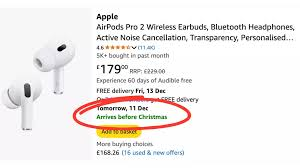
It helps the customer visualize the finish line. When users can see they are on "Step 2 of 3," their brain is wired to complete the task rather than quit.
Here’s what you can do:
- Visual roadmap: Place a clear, numbered bar at the top of every checkout page (e.g., Shipping → Payment → Review).
- Mobile-first design: On smaller screens, use a simple percentage or a breadcrumb trail to save space while still providing clarity.
- The "Visualization" hook: Combine your progress bar with the delivery timeline insight. Seeing "Step 3: Arrives Thursday" reinforces the reward of finishing the purchase.
7. Include product thumbnails in the cart
Including product thumbnails helps customers easily identify if they have added the correct items to their cart, reducing the chance of errors and the need for returns.
Display product thumbnails in the cart, checkout page, and order confirmation emails. This consistent use of imagery helps reinforce the customer’s purchase decision at multiple stages and prevents cart abandonment.
Related reading: How to Embed Images in Emails (Guide + Best Practices)
8. Offer free shipping
You can set a minimum order amount to qualify for free shipping. This not only improves satisfaction but also increases order value.
Reduce abandoned carts by using free shipping as a promotional tool and ensure that customers are aware of it. Highlight it on the homepage, product pages, and throughout the checkout process to maximize its impact.
9. Provide clear return policies
Online shopping inherently involves a "risk" for the consumer because they cannot physically touch the product before buying.
A vague or hidden return policy is a major friction point that leads to abandonment during the final decision-making phase.
Why it works:
- Risk reversal: It shifts the risk from the customer back to the brand.
- Trust building: Transparency regarding returns signals that you stand behind the quality of your products.
- Conversion lift: High-trust signals near the payment button can increase conversion rates by up to 15%.
How to implement this:
- Keep it Simple: Avoid "legalese." Use clear language like "No questions asked returns for 30 days."
- Strategic Placement: Don't just hide it in the footer. Place a summary or a link to your return policy directly in the cart or right next to the "Place Order" button.
- Highlight "Free" if applicable: If you offer free return shipping, shout it out. This is a massive competitive advantage in 2026.
10. Use trust badges and social proof
Online security and brand authenticity are the top concerns for digital shoppers. Trust badges and social proof act as "digital handshakes" that confirm your business is legitimate and secure.
Trust badges and social proof act as "digital handshakes" that confirm your business is legitimate and secure.
How to use social proof to reduce cart abandonment?
Use small, non-intrusive notifications like "Someone in Austin just bought this 5 minutes ago" to create a sense of community and urgency.
How to use trust badges to reduce cart abandonment?
If you sell organic products, use USDA Organic seals. If you are a B2B vendor, show "BBB Accredited" icons. Specificity builds higher trust than generic locks.
Don't just hide badges in the footer. Place them where the anxiety is highest: right next to the Credit Card Number field and the "Place Order" button.
11. Provide live chat
A single unanswered question can stop a customer from buying.This could be a question about size, compatibility, or shipping time.
If the shopper has to leave your site or wait hours for an email reply, they usually won’t come back.
Live chat removes problems instantly while the customer is checking out.
It answers questions at the exact moment of doubt.
Stores with live chat convert much better than stores without it.
Many shoppers leave carts just to “research.” Chat keeps them on the page.
How to use Live chat for reducing cart abandonment?
- Let AI handle common questions like shipping, returns, and stock.
Send complex questions to a human when needed. - Use proactive chat triggers. Show the chat if a user stays on the checkout page for over 60 seconds.
- Use a simple message like: “Have a quick question about your order? I’m here to help.”
- Connect chat to the cart. The agent should see what the customer has in their cart. This allows personalization without asking the customer to repeat anything.
12. Exit-Intent popups
With timely and targeted exit-intent popups, you can capture the attention of customers who are about to leave your store without completing their purchase.
Exit-intent popups for cart recovery often include special offers, discounts, or free shipping incentives that encourage customers to complete their purchases.
How exit-intent popups help reduce cart abandonment: This last-minute nudge by exit-intent popups can be highly effective in converting hesitant shoppers and reducing the cart abandonment rate.
How to recover abandoned carts? Win back lost sales
Now, we have strategies to prevent cart abandonment, but what about those that have already happened?
You can recover 15-25% of abandoned carts by reminding customers about their abandoned items and prompting them to finish the purchase.
Cart recovery tools for e-commerce include:
- Abandoned cart emails
- Cart abandonment recovery SMS
- WhatsApp marketing for cart recovery
- Retargeting ads
- Push notifications
Let’s see these strategies in detail.
Related reading: A Complete Guide to Market Expansion in E-Commerce
Abandoned cart emails
Email marketing for abandoned cart recovery is the best way to reduce cart abandonment and reclaim the lost sales.
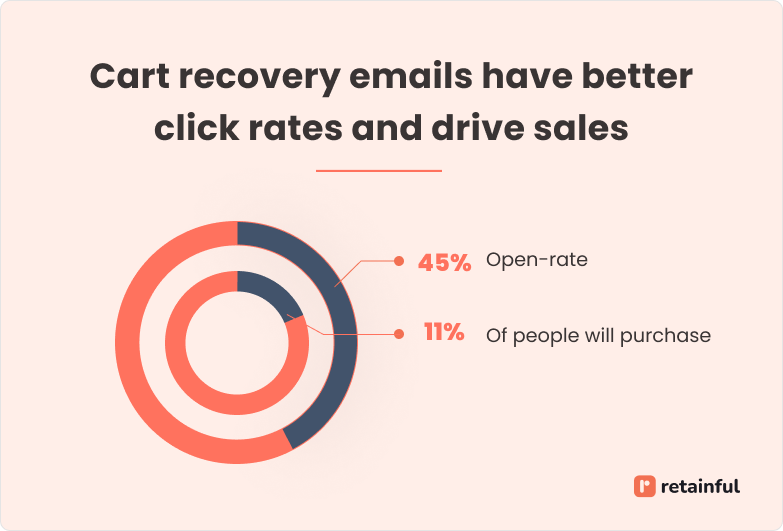
High engagement rate: Abandoned cart emails have an open rate of 45% – more than any typical marketing email. Out of that, 11% resulted in the recovery of the cart.
High conversion potential: An email campaign for abandoned carts can recover up to 15-20% of lost sales. To push the conversion rate higher, you can use email segmentation and personalization strategies.
These emails act as reminders, nudging the customers to return to the cart and finish their purchase. They help improve the cart conversion rate significantly.
To reduce the abandoned cart rate, you should send 3-5 emails at well-timed intervals. Each cart abandonment email should focus on different pain points and the customer’s objections.
Here is a 5-part email sequence to recover abandoned carts:
- The gentle reminder (After 30 minutes)
- The attractive incentive (After 24 hours)
- Evoking the urgency (After 48 hours)
- Sharing the social proof (After 5-7 days)
- The final call (After 10-14 days)
Related reading: 19 Effective Email Marketing Strategies
Cart abandonment recovery SMS
Emails are great for long-form persuasion. However, automated texts for abandoned cart recovery are about speed and directness.
The "Sweet Spot" for SMS is the 15-minute mark. Unlike email, which might sit for hours, an SMS is usually read within three minutes.
This allows you to resolve friction while the shopper is still holding their phone.
Here are 3 high-converting SMS templates for abandoned cart recovery:
1. The 15-minute nudge (Logistics focus):
"Hi Name! Your Product is ready to ship. Finish your order in the next 10 mins, and it’ll arrive by Thursday! Complete here: Link."
2. The "Hurry" alert (urgency focus):
"Stock is low, Name! We’re holding your cart for 20 more minutes. Don't miss out on your Product: Link."
3. The incentive (price focus):
"Still thinking about it? Here is a one-time free shipping code for your cart: SHIPFREE. Valid for 2 hours only: Link"
Best practices for SMS cart recovery
- Stay under 160 characters to avoid being split into multiple texts.
- Always start with your brand name so the customer knows who is texting.
- Never send more than two SMS messages per abandoned cart. Over-texting leads to high "STOP" (unsubscribe) rates and affects SMS deliverability.
- Ensure you have explicit marketing consent (typically a checkbox at checkout) before sending recovery texts.
Related reading: How to get SMS leads in 2025 ( 5 SMS apps + templates)
WhatsApp marketing for cart recovery
WhatsApp marketing allows for a "conversational commerce" approach.
Instead of a one-way notification, a WhatsApp message opens a dialogue where customers can ask questions about the product, sizing, or shipping before they commit.
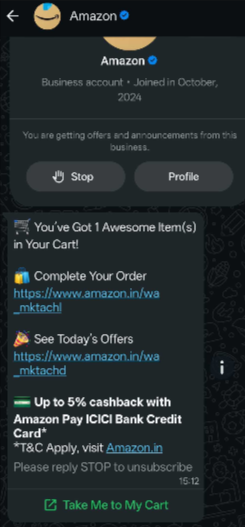
Here is an actual WhatsApp message example that i’ve received from Amazon for abandoned cart recovery.
Retargeting ads
Retargeting ads are a cart abandonment solution that reminds customers of the abandoned cart items as they browse other websites or social media platforms.
Repeated exposure to retargeting ads keeps your brand top-of-mind and reduces shopping cart abandonment. Even if customers don’t immediately return to complete their purchase, they are more likely to remember your brand for future shopping.
You can run personalized retargeting ads that target customers’ browsing behavior and cart contents.
Use Google Ads or Facebook Ads to track customer behavior on your store and target them with specific ads based on their actions on your site.
Push notifications
Push notifications are a cart abandonment solution that delivers instant messages directly to customers’ devices and captures their attention more quickly.
It can also be personalized based on user behavior, such as the items left in the cart.
Write concise and compelling messages that include a clear call-to-action (CTA). Highlight key details such as product names, prices, and any special offers or discounts.
How to automate abandoned cart recovery?
Retainful is a software specifically designed for e-commerce marketing and requirements like cart abandonment recovery.
You can reduce up to 30% of abandoned carts using Retainful’s:
- Omnichannel marketing capabilities with email, SMS and WhatsApp in one automation workflow.
- One-click cart recovery
- Pre-designed email templates
Here are the 5 steps to automate abandoned cart recovery:
- Log in to your Retainful Account. (If you don’t have one, create one for free - Sign up).
- In your dashboard, select the Automations option from the menu.
- Choose the pre-built abandoned cart recovery workflow template.
- Customize your cart recovery automation workflow.
- Click on Start workflow to go live.
Connect with our expert team to stop losing revenue to cart abandonments - Make a quick call
Industry benchmarks for cart abandonment
These figures are taken after looking at well-reputed sources like Baymard Institute, statistics from Shopify.
| Industry | Abandonment rate | Primary friction point |
| Travel & Luxury | 82% – 87% | Long research phases and price comparison. |
| Fashion & Apparel | 78% – 84% | Uncertainty over sizing and fit. |
| Home & Furniture | 80% | High shipping costs for heavy items. |
| Multi-Brand Retail | 70% – 72% | High "window shopping" and browsing behavior. |
| Pet Care | 55% | Essential repeat purchases (High loyalty). |
| Grocery (Food) | 50% | High intent and immediate need. |
Set up your cart recovery workflows effortlessly with Retainful’s custom triggers and automations
Wrap up!
Cart abandonment isn’t a sign that your store is failing; it’s a signal.
A signal that shoppers are interested, but something in the buying journey made them hesitate.
In 2026, reducing cart abandonment is no longer about one fix. It’s about removing friction before checkout and recovering intent after abandonment.
From transparent pricing and faster checkouts to mobile optimization and trust signals, every small improvement compounds. But even with a perfectly optimized checkout, some shoppers will still leave, and that’s normal.
What separates high-performing stores from the rest is how effectively they win those shoppers back.
With automated abandoned cart emails, SMS, WhatsApp messages, and one-click recovery links, you can turn lost carts into recovered revenue
Also Read:
What is Targeted Email Marketing? Beginner’s Guide & Examples
30 Best email marketing examples that drive sales in 2025
WooCommerce Abandoned Cart: Ultimate Guide to Recover 23% Sales
Cart abandonment frequently asked questions
A good cart abandonment rate in 2026 is under 70%. Rates above 75% signal checkout friction, while anything over 80% requires immediate optimization.
The most common cause of cart abandonment is unexpected extra costs, such as shipping fees, taxes, or additional charges revealed late in checkout.
You can reduce mobile cart abandonment by improving page load speed, enabling one-tap payments, reducing form fields, and optimizing checkout for smaller screens.
Yes, guest checkout significantly reduces cart abandonment, as around 25% of shoppers leave when forced to create an account.
You should send 3–5 abandoned cart emails over 10–14 days, each addressing a different objection, such as price concerns, urgency, or trust.
Yes, abandoned cart SMS messages are highly effective because they are read quickly and perform best when sent within 15–30 minutes of abandonment.
Yes, WhatsApp can be used for cart recovery by enabling two-way conversations that help shoppers resolve doubts and complete their purchase.
Abandoned cart recovery can reclaim 15–30% of lost carts, increasing revenue without additional ad spend.
Retainful is a leading cart abandonment recovery tool that offers one-click cart recovery and pre-built workflows.