A 15% increase in Average Order Value (AOV) will outperform a 50% increase in traffic every single time. Optimizing AOV lets you generate more ROI from customers you’ve already paid to acquire.
Rising ad costs and unpredictable algorithms make acquiring new customers harder, and customer loyalty takes time.
The real problem with most ecommerce stores is that they spend heavily to attract high-intent shoppers, only to see thin margins because customers check out with one low-value item.
This overreliance on volume instead of value makes your business vulnerable to rising CPCs and locks you into a “growth at all costs” cycle.
To break the cycle, stick till the end of the article. We are sharing:
- 7 proven frameworks to increase average order value
- Best tools to implement them.
Stop losing revenue to abandoned carts and recover your first sale today with Retainfu’s pre-built workflow.
Ecommerce definition of Average Order Value
Average Order Value (AOV) is an ecommerce metric that measures the average dollar amount spent each time a customer places an order on a website or app.
Unlike customer lifetime value, AOV focuses on the value per transaction rather than the value per customer.
Average order value formula
To calculate Average Order Value (AOV), divide your total revenue by the total number of orders over a specific time period.
Example:
If your store generated $5,000 in revenue from 200 orders last month, your AOV would be $25 ($5,000 / 200 = $25).
The 7 Proven Frameworks for AOV Growth
Increasing free shipping threshold increases average order value
Setting a slightly higher cart value to qualify for Free Shipping can increase your AOV significantly. In fact, studies show that 65% to 70% of consumers consider free shipping the most important factor when making a purchase decision.
By strategically setting your “Free Shipping Threshold” just above your current average, you turn a shipping cost into a powerful incentive for customers to add “just one more item” to their cart.
The psychology behind free shipping threshold increasing AOV
The reason this works isn’t just about saving $5 on shipping. It’s the Near-Miss Effect.
When a customer sees they are only $10 away from “unlocking” a reward, their brain shifts from spending mode to winning mode.
They would rather spend $15 on an extra product they like than pay $7 for shipping that provides no physical value to them.
How to calculate the right free shipping threshold?
To maximize profit without scaring away customers, use this simple formula:
If your current AOV is $50, set your free shipping at $65. It’s an attainable “nudge” that feels fair to the shopper.
Use Retainful to automate ‘Free Shipping’ reminders that actually boost your AOV.
How to use this free shipping threshold in the abandoned cart recovery email to increase cart value?
Recovery emails aren’t just for saving lost sales; they are a second chance to increase the value of that lost cart.
If a customer leaves $45 worth of items in a cart where the free shipping threshold is $60, they have a “Value Gap.”
Merchants pro tip:
Retainful is an omnichannel retention engine that turns lost shoppers into high-value customers.
It syncs live cart data with recovery flows and automatically calculates how close a shopper is to your free-shipping threshold to trigger the right upsell.
This way, you focus on margins while the software drives more revenue.
1. The “progress bar” email template
Retainful allows you to dynamically pull the customer’s current cart total into your cart recovery sequence. Instead of a generic reminder, your email subject line becomes a personalized driver for AOV:
Subject: You’re only $15 away from Free Shipping! 🚚
2. The “threshold nudge.”
In the body of the email, don’t just show the abandoned items. Use Retainful’s Product Recommendation feedto display items that bridge the gap to the threshold.
- The Result: The customer returns to complete the purchase and adds the recommended item to “win” the free shipping.
3. Tiered incentives
If the customer abandoned a high-value cart that already qualifies for free shipping, don’t stop there. Use your Retainful recovery flow to offer a tiered discount:
- “Complete your order now and get 10% off.”
- “Add $20 more to your cart to unlock 15% off your entire order!”
Related reading: 10 Best Discount Email Templates + Examples
Post purchase upsell: AI driven checkout upsell solutions for increasing average order value
The moment a customer clicks “Pay Now” is when their dopamine levels are at their peak.
Most stores kill this momentum with a boring “Thank You” email. High-growth brands use this exact second to offer a One-Click Upsell.
The psychology:
When a customer buys a camera, their brain immediately opens a new “loop”: What about a bag? What about an extra battery?.
By offering the “Next Logical Step” via a post purchase workflow, you are solving a problem they didn’t realize they had.
Related reading: 9 Best Post-Purchase Email Examples With Proven Retention
The Rules of a High-Converting Post-Purchase Upsell:
- The 30% Rule: The upsell should ideally cost 30% less than the original purchase. It needs to feel like an “easy add-on,” not a second major investment.
- Complementary, Not Competitive: If they bought a Coffee Maker, don’t try to sell them a different Coffee Maker. Sell them the Organic Coffee Beans or a Gold-Tone Filter.
- The “No-Friction” Click: If they have to re-enter their credit card details, the conversion rate drops by over 80%.
App recommended to implement upsell in different stages of marketing funnel and buyer journey: Upsell WP
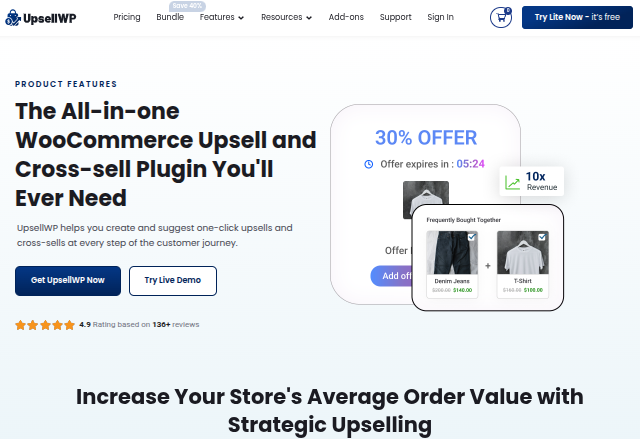
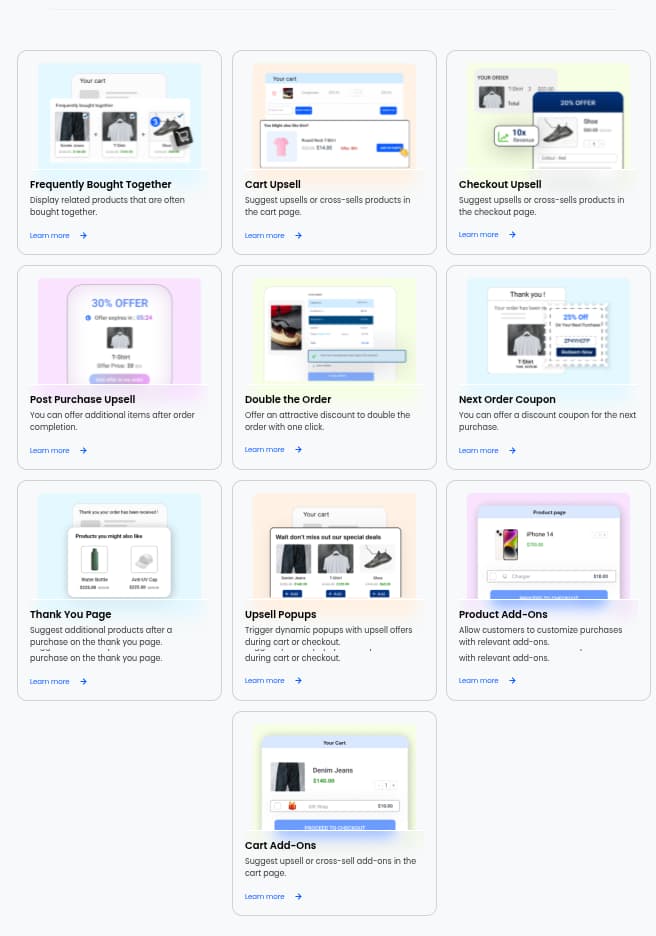
10 Features in Upsell WP to increase average order value:
- Frequently Bought Together
Display related products that are commonly purchased together. - Cart Upsell
Suggest upsell or cross-sell products directly on the cart page. - Checkout Upsell
Show relevant upsell or cross-sell offers during checkout. - Post-Purchase Upsell
Offer additional products immediately after order completion. - Double the Order
Let customers duplicate their order with one click at a discounted price. - Next Order Coupon
Provide a discount coupon for the customer’s next purchase. - Thank You Page Recommendations
Suggest related products on the order confirmation (thank you) page. - Upsell Popups
Trigger dynamic upsell offers during cart or checkout via popups. - Product Add-Ons
Allow customers to customize purchases with relevant add-ons on the product page. - Cart Add-Ons
Recommend add-ons directly within the cart before checkout.
The Volume based discount (Bulk buy incentives)
This framework is the “Costco Effect” of e-commerce. Suppose you sell anything consumable, like skincare or socks. This is your powerful lever for moving inventory and spiking AOV simultaneously.
The goal of this framework is simple: Increase the units per transaction (UPT). Instead of trying to find a different product to sell to the customer, you incentivize them to buy more of what they already like.
The psychology:
When a shopper sees that one bottle of serum costs $30, but three bottles cost $75 ($25 each), their brain stops focusing on the total spend ($75) and starts focusing on the $5 savings per unit.
By framing the purchase as “stocking up to save,” you shift the customer from a trial mindset to a loyalty mindset.
How to Structure Your Volume Tiers: Tiered pricing to increase AOV and units purchased per transaction
To make this work, you need a clear visual “Value Ladder” on the product page:
- Tier 1: Buy 2, Get 10% Off
- Tier 2: Buy 3, Get 15% Off
- Tier 3 (The Hero Tier): Buy 5, Get 25% Off + Free Shipping
The curated product bundle
A curated bundle groups complementary products into a single “kit” or “set.”
Instead of making the customer hunt through your navigation menu for a routine, you present the entire solution in one click.
The psychology: Decision fatigue vs. convenience
The average online shopper is overwhelmed by choice. When you offer a “Morning Glow Kit” or a “Home Office Essentials Bundle,” you are removing the cognitive load of decision-making.
Customers are willing to spend more (increasing your AOV) if it means they don’t have to worry about whether Product A works with Product B. You are selling convenience and confidence.
The 3 Most Effective Bundle Types:
- “Starter kit”: Perfect for new customers (e.g., Shaving Cream + Razor + Post-Shave Balm).
- “Gift set”: High AOV potential during holidays (e.g., Candle + Matches + Wick Trimmer).
- “Complete the look”: Essential for fashion and home decor (e.g., Sofa + Throw Pillow + Rug).
The “Scarcity-Driven” Checkout Timer
A checkout timer creates a “limited-time window” for a specific benefit, whether that’s a discount, a free gift, or a reserved inventory spot.
It forces the customer to stop overthinking and take action.
The psychology: Loss aversion
As humans, we are neurologically wired to fear losing something more than we enjoy gaining something. This is known as Loss Aversion.
When a shopper sees a timer ticking down, they aren’t just looking at a clock; they are watching their “Free Shipping” or “15% Discount” evaporate.
The fear of “losing out” on the deal outweighs the hesitation to spend a few extra dollars, leading to faster checkouts and higher conversion rates on upsell offers.
Two ways to use scarcity to improve AOV:
- Expiring reward: “Complete your order in 10:00 minutes to keep your 15% discount!”
- Reserved cart: “Items in your cart are in high demand. We’re holding them for 05:00 minutes.” (This works incredibly well for high-ticket or limited-edition items).
Last mile cross sell (In cart add ons)
The last mile cross sell targets the customer at the final stage of the journey: The Cart or the Checkout Page.
These are low-friction, high-margin items that don’t require the customer to leave the checkout flow to learn more.
The psychology: Micro transactions & “small wins”
When a customer reaches the cart, they have already made the “big” decision to buy. Their resistance to spending is at its lowest.
Adding a $5 or $10 “impulse buy” feels insignificant compared to a $100 cart. However, if 30% of your customers do it, your annual revenue spikes without any extra ad spend.
What makes a perfect cross sell product that increases AOV?
- Low Cost: Usually under 25% of your AOV.
- Universal Appeal: Something almost every customer needs (e.g., Gift wrapping, extended warranty, or a “mystery” accessory).
- No Choice Required: Don’t ask them to pick a size or color. Make it a “One-Click Add.”
Loyalty points to increase AOV and retention
While the previous frameworks focus on the immediate transaction, this framework uses Loyalty Gamification to push customers toward a higher AOV.
Instead of offering a discount, you offer “Value” in the form of points that can be used on their next visit, increasing retention.
The psychology: Endowed progress effect
The endowed progress effect suggests that when people feel they have a “head start” toward a goal, they are more likely to put in the effort to reach it.
By telling a customer, “Spend $10 more on this order to unlock 500 Gold Points,” you are giving them a reason to return.
This turns a one-time high-value order into a recurring customer relationship.
How to use loyalty to spike AOV?
- Point Multipliers: “Earn 2x Points on all orders over $100.”
- Milestone Rewards: “Reach $150 in your cart to unlock ‘VIP Status’ and a permanent 5% discount.”
- Points for Add-ons: Offer bonus points specifically for adding “Last-Mile” items to the cart.
Loyalty tools to increase AOV: WPLoyalty
WPLoyalty is the best WooCommerce loyalty program strategy for increasing average order value and retaining customers effectively.
WPLoyalty features:
- Earning Actions: Customers can earn points for sign-ups, writing product reviews, social media shares (Facebook, Instagram, Twitter), daily logins, and birthdays.
- Flexible Reward Types: Points can be redeemed for fixed discounts, percentage coupons, free shipping, or even specific free products.
- Tiered VIP Levels: You can create VIP levels (e.g., Silver, Gold, Platinum) based on total spending or points earned. Higher tiers can unlock better point multipliers (e.g., Gold members earning 1.5x points).
- Referral Program: Every customer receives a unique referral link. You can reward both the referrer and the referee once a successful purchase is made.
- On-Cart Redemption: Shoppers can easily apply their points for discounts directly on the cart or checkout page with one click.
5 Must have tools to increase your AOV and automate your retention strategies
| Software Name | Platform Specific | Free Plan | Why it is a Must-Have Tool | Starting Price | Best For |
| Retainful | Shopify & WooCommerce | ✅ | Automates the “Value Gap” with dynamic abandoned cart recovery and next-order coupons. | $9/mo | Dynamic Cart Recovery |
| WPLoyalty | WooCommerce | ✅ | Uses “Spend Goals” and VIP tiers to incentivize customers to buy more for rewards. | $99/yr | Advanced WooCommerce Loyalty |
| Yuko | Shopify & WooCommerce | ✅ | All-in-one retention: Unifies reviews, loyalty, and referrals to boost trust and repeat sales. | Free | One-stop Retention Stack |
| Judge.me | Multi-platform | ✅ | Aggregates social proof to build the trust needed for higher-priced bundles. | $15/mo | Specialized Review Management |
| Candy Rack | Shopify | ❌ | A “Last-Mile” powerhouse for one-click upsells right on the Add-to-Cart button. | $29.99/mo | Pre-purchase Upsells |
Implementation checklist: Increase AOV in under 30 minutes
| Phase | Time | Key Action | Why It Works | Recommended Tool |
| Threshold | 10 Min | Set Free Shipping at AOV + 20% | Encourages “gap-filling” purchases to save on shipping. | Retainful |
| Impulse | 5 Min | Enable a Last-Mile Cart Add-on | Captures low-friction impulse buys right at the “Add to Cart” moment. | Candy Rack |
| Upsell | 5 Min | Trigger an AI Post-Purchase Offer | Presents a “one-click” relevant item immediately after the sale is secured. | Yuko |
| Proof | 5 Min | Automate Review Requests | Builds the trust necessary for customers to commit to higher-priced bundles. | Yuko / Judge.me |
| Hook | 5 Min | Set a Spend-Goal Reward | Gamifies the experience by rewarding higher cart totals with bonus points. | WPLoyalty / Yuko |
Spend less time sending emails and more time scaling your brand. Let Retainful automate your AOV growth.
Wrap up!
When you optimize for AOV, you aren’t just making more money; you are buying margin of safety.
If your AOV is high enough to cover your Customer Acquisition Cost (CAC) on the first purchase, every subsequent order is pure profit. That is how you shift from “surviving” to “scaling.”
The Growth Loop: AOV + Retention
To wrap up your strategy, think of your store as a two-part system :
- AOV: Uses the 7 frameworks (Thresholds, Bundles, AI Upsells) to ensure that the very first transaction is as profitable as possible.
- Retention: Uses tools like Yuko or WPLoyalty to ensure that once a customer is in your ecosystem, the cost to bring them back is $0.
Frequently asked questions
Use both. Upselling works best on product pages to nudge shoppers toward higher-tier versions of an item. Cross-selling is the “king of the checkout,” suggesting complementary add-ons (like batteries or cases) once the initial purchase intent is locked in.
A healthy benchmark is 20–30% higher than your median product price. For mid-market stores, an AOV between $75 and $125 is a strong baseline. The goal is to ensure AOV exceeds your Cost Per Acquisition (CPA) on the first sale.
AOV measures revenue from a single transaction, while Lifetime Value (LTV) predicts the total revenue a customer generates over their entire relationship with you. Boosting AOV provides immediate cash flow to fuel long-term retention.
Tools like Klarna or Affirm reduce “price shock.” By splitting totals into installments, customers feel comfortable adding premium items or larger bundles, often increasing AOV by up to 40%.
Yes. If driven by deep discounts or followed by high return rates, your profit margins suffer. Always track Gross Margin per Order alongside AOV to ensure your growth is actually profitable.
Divide your Total Conversion Value (tracked by the pixel) by the Total Number of Purchases. This identifies which creatives attract “big spenders” versus bargain hunters.