Is your marketing strategy based on data or just a shot in the dark? To stay ahead, you must check competitors’ email marketing and ad strategies to see exactly what is converting in your niche.
Constantly playing catch-up is exhausting and expensive. Instead of wasting your budget on unproven experiments, you can perform a “digital stakeout” to reverse-engineer successful funnels.
In this article, we’ll show you
- How to manually monitor competitor campaigns
- Best Tools you can use to monitor competitors’ campaigns
- The important metrics you must keep an eye on in competitor’s campaigns
- How you can replicate and automate your campaigns to outperform your competitors.
Ready to bridge the gap between your brand and the competition? Launch your campaign in minutes using Retainful.
What is competitor email marketing analysis?
Competitor email marketing analysis is the process of subscribing to, tracking, and deconstructing the email strategies used by your business rivals.
It’s essentially a “digital stakeout” where you look beyond the design of an email to understand the underlying strategy.
This analysis isn’t just about reading newsletters. It involves evaluating their sending frequency, technical setup (ESP), promotional triggers, and how they personalize content.
Think of it as reverse-engineering a rival’s marketing funnel.
By analyzing their emails, you can see exactly how they welcome new leads and recover lost sales through abandoned cart flows. Moreover, you can find out what kind of discounts they offer to keep customers loyal.
Why is checking your competitor’s email campaigns important?
Checking your competitor’s email campaigns is vital because it provides a proven roadmap for what works in your specific market.
Instead of spending months on expensive A/B testing, you can observe the “vetted” strategies your rivals are already betting their budget on.
This data allows you to pivot your strategy in real-time and avoid common industry pitfalls.
Here are the 6 key reasons to monitor competitor’s marketing campaigns:
- Identifies content gaps: You can spot topics or customer pain points that your competitors are ignoring. This allows you to position your brand as the solution that fills the gap.
- Benchmark performance: By seeing their sending frequency and discount depths, you can determine if your own strategy is too aggressive or not competitive enough.
- Reverse-engineers sales funnels: You gain a front-row seat to their “hidden” email automation, such as how they handle abandoned carts or re-engage lapsed customers.
- Saves marketing budget: Learning from a competitor’s failed experiment (like a discontinued promotion) prevents you from making the same costly mistake.
- Predicts market trends: Sudden shifts in a competitor’s tone or product focus often signal larger industry movements before they become obvious.
- Technical intelligence: Identifying their tech stack (ESP) and deliverability tactics (like BIMI) helps you understand their technical capabilities and inbox placement success.
Don’t let recovered carts be a manual task. Use Retainful and automate your recovery revenue.
How to manually check competitor emails?
Since you can’t look inside someone else’s inbox, you have to “infiltrate” their email list.
There are 2 methods:
- The “Burner” subscription method
- Use “Milled” or “Really Good Emails”
1. The “Burner” subscription
- Create a dedicated Gmail account (e.g., [email protected]).
- Visit the competitor’s website and sign up for their newsletter.
- Abandon a cart. Put an item in your cart, reach the checkout, enter your email, then leave. This allows you to see their “Cart Abandonment” automation flow.
- Similarly, try out browse abandonment, reorder emails, and more.
Connect with our expert team and set up your email campaigns within hours – Make a quick call
2. Use “Milled” or “Really Good Emails”
If you don’t want to wait for emails to arrive, use these public archives:
- Milled.com: Search for any brand, and it will show you a visual history of every marketing email they have sent in the last few years.
- ReallyGoodEmails.com: Great for seeing the design and code structure of top-tier ecommerce brands.
How to check competitor’s ads manually?
Most major social platforms now offer “transparency” tools that allow you to see exactly what any brand is running.
1. Facebook & Instagram (Meta Ad Library)
Here are 4 easy steps to check your competitor’s ads in Facebook and Instagram
- Go to the Meta Ad Library.
- Select “All Ads” in the category dropdown.
- Search for your competitor’s name.
- View all their active ads.
Pro tip: Look for ads that have been running for more than 3 months; those are usually their highest-converting ads.
2. Google & YouTube (Google Ads Transparency)
Here are 4 easy steps to check your competitor’s ads on Google and YouTube.
- Go to Google Search and type in the competitor’s brand name.
- Find one of their “Sponsored” ads.
- Click the three vertical dots (or the small arrow) next to the ad URL.
- Click “See more ads by this advertiser.” Google will show you all Search, Display, and YouTube ads they’ve run recently.
What insights should you look for while monitoring competitor campaigns?
Competitor email strategy audit
Use the email metrics in this table when reviewing emails in your “Burner” inbox or on Milled.com to understand their retention strategy.
| Element | What to observe | Insight gained |
| Subject line | Do they use emojis, personalization, or “Urgency” (e.g., “Ends in 2 hours!”)? | Tells you what it takes to increase open rate in your specific industry. |
| Send frequency | How many emails did they send during a “Holiday Week” vs. a “Normal Week”? | Helps you schedule your automations to avoid being “drowned out.” |
| Incentive type | Is the primary offer a discount, free shipping, or early access? | Shows what “bribe” is necessary to get their customers to click. |
| Mobile layout | Is the email easy to read on a phone?Are the CTAs large? | Benchmark their technical sophistication and UX priority. |
| Flow triggers | If you abandoned a cart, did they send 1 email or a sequence of 3? | Reveals the “tightness” of their recovery system. It is a deal for benchmarking your own automation flows. |
Competitor ad performance audit
Use this table when browsing the sponsored adsto understand their paid strategy.
| Element | What to observe | Insight gained |
| Primary hook | What are the first 3 lines of text or the first 3 seconds of video? | Identifies the emotional trigger (Fear, Gain, Curiosity) they use to stop the scroll. |
| Creative format | Is it a single image, carousel, lo-fi UGC, or high-production video? | Shows which content type they believe has the highest ROI for their budget. |
| Active duration | How many days/weeks has this specific ad been active? | The “Winner” signal: Ads running for 14+ days are almost certainly profitable. |
| Landing page match | Does the ad link to a product page, a collection, or a specific “hidden” landing page? | Reveals their conversion funnel (Direct sell vs. Education-based sell). |
| Social sentiment | (If visible) Are the comments positive, or are customers complaining about shipping/quality? | Look for “Pain Points” you can solve in your own ad copy. |
Expert tips for advanced email analysis
Here are 7 expert tips for advanced email analysis:
- Reverse-engineer their automation
- Check how much text vs. images they use
- Spot their “attention grabbers” vs. “money makers”
- Watch when they send emails (not just the time)
- Review the unsubscribe & footer section
- Look for personalized content
- Study what happens after the purchase
1. Reverse-engineer their automation
- Don’t just read their emails. Act like a customer.
- Add a product to the cart and leave, browse without buying, or click a link and stop.
- Notice how many emails you get and how fast they send them (30 minutes later? same day?).
- This shows which automated emails they use most to make money.
2. Check how much text vs. images they use
- Look at the email design.
- Is it one big image, or mostly text with buttons?
- Emails with more text usually reach inboxes better and work for more people.
- If a competitor uses mostly text, they’re likely focusing on deliverability and accessibility.
3. Spot their “attention grabbers” vs. “money makers”
Notice which products appear again and again in their emails.
If the same product is promoted all month, it’s either:
- A high-profit product, or
- A cheap product used to bring people to the site.
- Use this insight to decide which products you should promote in your 2026 campaigns.
4. Watch when they send emails (not just the time)
Don’t look only at the hour, look at the pattern.
Do they send on:
- Paydays?
- Weekends?
- Right before the holidays?
- If they send at the same time every week, they follow a fixed schedule.
- If timing changes around events, they’re event-driven. Both reveal strategy.
5. Review the unsubscribe & footer section
Scroll to the bottom of the email. Do they offer options like:
- “Pause emails for 30 days”
- “Change preferences”
- Smart brands reduce unsubscribes by letting users take a break instead of leaving forever.
- This is a high-level retention tactic you can copy.
6. Look for personalized content
Open the same email on:
- Two devices, or
- Two browser profiles
- If product recommendations change, they’re using personalized content.
- This means they have strong segmentation and automation, something you’ll need to match or beat.
7. Study what happens after the purchase
If possible, buy a low-cost item. Watch the emails that come next:
- Thank you email
- Shipping updates
- Review request
These emails build trust and repeat purchases. This is often where competitors are weakest and where you can outperform them easily.
Best tools for spying on competitor email campaigns
| Tool | One best feature | Price |
| Milled | Massive Visual Archive: A huge, searchable database of historical marketing emails from thousands of brands. | Free (Paid plans for advanced search) |
| Really Good Emails | Design & Code Inspection: Best for viewing the mobile/desktop responsiveness and the “behind-the-scenes” code of top brands. | Free |
| MailCharts | Benchmarking Reports: Compare your send frequency and holiday timing against industry-specific averages. | Free tier available (Paid plans for data exports) |
| Panoramata | Full Journey Tracking: Captures not just emails, but also ads, landing pages, and SMS from your specific competitors. | Paid (Free trial usually available) |
| Owletter | Trend Analysis: Automatically snapshots competitor emails and alerts you when they change their send frequency or strategy. | Paid (Starting around $19/mo) |
How to replicate and outperform your competitor’s trigger-Based Flows?
Identifying a competitor’s strategy is only half the battle. The real win comes from building a system that responds to your customers faster and more effectively than they do.
This is where Retainful becomes your secret weapon. If you don’t have an account, create one for free – Sign up)
Why Retainful:
- 10+ Pre-built automation workflows:Don’t guess the logic. Whether it’s Cart Abandonment, Welcome Series, or Win-back flows, Retainful has the “Best Practice” blueprints ready to launch.
- Real-time behavioral triggers: While competitors send “delayed” emails, Retainful reacts the second a customer interacts with your store, ensuring you hit their inbox at the moment of highest intent.
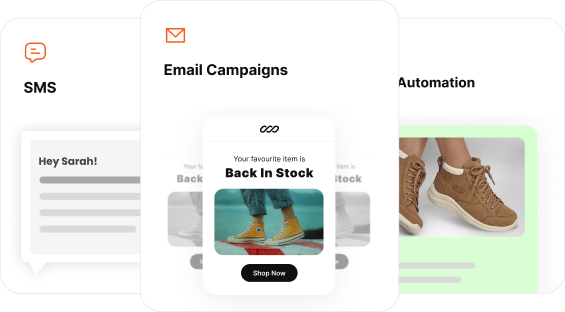
- Omnichannel capabilities: Outreach doesn’t stop at the inbox. Combine the power of Email + SMS to ensure your brand stays top-of-mind, no matter where your customers are scrolling.
- Drag-and-drop email templates: You don’t need a designer to look like a top-tier brand. Choose from a library of pre-designed, mobile-responsive templates that are built to convert.
Use Retainful’s real-time triggers to hit the inbox while your competitor is still sleeping.
Wrap up!
Monitoring your competitors isn’t about copying their every move; it’s about understanding the market’s pulse so you can provide a better experience.
Identify where your rivals are failing, whether it’s slow response times or generic messaging you create an opportunity for your brand to shine.
But remember: information is only power if you act on it. Use the insights from your audit to fuel your strategy, then let Retainful handle the execution.
With real-time triggers, omnichannel SMS and email, and expert-level templates, you have everything you need to outperform the competition on autopilot.
Also read:
- 75+ Valentine’s Day email subject lines that customers love to see
- 30 Best email marketing examples that drive sales in 2025
- What is Targeted Email Marketing? Beginner’s Guide & Examples
Frequently asked questions
Yes. Subscribing to public newsletters and viewing public ad libraries is standard market research and perfectly legal.
A deep dive once per quarter is ideal, with quick monthly check-ins to spot seasonal shifts or new promotions.
Not if you use a “burner” email address. They will only see you as another subscriber in their database.
Ad longevity. If a competitor has run the same ad for over 30 days, it is a proven profit-generator.
Don’t just lower prices. Outperform them with better timing, personalized content, and omnichannel SMS reminders via Retainful.