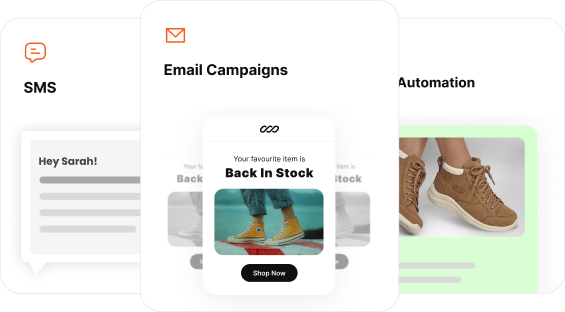
Mastering the art of urgency is the fastest way to spike your store’s revenue, and studying successful flash sale examples is the best place to start.
A well-executed flash sale does more than just move inventory; it creates a “buzz” event that re-engages your customer base and lowers acquisition costs through high-speed impulse buying.
In this guide, we’re decoding 10 real-world examples from brands like Amazon, Walmart, and Sephora to show you the exact psychological triggers they use to convert casual browsers into frantic buyers.
Create high-impact flash sale campaigns without any hassle using Retainful’s automation workflows.
What is a flash sale?
A flash sale is a high-value promotion where a brand offers significant discounts (often 40%–80%) for a limited quantity of products in a very short window, typically 3 to 24 hours.
Unlike a standard clearance sale or a BFCM sale, a flash sale relies on three psychological triggers:
- Urgency: A ticking clock that demands immediate action.
- Scarcity: Limited stock levels that trigger a “get it before it’s gone” mentality.
- Surprise: Often announced with little warning to create a “buzz” event.
When is the right time to announce a flash sale?
The best time to announce a flash sale is mid-week (Tuesday or Wednesday), either during the early morning (8 AM – 10 AM) to catch early browsers or “after-hours” (7 PM – 9 PM) when mobile engagement peaks.
Successful timing relies on a multi-touch sequence that builds anticipation before the clock starts and creates maximum urgency before it stops.
Timing is the difference between a record-breaking day and a “glitch” in the inbox.
Here is the complete timeline to announce your flash sale:
- The warm-up (24 hours before): Send a “Teaser” email or SMS to build anticipation without revealing the full deal. This primes the customer’s brain for a future purchase.
- The launch (8:00 AM or 10:00 AM): Deploy your primary announcement as people start their workday or take their first coffee break. This captures the first wave of high-intent shoppers.
- The “After-Hours” surge (7:00 PM – 9:00 PM): Many high-performing brands like Nykaa or Zulily launch evening flash sales. This targets users when they are relaxed and scrolling on their phones at home, leading to higher impulse-buy rates.
- The last call (2 hours before the end): Never skip the final reminder. Data shows that 30% of flash sale revenue typically comes from the “Last Call” notification as the fear of missing out (FOMO) reaches its peak.
Send the perfect flash sale announcement to the right people with Retainful’s list segmentation
10 Flash sale examples from high-performing brands decoded
We’ve curated a list of the 15 best flash sale examples from high-performing brands along with key takeaways for each example.
The best 10 flash sale examples are
- Walmart: The “Weekly Finds” flash sales for creating a routine-based shopping behavior
- Zulily: The “Personalized flash” lead magnet
- Going – Flash sale announcement example for premium upgrade using a custom coupon code
- Dunham’s Sports: Category-specific flash sales & SMS lead capture
- Amazon haul: The “Under $1” impulse buy flash sale
- Trampoline.com: Bundle-based holiday flash sales example
- Sephora: The app-exclusive flash coupon example
- Levi’s: The “High-Volume” Buy 2 Get 2 Free Flash Sale
- JioMart: The “FUNbelievable” year-end RCS flash sale
- American Eagle: The “Today’s Offers” Micro-campaign flash sale
1. Walmart: The “Weekly Finds” flash sales for creating a routine-based shopping behavior
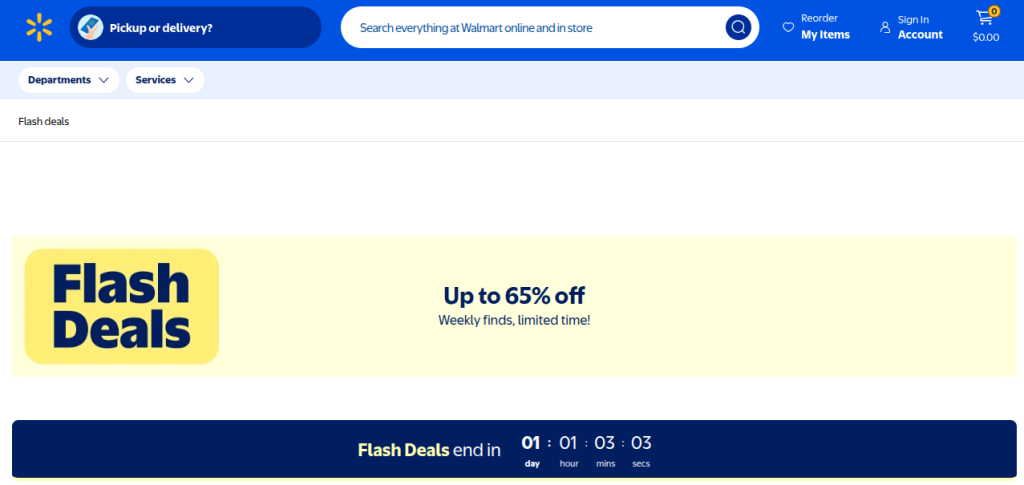
Walmart utilizes a dedicated “Flash Deals” section to clear high-demand inventory through massive price cuts that are refreshed frequently.
Labeling these as “Weekly finds,” they create a recurring shopping habit while using live countdown timers to drive immediate conversions.
Key takeaways:
- Visual urgency: The use of a high-contrast countdown timer at the bottom of the banner forces the eye to recognize exactly how much time is left to claim the deal.
- Deep discounting: Offering “Up to 65% off” creates a powerful price anchor that makes the “Flash Deal” price significantly more attractive than standard everyday low prices.
- Routine-based shopping: By branding these as “Weekly finds,” Walmart encourages customers to check the site regularly to see new items, turning a one-time sale into a recurring traffic driver.
2. Zulily: The “Personalized flash” lead magnet
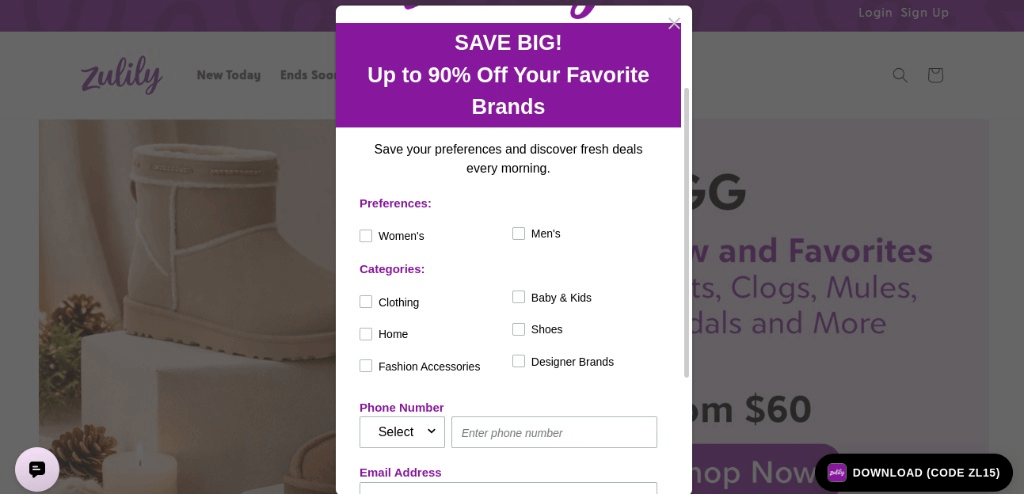
Zulily takes a different route by using a flash sale offer as a way to segment its audience before they even start shopping.
This is a brilliant way to ensure their future SMS and Email alerts are highly relevant.
Key takeaways:
- Preference-based scarcity: By asking for “Preferences” and “Categories” immediately. This way, Zulily can send personalized discount alerts (e.g., only sending “Shoe” deals to people who checked that box), which significantly increases open rates.
- The Lead magnet swap: They offer an extreme value proposition (“Up to 90% off”) in exchange for two of the most valuable pieces of marketing data: a phone number and an email address.
- Gamified discovery: The phrase “Discover fresh deals every morning” creates a habit-forming hook, encouraging users to check their inbox daily like they would a morning newspaper.
Related reading: 14 Inspiring Lead Nurturing Email Examples
3. Going – Flash sale announcement example for premium upgrade using a custom coupon code
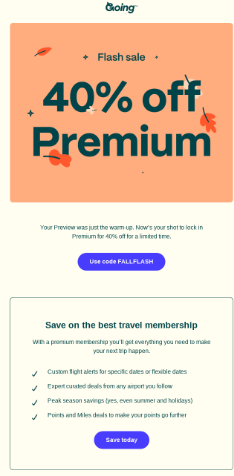
Going uses a clean, seasonal email design to promote a limited-time discount on its premium membership.
Key takeaways:
- Trackable custom codes: Using a specific coupon code like FALLFLASH allows the brand to attribute revenue directly to this specific email campaign, helping them measure email ROI accurately.
- Segmented warm-up: The copy mentions that a previous “Preview” was just a warm-up, rewarding engaged users who have been following the brand’s recent activity.
- Benefit-driven scarcity: Rather than just showing a price, the email lists four clear benefits (custom flight alerts, curated deals, etc.) to remind the user exactly what they lose if they don’t act before the code expires.
- Multi-platform conversion: The email cleverly includes a section to download the app, ensuring that even if the user doesn’t buy immediately, they are pushed further into the brand’s ecosystem for future mobile-exclusive flash alerts.
4. Dunham’s Sports: Category-specific flash sales & SMS lead capture
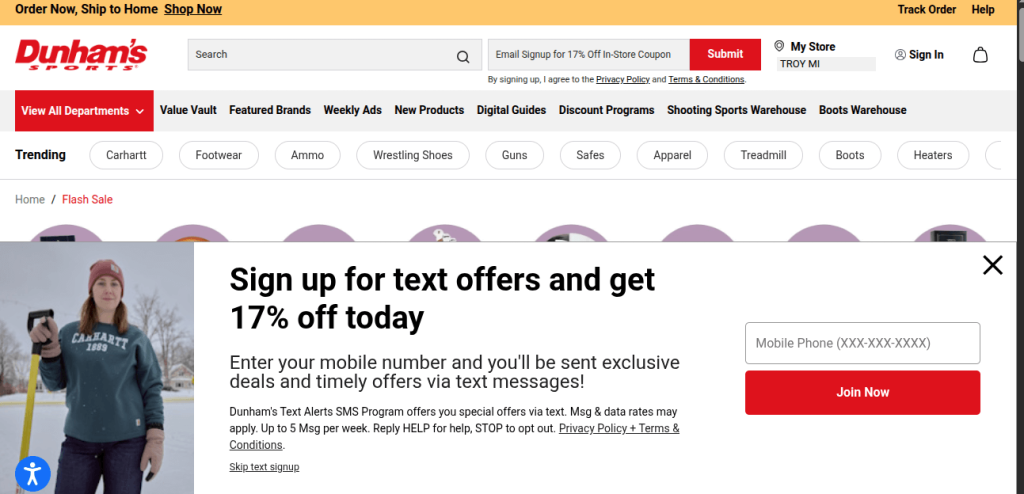
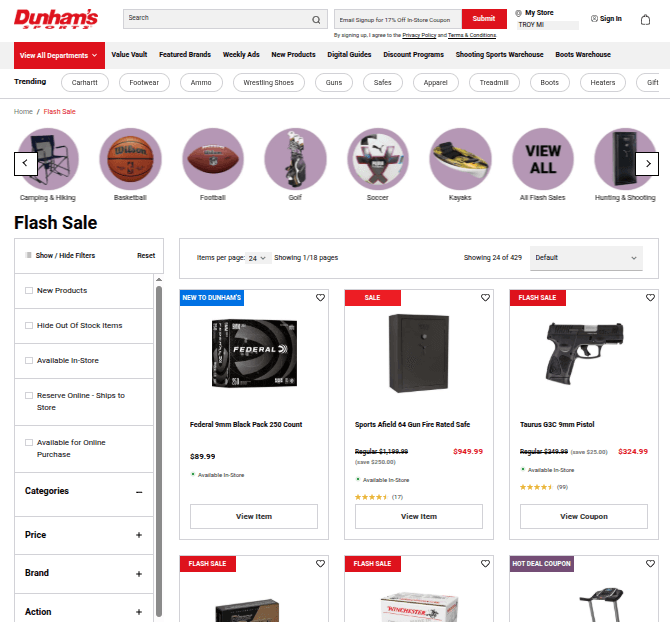
Dunham’s Sports uses a dual strategy to drive flash sale revenue. A dedicated, filterable landing page for immediate browsing.
Moreover, they use a high-conversion “SMS Bridge” to capture shoppers for future urgent alerts.
Key takeaways:
- Frictionless navigation: By providing robust filters on a flash sale page, Dunham’s helps customers find relevant deals quickly before the clock runs out.
- Trust signals: Each product card includes star ratings and “Regular vs. Sale” price comparisons to validate the quality and depth of the discount.
- High-speed conversion: Offering a discount that is usable “today” turns a casual browser into a subscriber immediately.
- Building a flash list: They clearly state they will send “timely offers via text,” setting the expectation for future flash sale notifications directly to the user’s pocket.
5. Amazon haul: The “Under $1” impulse buy flash sale
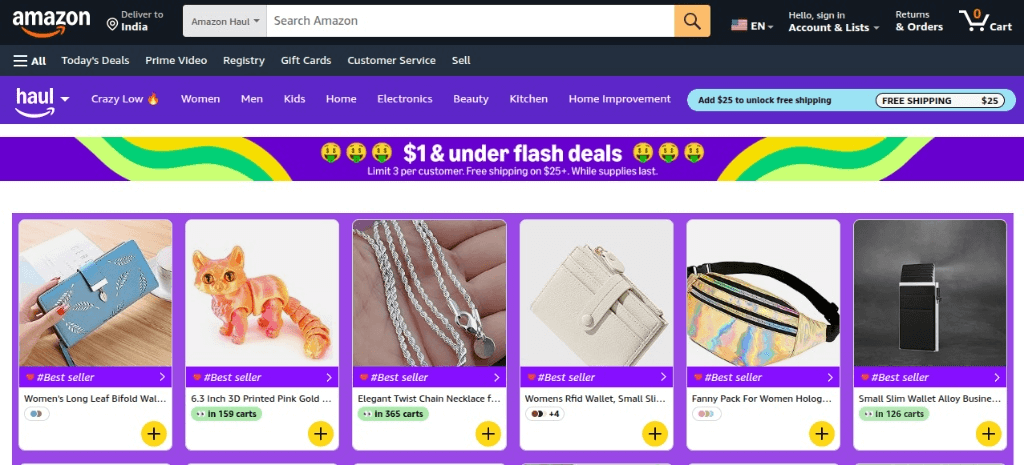
Amazon Haul leverages extreme low-price anchoring with their “$1 & under flash deals” to drive high-volume, impulse purchases.
This strategy turns the shopping experience into a treasure hunt, using social proof indicators to create a sense of popular demand.
Key Takeaways:
- Extreme Price Anchoring: By highlighting deals for $1 and under, Amazon lowers the barrier to entry so significantly that customers often add multiple items to their carts without hesitation.
- Real-Time Social Proof: Each product card includes a live “In [X] carts” notification, which triggers FOMO by showing real-time interest from hundreds of other shoppers.
- Strategic Purchase Limits: The banner explicitly states a “Limit 3 per customer,” which paradoxically makes the items feel more valuable and scarce, encouraging users to hit that maximum limit.
- Unlocking Secondary Incentives: Amazon uses the “under $1” flash sale to push higher average order values by promising free shipping only after reaching a specific threshold ($25+).
6. Trampoline.com: Bundle-based holiday flash sales example
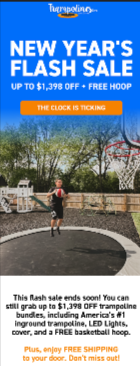
Trampoline.com uses a high-value holiday flash sale to move big-ticket inventory by combining deep price cuts with premium free gifts.
This “New Year’s Flash Sale” focuses on high-ticket bundles, making the offer feel like a significant investment opportunity rather than just a simple discount.
Key takeaways:
- Visual urgency without a live timer: While it lacks a ticking clock, the bold orange button stating “THE CLOCK IS TICKING” serves as a powerful psychological trigger that time is running out.
- Increasing Average Order Value (AOV): By focusing the flash sale on high-ticket bundles (including LED lights, covers, and free hoops) rather than individual accessories, the brand ensures a much higher AOV per transaction even with the deep discount applied.
- Stackable incentives: The brand combines three distinct “wins” for the customer—a massive dollar-off discount ($1,398), a physical free gift (Basketball Hoop), and free shipping—to eliminate any remaining purchase friction.
- Authority positioning: Including the claim “America’s #1 inground trampoline” within the flash sale copy provides the necessary social proof to justify the purchase during a high-speed sale window.
7. Sephora: The app-exclusive flash coupon example
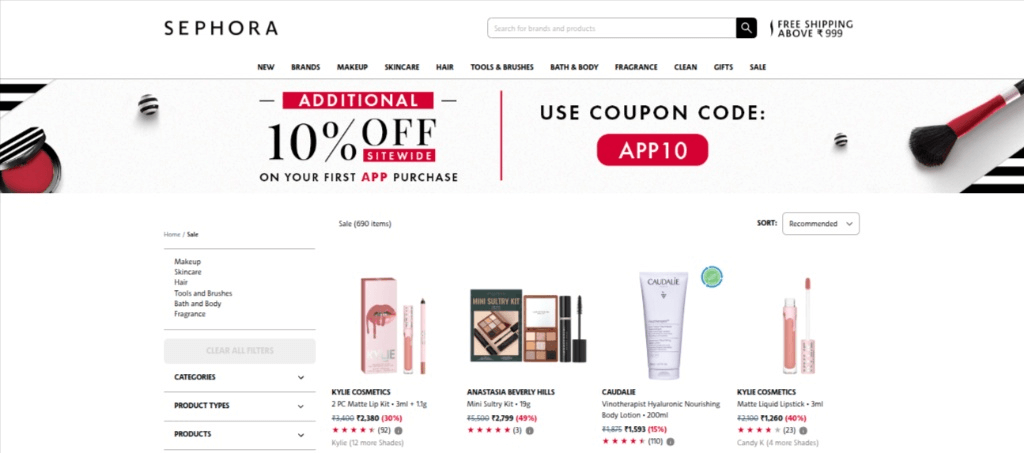
Sephora utilizes a strategic banner to drive high-value traffic directly to its mobile platform.
By offering an additional sitewide discount specifically for first-time app users, they trade a small margin for long-term customer retention.
Key takeaways:
- Mobile ecosystem growth: Offering an exclusive code like APP10 incentivizes mobile web users to download the app, where conversion rates are typically higher due to a more streamlined checkout process.
- High-visibility banner placement: The banner is placed at the very top of the category page, ensuring that every shopper sees the incentive before they start browsing.
- Stackable savings perception: By labeling it as an “Additional” 10% off, Sephora makes the offer feel more valuable, as customers perceive they can save even more on top of existing product discounts.
- Free shipping thresholds: The top-right corner maintains a “Free Shipping Above ₹999” notice, which works alongside the flash coupon to naturally increase the Average Order Value (AOV) as shoppers add more items to qualify for both perks.
8. Levi’s: The “High-Volume” Buy 2 Get 2 Free Flash Sale
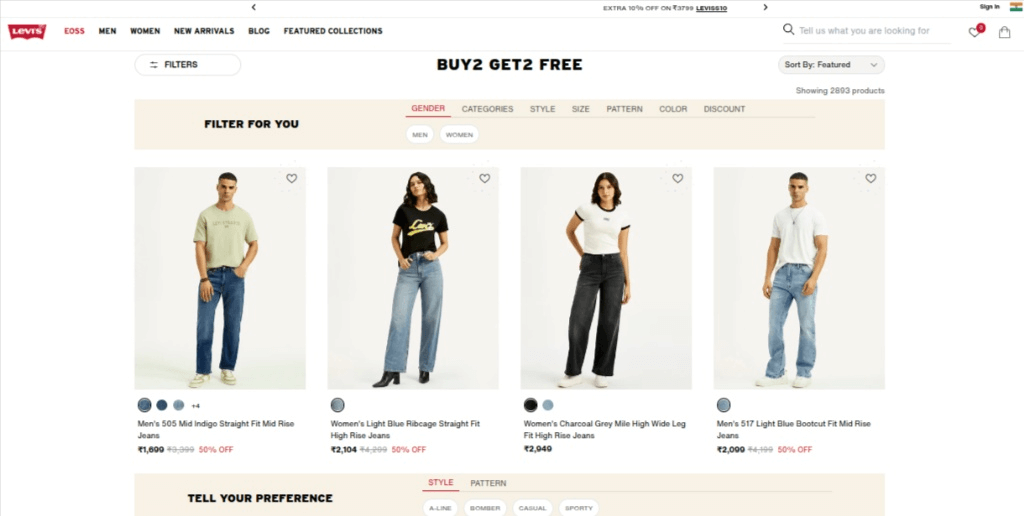
Levi’s utilizes a high-impact “Buy 2 Get 2 Free” strategy to aggressively move massive amounts of inventory in a single flash window.
It combines deep multi-buy discounts with personalized filtering, transforming a standard clearance event into a high-speed, personalized shopping experience.
Key takeaways:
- Massive AOV scaling: By requiring a four-item commitment for the full discount, Levi’s ensures a high cart value per transaction, effectively clearing warehouse space while maximizing revenue per customer.
- Intent-based personalized filtering: The “FILTER FOR YOU” and “TELL YOUR PREFERENCE” sections allow users to bypass over 2,800 products instantly. This reduces “decision fatigue” during a high-pressure flash sale, leading to faster checkouts.
- The “double anchor” discounting: The page shows products at 50% off individually while simultaneously pushing the “Buy 2 Get 2 Free” offer. This creates a powerful psychological “win” for the customer, making the deal feel twice as valuable.
- Inventory liquidation at scale: Showing over 2,893 products in a single flash category proves to the customer that this isn’t just a limited “leftovers” sale, but a major brand event worth their time.
9. JioMart: The “FUNbelievable” year-end RCS flash sale
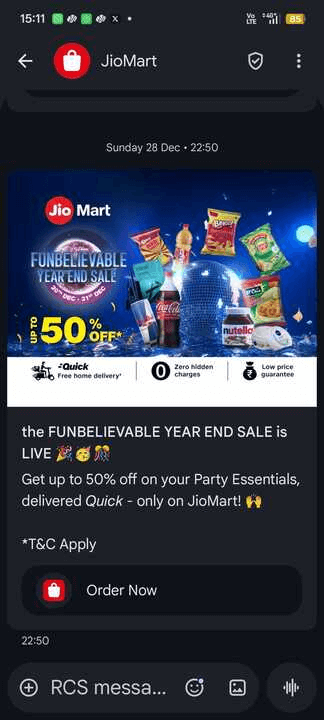
JioMart utilizes Rich Communication Services (RCS) messaging to deliver high-impact, visual flash sale alerts directly to a user’s primary messaging app.
This method bypasses crowded email inboxes by using interactive “Order Now” buttons and vibrant imagery to drive immediate year-end purchases.
Key takeaways:
- Conversational commerce integration: By using RCS instead of standard SMS, JioMart provides a rich, app-like shopping experience.
- The “Party Essential” anchor: The sale specifically targets “Party Essentials” during the late December window, aligning the flash discount with the exact seasonal needs of the consumer to increase relevance.
- Call to Action (CTA): The use of a native “Order Now” button within the message reduces the number of clicks between the initial alert and the final purchase, significantly lowering friction.
- Strategic messaging time: The message is timestamped late in the evening (22:50), targeting the “night-time scroller” demographic when impulse buying for upcoming New Year’s events is at its peak.
10. American Eagle: The “Today’s Offers” Micro-campaign flash sale
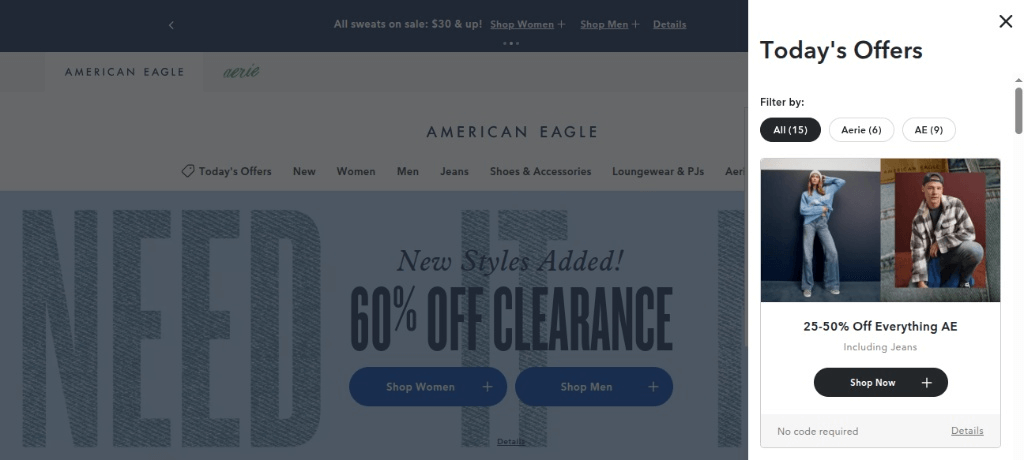
American Eagle utilizes a multi-layered approach to flash sales by integrating persistent countdown timers with a dedicated “Today’s Offers” side panel.
This creates a centralized hub for all active promotions, allowing shoppers to navigate multiple flash deals without leaving their current browsing path.
Key takeaways:
- Centralized deal hub: By using a “Today’s Offers” side panel, American Eagle prevents the main site from becoming cluttered with banners while ensuring users have instant access to every active flash promotion.
- The “Navigation Overlay” tactic: The use of a small blue tooltip to point out the offers section acts as a non-intrusive guide, nudging the customer toward sales without disrupting the primary shopping experience.
- Segmented urgent messaging: The top-bar timer specifically calls out categories like “including jeans,” which helps drive targeted traffic to high-margin departments during a sitewide event.
- Frictionless redemption: Explicitly stating “No code required” in the offer panel removes a major checkout hurdle, catering to the impulsive nature of flash sale shoppers.
- Inventory preservation: American Eagle frequently adds “New Styles Added” tags to their 60% off clearance flash sales, signaling to the customer that the selection is fresh and items are moving fast.
What makes a flash sale convert?
To turn a short-term discount into a high-revenue event, high-performing brands focus on psychological triggers and frictionless execution.
Based on the successful strategies of brands like Walmart, Amazon, and American Eagle.
Here are the 5 key factors that make a flash sale convert:
- Visual scarcity and real-time urgency
- High-impact price anchoring
- Frictionless path to purchase
- Strategic audience segmentation
- The “3-3-3” marketing rule
1. Visual scarcity and real-time urgency
The most effective flash sales make the “ticking clock” impossible to ignore.
- Live countdown timers: Using high-contrast timers (as seen in Walmart’s banner) creates a physical sense of urgency that discourages overthinking.
- Progress bars: Amazon Haul uses “In [X] carts” indicators to trigger social proof and micro-scarcity at the product level.
- Persistent reminders: Sticky headers or side panels, like American Eagle’s “Today’s Offers,” keep the deadline in the user’s peripheral vision throughout their journey.
2. High-impact price anchoring
Conversion rates peak when the gap between the “Regular Price” and the “Flash Price” is dramatic.
- Extreme discounts: Offers like Zulily’s “Up to 90% off” or Amazon’s “Under $1” deals lower the barrier to entry so significantly that they drive high-volume impulse buys.
- Bundle-based savings: Trampoline.com increases Average Order Value (AOV) by offering massive dollar-off discounts on high-ticket bundles rather than individual items.
3. Frictionless path to purchase
Flash sales are built for speed; any hurdle in the checkout process can kill the “impulse” momentum.
- No-Code redemption: Removing the need for manual coupon codes (a tactic used by American Eagle) ensures a seamless transition from browsing to buying.
- Platform-specific optimization: Sephora and Gymshark use flash deals to migrate users to their mobile apps, where one-tap checkouts and push notifications drive higher conversion rates.
- Direct-to-message CTAs: JioMart’s use of RCS messaging with native “Order Now” buttons reduces the number of clicks required to complete a transaction.
4. Strategic audience segmentation
Blasting the same sale to your entire list can lead to “discount fatigue.” Top brands use data to target the right people.
- Zero-Party data: Zulily asks users for category preferences (e.g., “Shoes” or “Men’s”) before they join, ensuring future flash alerts are hyper-relevant.
- VIP exclusivity: Creating “unlockable” deals with custom codes or password-protected pages makes loyalists feel valued, increasing their likelihood to convert.
5. The “3-3-3” marketing rule
As discussed in current e-commerce best practices, high-converting sales typically follow a multi-touch cadence:
- Warm-Up: A teaser 24 hours prior to build anticipation.
- Launch: A primary announcement via Email or SMS during peak browsing hours.
- Last Call: A final reminder 2 hours before the end, which can account for up to 30% of total revenue.
Flash sale preparation checklist
1. Goal setting & inventory
- Define your goal: Decide if this sale is for clearing old stock, acquiring new customers, or boosting immediate cash flow.
- Audit your stock levels: Ensure you have enough inventory to handle a sudden surge in orders without overselling.
- Set your “Floor Price”: Calculate your deepest possible discount to ensure you remain profitable even with high-volume sales.
2. Campaign timing & schedule
- The 24-Hour warm-up: Schedule a “Teaser” email or SMS to build anticipation before the sale goes live.
- Peak launch window: Aim for a mid-week launch (Tuesday/Wednesday) between 8:00 AM and 10:00 AM.
- The “After-Hours” surge: Plan a reminder for 7:00 PM – 9:00 PM to catch mobile users scrolling at home.
- The 2-hour “last call”: Automate a final urgency message to capture the 30% of revenue that typically occurs at the very end.
3. Technical setup & friction removal
- Verify site speed: Test your landing pages to ensure they can handle a significant spike in concurrent traffic.
- Simplify the checkout: Remove unnecessary form fields; if possible, enable “No-Code” discount redemption or one-tap checkouts.
- Deploy scarcity tools: Activate live countdown timers and “Low Stock” indicators on your product pages.
- Mobile optimization: Double-check that your banners and pop-ups are easy to close and look perfect on smartphone screens.
4. Omnichannel marketing
- Sync your messaging: Ensure your website banners, email headers, and social media graphics all share the same visual theme.
- SMS/WhatsApp Integration: Set up your text-based alerts for the highest open rates (aim for 98%).
- Segment your lists: Separate your “VIPs” from “New Leads” to send personalized offers that increase relevance.
5. Post-sale strategy
- Automate customer win-backs: Set up a follow-up email for those who didn’t buy, offering a smaller “consolation” discount.
- Prepare support teams: Brief your customer service team on the sale details to handle an influx of shipping or discount-related queries.
How Retainful can help you create high-performing flash sale campaigns?
Retainful streamlines the technical aspects of your promotions, allowing you to focus on sales. Here is how it helps you build high-performing flash sale campaigns:
- Drag-and-drop editors & pre-built workflows:Create professional announcements in minutes and use automated workflows to handle all your scheduling and timing needs.
- Single-workflow omnichannel reach: Send email and SMS messages through a single workflow to reach customers on their favorite platforms simultaneously.
- Dynamic one-time coupons:Generate unique, one-time-use discount codes for every customer to prevent coupon leakage and misuse.
- Granular audience segmentation:Target specific groups based on their purchase history and behavior to ensure your flash sales are always personalized and relevant.
Create a synchronized flash sale campaign without hassle using Retainful’s omnichannel workflows.
Wrap up!
As we’ve seen from brands like Levi’s and American Eagle, the difference between a mediocre sale and a record-breaking day lies in the details.
Now that you have the blueprint and the checklist, it’s time to stop planning and start launching. Use these flash sale examples as your foundation, but don’t let the technical setup slow you down.
Ready to launch your own high-converting flash sale? [Try Retainful for free] and use our pre-built automation workflows to reach your customers via Email, SMS, and WhatsApp in one seamless sequence.
Also Read:
- 14 Subscription email examples (Types, templates & best practices)
- Omnichannel vs multichannel marketing (differences + examples)
- 5 Real-life Omnichannel marketing examples (Detailed case study)
Flash sales Frequently Asked Questions
A standard sale lasts weeks with moderate discounts. A flash sale is a high-intensity event offering deep discounts (40%–80%) for a very short window, relying on extreme urgency and limited stock.
It is a multi-touch sequence: a “Warm-up” teaser 24 hours before, a “Launch” announcement at start-time, and a “Last Call” reminder 2–3 hours before the end to maximize FOMO.
Most high-performing sales last 3 to 24 hours. A window under 24 hours is ideal because it forces an immediate decision, preventing customers from “saving it for later” and forgetting.
This is a promotion where the exact discount is hidden until the user clicks through. This gamified approach uses curiosity to drive significantly higher click-through rates.
Yes. Flash sales help small businesses clear slow-moving stock and boost cash flow quickly. Automation tools like Retainful allow small teams to manage these timed sequences effortlessly.
Aim for once a month or quarter. Running them too often creates “discount fatigue,” where customers refuse to pay full price. Keep it rare to keep it special.