In 2026, Valentine’s Day falls on a Saturday, shifting the consumer mindset from “quick office delivery” to “planned weekend experiences.” Your Valentine’s Day marketing should stand out.
Combined with a record $1.5B+ spending on pets and a 60% surge in Gen Z self-gifting, the traditional “roses and chocolates” approach is no longer enough.
So if you’re wondering what you should do for Valentine’s Day marketing, this article is for you.
We’ve curated a list of the 20 best Valentine’s Day marketing ideas.
Let’s dive in.
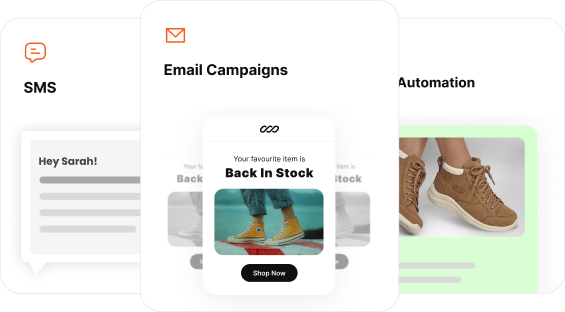
Turn V-Day gift-buyers into repeat customers with Retainful’s omnichannel marketing.
20 Best Valentine’s Day marketing ideas
- Leverage “Loss aversion”
- The “Anti-Valentine” pivot
- The “Pet-Valenteen” bundle
- Implement an Al gift curator
- Focus on “affordable luxury.”
- Sentimental motifs in Valentine’s Day
- The Saturday “experience” upsell
- Galentine’s Day (Feb 13) group gifting
- Alerts for last-minute shoppers
- The “charity tie-in.”
- The “Date Night at Home” subscription box
- “Pay It Forward” Galentine’s discounts
- Al-powered “Relatable” card generators
- The “Relationship Milestone” tiered promo
- “Last-Minute” local pickup partnership
- The “Love for your future self (Financial Wellness)
- The “Anti-ghosting” marketing campaign
- Mystery “Blind date with a book/product.”
- “Kid-entine classroom bundles
- Host a workshop
1. Leverage “Loss aversion.”
Psychology shows that the pain of losing is twice as powerful as the joy of gaining. Instead of saying “Make them happy,” use “Don’t show up empty-handed.”
- The data: 34% of shoppers cite “stress over the right gift” as a primary pain point.
- Tactical execution: Use countdown timers with the heading: “3 hours left to save your Saturday surprise.” This frames the deadline as a risk to their social standing.
For example, the Valentine’s Day email strategy by Keyzar
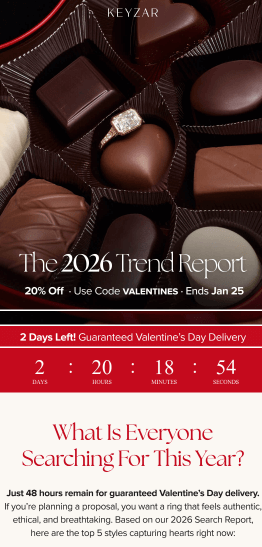
Keyzar’s 2026 email doesn’t sell diamonds; it sells certainty.
It combines a ticking clock with a “guaranteed delivery” promise; it turns a luxury purchase into a mission-critical deadline.
Key takeaways:
- Move from “Benefit” to “Risk” framing: Instead of focusing on the joy of the gift, highlight the social cost of failure.
- Create a “Visual deadline”: A countdown timer is a psychological “nudge” that increases urgency and reduces choice paralysis.
- The “Safety Net” guarantee: Loss aversion is fueled by the fear of things going wrong (e.g., shipping delays). Explicitly labeling a “Guaranteed Delivery” date acts as an insurance policy for the customer’s emotions, making it “safer” to buy now than to wait.
Send stunning V-themed emails within minutes using Retainful’s pre-designed templates.
2. The “Anti-Valentine” pivot
Gen Z is rebelling against traditional romance. 2026 is seeing a massive uptick in “Self-Love” and “Ex-Bash” campaigns. Moreover, there is a 596% surge in self love searches according to the Pinterest Predicts.
- The data: 45% of single adults now participate in “Anti-Valentine” activities.
- Tactical execution: Run a “Shred Your Ex” promo where customers get 20% off for “shredding” a digital past and upgrading to a self-care bundle.
3. The “Pet-Valenteen” bundle
In 2026, the “fur-baby” is the new primary Valentine.
- The data: 62% of dog owners plan to buy their pet a gift, with 1 in 3 spending as much on their pet as on a partner.
- Tactical execution: Create “Date Night for Two” kits that include a treat for the human and a matching toy/treat for the pet.
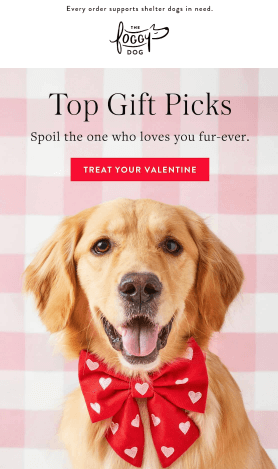
Pet-Valenteen example: The “Human + Pet” matching set
The Foggy Dog leverages the “Humanization of Pets” trend by selling matching accessory sets (e.g., a dog bandana paired with a human scrunchie).
Key takeaways:
- Elevate the bond: Position pets as the “ultimate Valentine” to capitalize on the fact that 1 in 3 owners spend as much on their animals as they do on human partners.
- Integrate social impact: Explicitly state that purchases support causes (like shelter dogs) to appeal to the 60% of Gen Z who prioritize purpose-driven brands.
4. Implement an AI gift curator
Choice paralysis is a conversion killer. AI can solve it.
- The data: 70% of 2026 shoppers prefer “curated” paths over browsing large catalogs.
- Tactical execution: Embed a “3-Question Matchmaker” quiz on your landing page. Use AI to recommend 3 specific products based on “Relationship Length” and “Partner Personality.”
For example, Uncommon Goods uses a quiz to overcome choice paralysis.
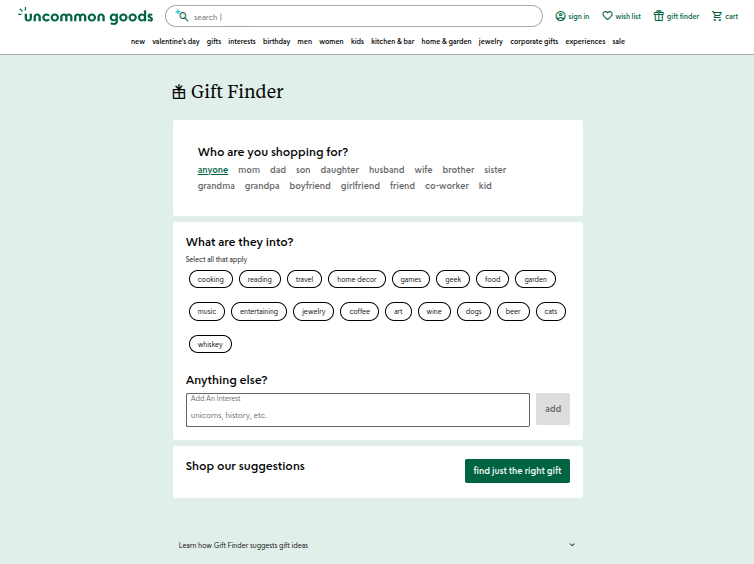
Instead of a standard search bar, the AI asks about the recipient’s personality.
Key takeaways:
- Kill choice paralysis: Limit recommendations to the “Sweet Spot” of 2–4 products to boost conversion rates and reduce the “Paradox of Choice” for overwhelmed buyers.
- Build trust with “why”: Explain the logic behind each pick, such as matching a partner’s traits to turn hesitant browsers into confident, high-value purchasers.
- Capture zero-party data: Use quiz responses to collect direct insights on customer preferences, fueling hyper-personalized marketing for the rest of the year.
5. Focus on “affordable luxury.”
Economic shifts have led to “premium restraint.” Shoppers are trading $5,000 jewelry for $150 “sensory experiences.”
- The data: Spending is shifting from big-ticket items to high-quality “practical indulgences” like gourmet coffee or premium skincare.
- Tactical execution: Bundle your best-sellers into “The Home Spa” or “The Chef’s Date” to provide a luxury experience at a fraction of the cost of a gala dinner.
6. Sentimental motifs in Valentine’s Day
Generic monograms are out. “Storytelling” jewelry and items are in.
- The data: Demand for personalized jewelry with “sentimental motifs” (zodiacs, coordinates, lockets) has tripled in the last quarter.
- Tactical execution: Offer free engraving for “Special Dates” or “Secret Messages” hidden inside product packaging.
For example, Astrid & Miyu leverages the surge in sentimental gifting through their “Story Chain” service.
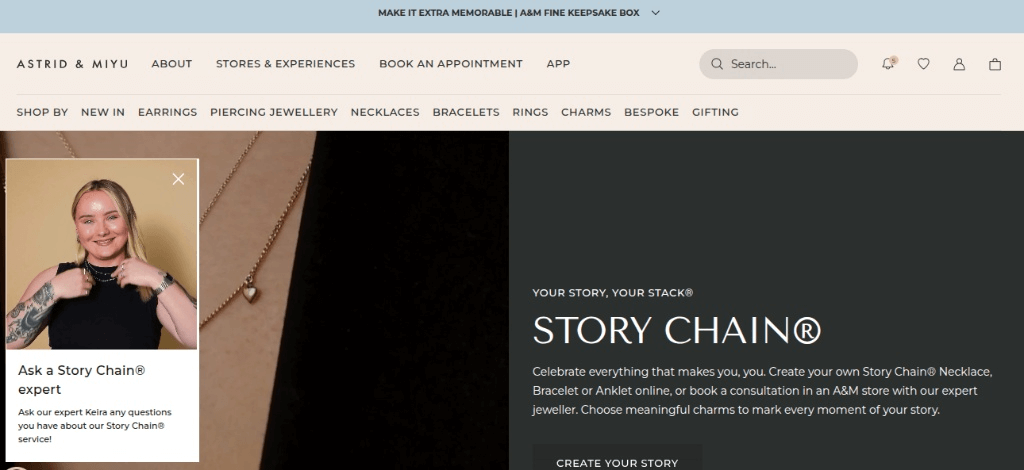
Alt text: The Astrid & Miyu website featuring their ‘Story Chain’ service, where users can customize jewelry.
Key takeaways:
- Replace names with narratives: Shift focus from generic monograms to symbolic charms like birthstones or zodiac signs that represent a deeper, more private connection between the giver and receiver.
- Incentivize hidden sentiments: Use the “Secret Message” trend by offering free engravings inside lockets or on the back of pendants to satisfy the high demand for intimate, “for-your-eyes-only” details.
- Interactive customization: Adopt a visual “story builder” interface like Astrid & Miyu’s to reduce choice paralysis while allowing customers to create an instant heirloom that feels truly one-of-a-kind.
7. The Saturday “experience” upsell
Since Feb 14, 2026, is a Saturday, people are staying home and hosting.
- The data: Pizza and “DIY Date Night” kits are projected to outperform fine dining in total volume this year.
- Tactical execution: If you sell physical goods, include a “Date Night Playlist” QR code or a “Conversation Starter” card deck with every order.
8. Galentine’s Day (Feb 13) group gifting
“Platonic Love” is the fastest-growing V-Day segment.
- The data: Retailer searches for “Galentine” are up 250% year-over-year.
- Tactical execution: Offer “Buy 3, Get 1 Free” on sets designed for friend groups (e.g., wine glasses, masks, or candles).
Example – Uncommon Goods leans into the Galentine’s trend by curating “Bestie Bundles”, like their Wine Gummies Trio or Shower Steamer Sets.
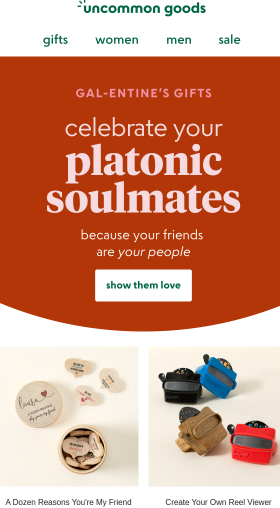
Alt Text: “An e-commerce product display of a Galentine’s Day ‘Bestie Bundle’ featuring matching sets of wine glasses and self-care items.”
Key takeaways:
- Incentivize the “Squad” Purchase: Use “Buy 3, Get 1 Free” or tiered volume discounts to encourage shoppers to buy for their entire friend group in a single transaction.
- Bundle for Shared Rituals: Focus on “Saturday Night In” products like matching wine glasses, face mask sets, or cocktail kits that facilitate the group activities 45% of single adults now prioritize.
- Market “Split-Ability”: Highlight products that are naturally divisible (like a set of 3 candles or 4 sleep masks) to make it easy for a group leader to distribute gifts at a Galentine’s brunch.
9. Alerts for last-minute shoppers
Email open rates for flowers and chocolate peak at 17%, but SMS hits 98%.
- The data: 38% of Valentine’s purchases happen in the final 48 hours.
- Tactical execution: Send a “Skip the Panic” text on Feb 12th with a link to “Instant Digital Gift Cards” or “Local Pickup” options.
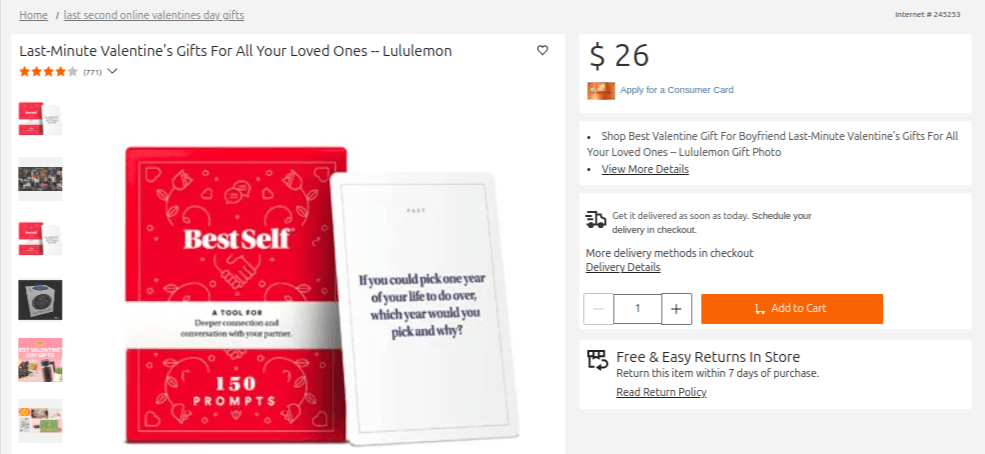
Alt text: “Lululemon featuring ‘BestSelf’ conversation cards as a last-minute Valentine’s gift with options for instant delivery and in-store pickup.”
Key takeaways:
- Market “instant” value: Use your final SMS and email blasts to lead with digital gift cards or downloadable content, ensuring you capture revenue from the 98% of SMS users who check their phones in those critical final 48 hours.
- Bridge the delivery gap: Solve shipping anxiety by clearly highlighting “In-Store Pickup” or “Instant Delivery” on your product pages, turning a logistical hurdle into a competitive advantage for frantic buyers.
- Sell connection, not just stuff: Follow Lululemon’s lead by promoting “Experience Gifts” like conversation starters or digital class passes.
10. The “charity tie-in.”
Purpose-driven brands win with 2026’s “Conscious Consumer.”
- The data: 60% of Gen Z prefer brands that support social causes.
- Tactical execution: Donate a portion of “Anti-Valentine” sales to animal shelters or “Galentine” sales to women’s empowerment funds.
11. The “Date Night at Home” subscription box
Since V-Day 2026 is a Saturday, many will avoid the “crowd surge” at restaurants.
- The idea: Create a one-time “Table for Two” bundle (e.g., a specialty pasta sauce, a high-end candle, and a curated Spotify playlist).
- Data point: At-home date night spending is projected to grow 14% in 2026 as consumers prioritize intimacy over expensive reservations.
12. “Pay It Forward” Galentine’s discounts
Leverage the social nature of female friendship groups.
- The idea: A “refer-a-bestie” program where if a customer buys a gift for a friend, the friend gets a discount code to “pay it forward” to someone else in their circle.
- Data point: 72% of Gen Z women report they would rather receive a gift from a friend than a romantic partner.
13. AI-powered “Relatable” card generators
Standard cards are often too cheesy.
- The idea: Offer a free tool on your site where users input three “inside jokes,” and AI generates a custom, printable card.
- Data point: Personalized greeting card demand is up 22% year-over-year as “generic” sentiments lose favor with younger demographics.
14. The “Relationship Milestone” tiered promo
Target long-term couples who are “bored” with traditional gifts.
- The idea: Offer discounts based on years together (e.g., “5 years = 5% off,” “20 years = 20% off”).
- The twist: This builds massive social proof when people share their “years of love” on social media.
15. “Last-Minute” local pickup partnership
Solve the “Shipping Anxiety” that peaks on Feb 12th.
- The idea: If you are an e-commerce brand, partner with local coffee shops to serve as “Gift Pickup Hubs” for orders placed 24 hours before the 14th.
- Data point: 48% of shoppers abandon carts 3 days before V-Day due to fear of late delivery.
16. The “Love for your future self” (Financial Wellness)
A pivot for B2B or Fintech brands.
- The idea: “Fall in love with your retirement.” Offer a bonus for opening a joint savings account or a high-yield “Couple’s Goal” fund.
- Data point: Financial stability is cited as the #1 “Attractive Trait” by 2026 singles in the “Practical Love” era.
17. The “Anti-ghosting” marketing campaign
Perfect for Apps, SaaS, or Service industries.
- The idea: A lighthearted campaign focused on “Reliability.” “We’ll never ghost you, unlike your ex.” Offer a “Commitment Discount” for annual subscriptions.
18. Mystery “Blind date with a book/product.”
Capitalize on the “Surprise and Delight” trend.
- The idea: Wrap products in brown paper with only 3 descriptive bullet points (e.g., “Smells like rain,” “Best for cozy nights,” “Under $30”).
- The data: Mystery box sales see a 40% higher engagement rate on TikTok compared to standard product reveals.
19. “Kid-entine” classroom bundles
Targeting the busy parent demographic.
- The idea: Pre-packaged sets of 20+ small, non-candy items (stickers, erasers, eco-friendly toys) for school exchanges.
- The twist: Markets to the “Mental Load” of parents who forget school parties until the last minute.
20. Host a workshop
Experience-led retail for Saturday afternoon.
- The idea: Host a virtual or in-store event where couples or friends create a signature product for their 2026 memories.
- Data point: 65% of 2026 consumers prefer “making something” together over simply “buying something.”
Simplify your 2026 holiday workflow: Explore Retainful’s pre-built automation templates and save hours on campaign setup.
Wrap up!
For e-commerce owners, Valentine’s Day 2026 represents a critical shift toward experience-driven retail and niche audience segmentation.
With the holiday falling on a Saturday, the opportunity lies in moving beyond commodity products to offer high-margin “Date Night” bundles and AI-curated gift paths.
By integrating psychological triggers like loss aversion and urgency, you can diversify your revenue streams and lower customer acquisition costs.
Also Read:
- 75+ Valentine’s Day email subject lines that customers love to see
- 10 Flash sale examples from high-performing brands
- E-commerce marketing calendar 2026: Key holidays & sales events for every industry
Frequently asked questions
Since the holiday falls on a weekend, standard shipping deadlines are more aggressive. Merchants should pivot to “Experience Bundles” and heavily promote “Local Pickup” or “Instant Digital Certificates” starting Feb 12 to capture the 38% of shoppers who miss the shipping cutoff.
Gen Z and “Pet Parents” are the primary drivers. With a 596% surge in self-love searches and over $1.5B spent on pets, marketing toward non-traditional recipients.
Implement an AI gift curator to eliminate choice paralysis. Since 70% of shoppers prefer a curated path, narrowing options to three hyper-targeted recommendations based on recipient personality significantly increases conversion and reduces checkout friction.
Yes. While seasonal email open rates often stall at 17%, SMS maintains a 98% open rate. Use SMS specifically for “Zero-Hour” urgency alerts, delivery guarantees, and limited-time discount codes in the final 48 hours.
60% of Gen Z consumers prioritize brands that support social causes. A charity alignment increases brand affinity and provides a distinct competitive edge, allowing your brand to justify “Premium Restraint” pricing through value-based differentiation.