Acquiring a new customer is more expensive today than ever before, making Average Order Value the most critical metric for your Shopify store. If you are not actively encouraging customers to add one more item to their cart, you are missing out on vital revenue.
While simple sales events hurt your margins, data shows that gift-with-purchase strategies can increase your average order value by 15-30%. Shoppers love the psychological thrill of earning a reward. To help you unlock this powerful revenue driver, this guide will walk you through:
- Proven methods to set the right spending threshold
- How to implement tiered gifting for higher spending
- Ways to gamify the cart experience for urgency
- Rules for keeping gift costs highly profitable
- Top tools and methods to set up your campaign on Shopify
Let’s check them out!
Why gift-with-purchase works for increasing AOV
Offering a free gift encourages customers to spend more by triggering 3 simple psychological responses:
- Anchoring effect: People often judge a deal by the price of the free item. If you highlight that the bonus gift is normally worth $30, shoppers focus heavily on gaining that specific $30 value. This mindset makes adding another item to their cart feel like a smart financial decision rather than an extra expense.
- Threshold-driven behavior: Shoppers naturally seek clear goals. When a customer sees they only need to spend $15 more to unlock a reward, checking out immediately often feels like a missed opportunity. This small gap easily motivates them to browse your store for one additional product to complete the requirement.
- Perceived deal versus actual cost: A physical product usually feels much more exciting to buyers than a small percentage discount. Customers focus on the high retail value of the gift they receive. However, the actual cost to you of sourcing that item is usually very low, which protects your profit margins while keeping the buyer happy.
5 Proven gift with purchase strategies to increase AOV
1. Spend threshold gift
A spend threshold gift means customers get a free gift once their cart reaches a minimum order value. For example, “Spend $89 and get a free mini gift.” The reason it works is that once shoppers are close to the target, adding one more item often feels easier than checking out and missing the reward.
This works best for brands with plenty of low- to mid-priced add-on products, especially beauty, skincare, supplements, accessories, and home goods. It is much less effective if your catalog is too narrow or your price points are already high, because the customer may not have an easy product to add just to cross the line.
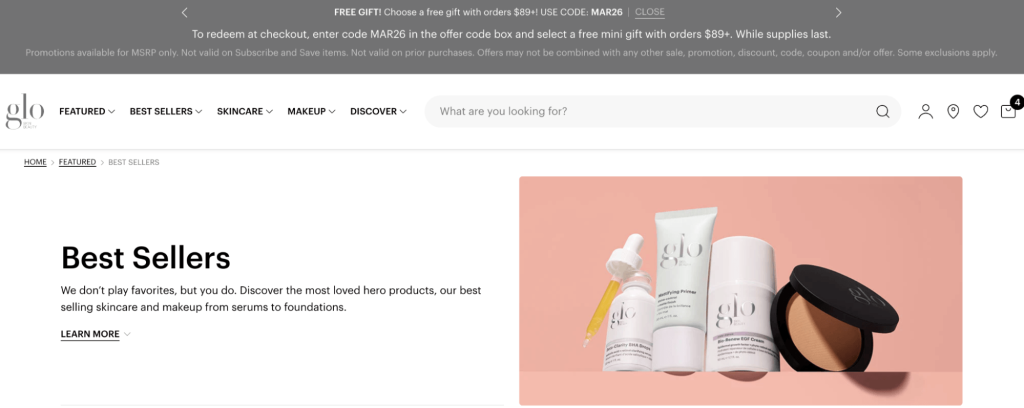
Glo Skin Beauty is a good example here. The site banner promotes a free mini gift with orders of $89 or more, which gives shoppers a clear spending target before they finish checkout.
Best practices:
- Set the gift threshold just above your current AOV so shoppers can reach it by adding one small item, not by rebuilding their cart.
- Place low priced add ons near the cart, such as minis, accessories, or travel sizes, so customers have an easy way to close the gap.
- Show the remaining amount in real time, such as “You’re $12 away from a free gift,” to make the next action obvious.
2. Tiered gifts
A tiered gift strategy means customers unlock different gifts at different spending levels. For example, a store might offer a small gift at $150, a better one at $200, and a premium one at $250. This works because once people unlock the first reward, the next one suddenly feels closer and more worth stretching for.
This works best for stores that sell routines, bundles, or repeat purchase products, where shoppers can realistically add another item without overthinking it. It is not a great fit for low-margin stores or stores where all gifts feel roughly the same, because then the higher tier does not create enough extra motivation.
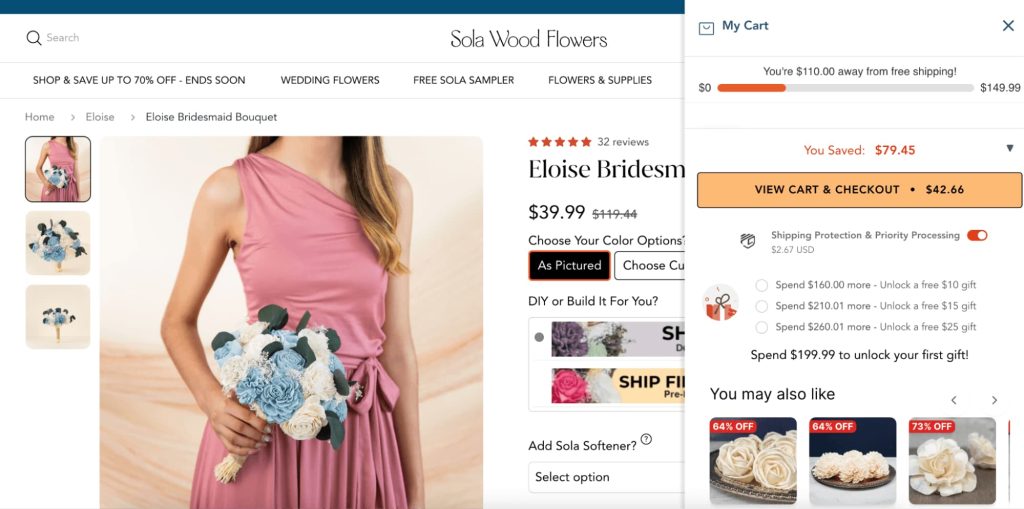
Sola Wood Flowers shows this clearly in the cart. The shopper can see three separate milestones tied to free $10, $15, and $25 gifts, making the upgrade path very visible right before checkout.
Best practices:
- Make each higher tier clearly better, not just slightly different, so the upgrade feels worth chasing.
- Keep the gap between tiers close enough that 1 or 2 extra products can move the shopper up.
- Give your best-value gift at the top tier, because that is what pushes customers to add more to their cart.
3. Exclusive or limited gifts
An exclusive or limited gift means the reward is not available at any time. For example, it could be an online-only ritual set, a seasonal item, or a gift available only while stock lasts. This works because the gift feels more special than a regular freebie, and the shopper knows waiting too long could mean missing it.
This works best for beauty, fashion, lifestyle, and premium brands where presentation and scarcity matter. It is weaker for very functional categories, because if the buyer is focused only on price and utility, exclusivity will not add much emotional pull.
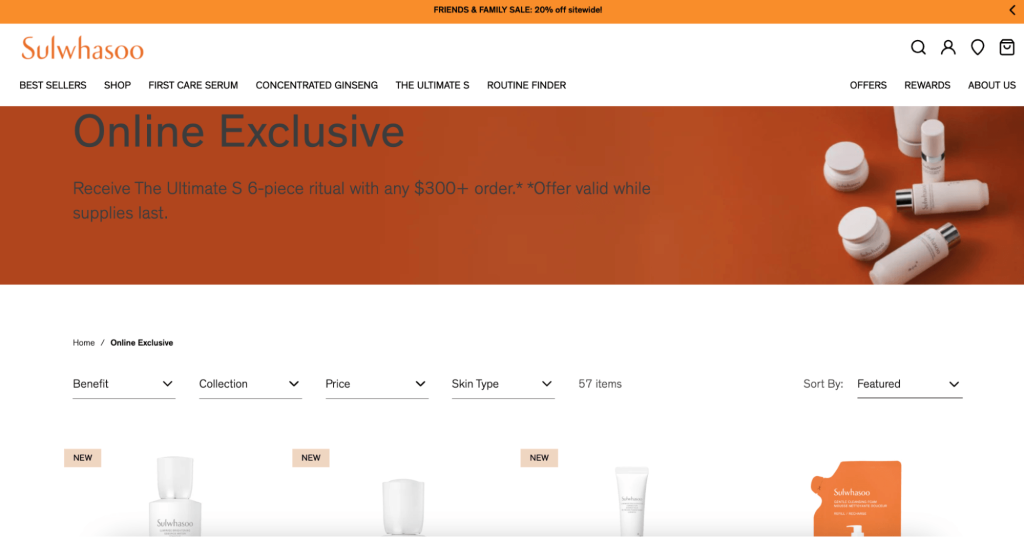
Sulwhasoo uses this approach well. The page promotes an Online Exclusive six-piece ritual for orders over $300 and states that the offer is valid while supplies last, which makes the gift feel both premium and limited.
Best practices:
- Use gifts that shoppers cannot normally buy on their own, because that is what makes the offer feel special.
- Tie the offer to a real campaign moment, such as a launch, holiday, or seasonal drop, like Thanksgiving or New Year, so the urgency feels believable.
- State the limit clearly on site, whether that means online exclusive, this week only, or while supplies last.
4. Mystery gifts
A mystery gift means the customer gets a free reward, but the exact item is not revealed upfront. It works because curiosity does some of the persuasion for you, especially when the audience already likes the brand and enjoys the surprise.
This works best for fan-driven brands, beauty brands, collectibles, and lifestyle products where discovery feels fun. It is harder to use effectively in categories where buyers need a very specific item, because a random reward can feel irrelevant rather than exciting.
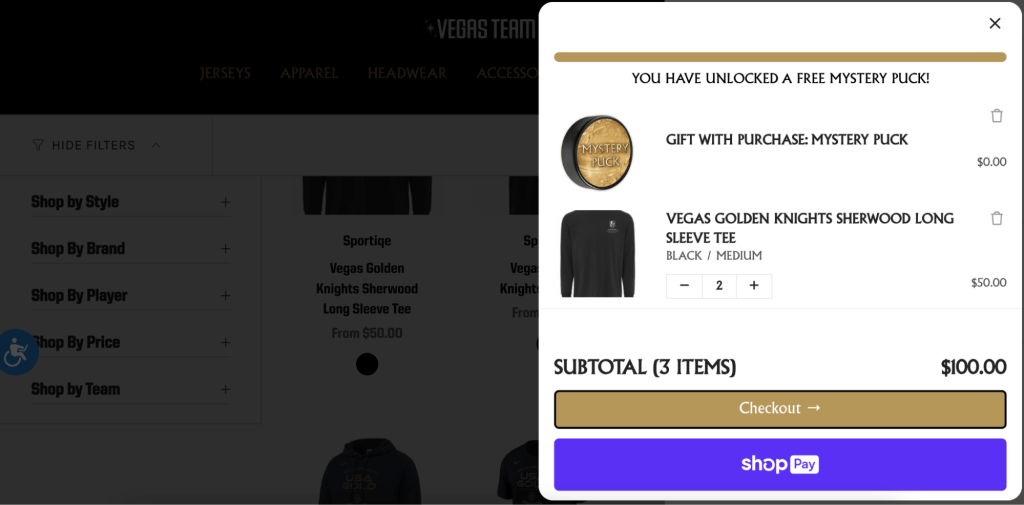
Vegas Team Store is a strong example. Once the shopper qualifies, the cart shows that a free mystery puck has been unlocked and added automatically, so the reward feels instant and frictionless.
Best practices:
- Keep the mystery gift relevant to the main purchase so the surprise still feels useful.
- Name the gift category upfront, such as mystery mini, mystery puck, or mystery accessory, so shoppers know what kind of reward they are getting.
- Auto-add the gift once the condition is met, because mystery offers lose impact when customers have to claim them manually.
5. Choice-based gifts
A choice-based gift lets shoppers pick from a small selection of free gifts. For example, a skincare brand might let them choose between a retinol sample, an exfoliant sample, or a body treatment sample. It works because people value rewards more when they align with their own needs.
This works best for skincare, makeup, wellness, and similar categories where customers have different concerns and product preferences. It is less effective when the choice set is too large or too confusing, because it adds friction rather than helping conversion.
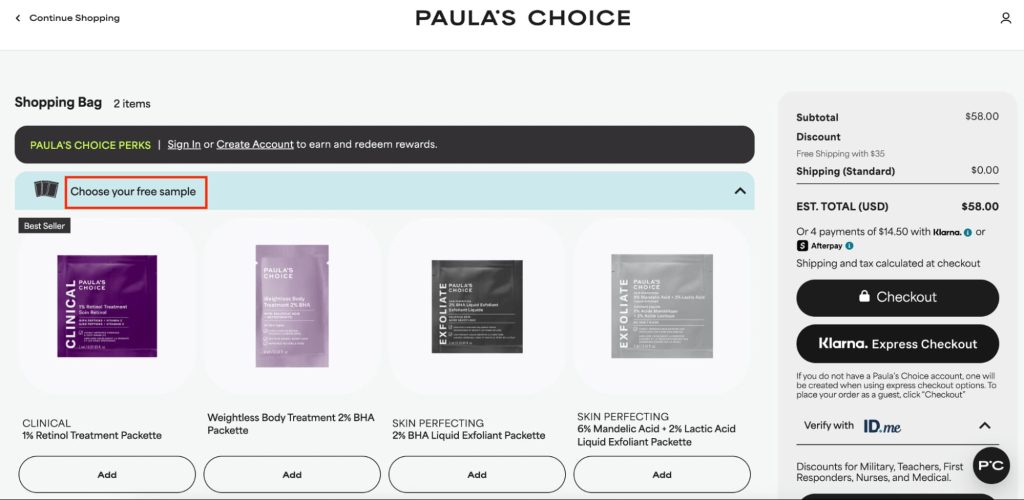
Paula’s Choice does this nicely in the cart with a “Choose your free sample” section and several sample options shown directly before checkout. That makes the reward feel personal and keeps the experience simple by having the choice happen in the cart, not through a complicated extra step.
Best practices:
- Limit the gift options to three so customers can choose fast without overthinking.
- Make each option serve a different need, such as hydration, exfoliation, or repair, so the choice feels meaningful.
- Put the gift selector inside the cart, where shoppers can act on it immediately without extra clicks.
How to set up gift-with-purchase on Shopify
There are 2 methods of setting up GWP on Shopify.
Method 1: Using native Shopify discounts (Buy X Get Y)
The fastest way to offer a free item without installing extra software is by using the built-in discount engine.
Quick setup guide: Go to your Shopify Admin > Discounts > Create Discount > Buy X Get Y. From there, simply pick the qualifying product and assign the free gift.
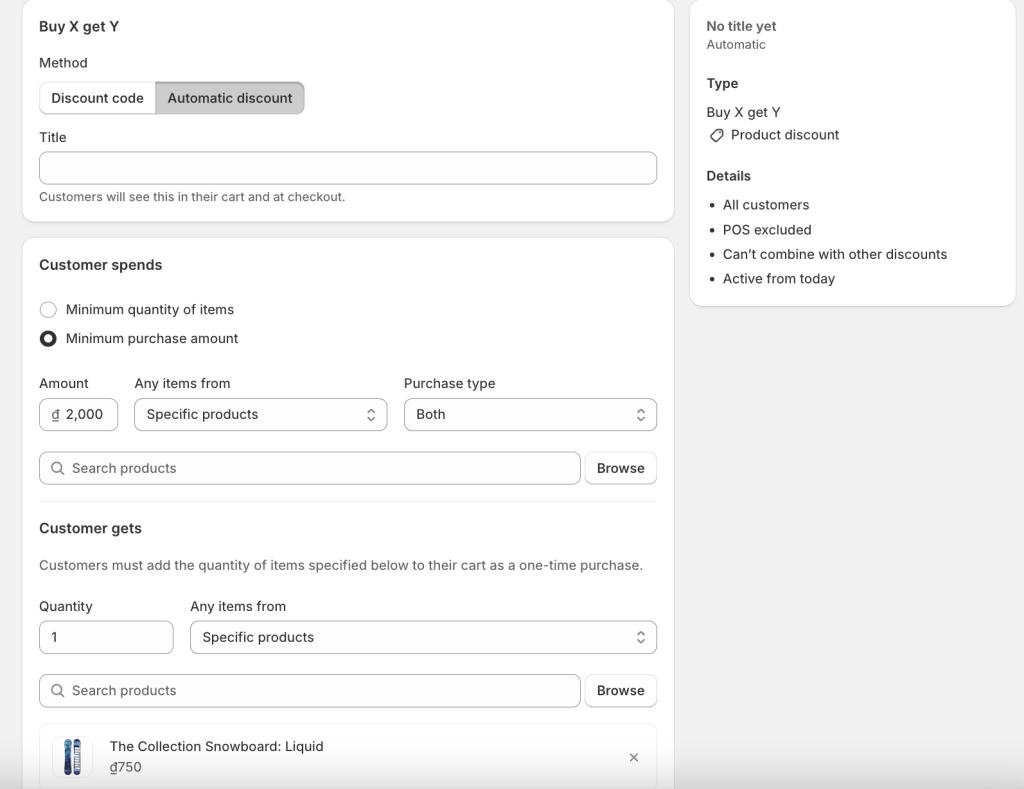
While this approach is easy and free, it comes with major limitations that make it hard to scale your AOV:
- It only works when a customer buys a specific product or shops from a specific collection.
- It completely lacks support for storewide spend thresholds, meaning you cannot run a campaign based on total cart value.
- It often requires customers to manually add the gift item to their cart before the discount applies, which adds friction to the checkout process.
Method 2: Using a dedicated Shopify GWP app (the best way)
To run highly effective promotional strategies, using a dedicated gift-with-purchase app is the best route. Third-party apps are built to solve the exact limitations of the native system, giving you the flexibility to build campaigns that actually drive revenue.
Here is why using a dedicated app is the better choice for your store:
- Storewide thresholds: You can set rules based on the total cart value, allowing shoppers to buy whatever they want and still earn the reward.
- Auto-addtocart: The app automatically adds the free gift to the cart the moment a shopper qualifies, removing all guesswork and extra steps.
- Cart progress bars: You can display a highly visible progress bar right inside the cart drawer, constantly reminding shoppers how much more they need to spend to unlock the prize.
Top 3 tools to automate your GWP campaigns
1. BOGOS: Free Gift & Bundle Upsell
- Best for: Established stores wanting an all-in-one engine to run multiple complex gift campaigns at the same time.
- Pricing: Free plan available. Paid plans range from $29.99 to $109.99 per month, depending on your Shopify tier and monthly free orders.
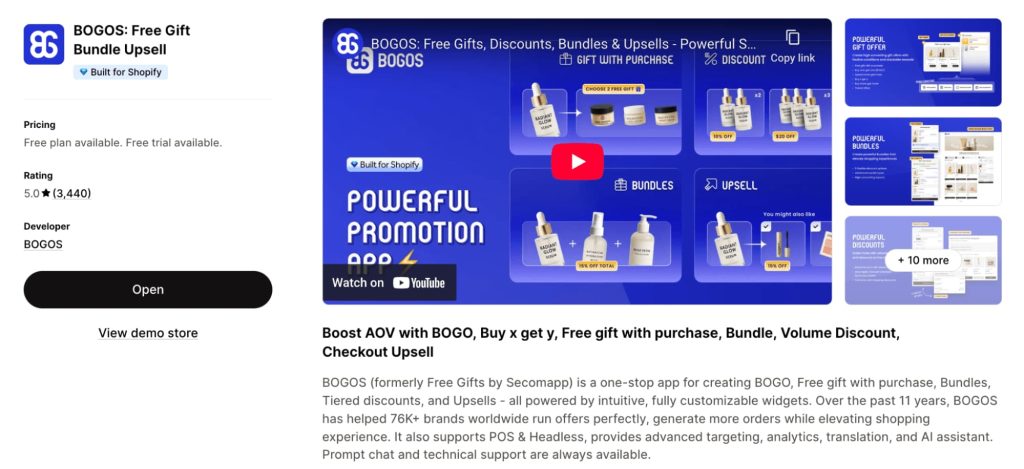
BOGOS is not just a simple pop-up tool. It is a heavy-duty promotion platform built to handle serious sales events. It shines when you need to run staggered rewards, such as a spend threshold gift, a BOGO deal, and a bundle offer all at once, without the rules clashing. It effectively replaces several marketing plugins, making it the safest choice for brands running massive Holiday or Black Friday campaigns that require deep customization and perfect execution.
Key GWP features:
- Create tiered free gift ladders triggered by cart value, item quantity, or specific collections.
- Auto-add gifts to the cart or display a slider that lets shoppers select their own reward.
- Run classic Buy X Get Y campaigns alongside gifts based on total cart value thresholds.
- Target specific gift promotions based on customer purchase history, location, or customer tags.
- Multiply rewards automatically as the cart value grows.
| Pros | Cons |
| Manages complex and multi-tiered free gift rules perfectly without glitches | The free plan limits usage to an initial order batch |
| Delivers a frictionless customer experience through auto-add functions | Upgrade costs scale directly with your Shopify plan level and order volume |
| Replaces multiple standalone apps by including built-in bundles and upsells | |
| Provides highly rated 24/7 customer support |
2. Gift Box: Free Gift Purchase
- Best for: New or small stores that need a clean, lightweight, and fast setup without advanced logic.
- Pricing: Free for trial stores. Live store plans scale from $29.99 to $79.99 per month based entirely on your monthly order volume.
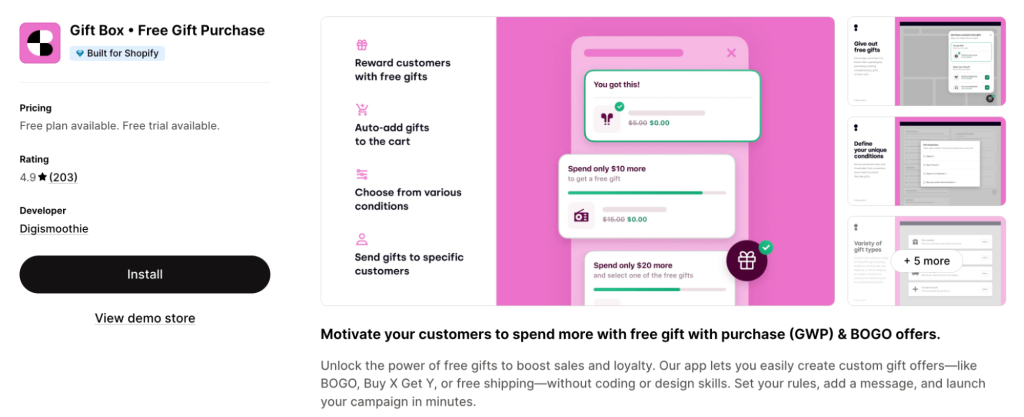
When you want to launch a campaign in under five minutes without touching any code, Gift Box is the right choice. It strips away complicated pricing logic and focuses purely on telling the customer exactly how much more they need to spend to unlock a reward. This simplicity makes the app incredibly reliable and ensures it won’t slow down your website.
Key GWP features:
- Set straightforward Spend X or Buy X Get Y gift rules.
- Display a mobile-responsive progress bar directly in the cart.
- Automatically add the earned free gift to the customer’s cart.
- Support for unlimited free gift campaigns across all paid tiers.
| Pros | Cons |
| Setup takes minutes and requires absolutely zero coding skills | Cannot execute advanced pricing logic, staggered tiers, or bundles |
| Lightweight code ensures your storefront stays incredibly fast | Offers zero internal analytics to measure campaign success |
| No hidden usage charges once you are on a paid tier | Pricing model forces new merchants straight to a paid tier for live stores |
3. KOALA Free Gift BOGO Upsell
- Best for: Brands selling subscription products or stores needing hyper-specific regional targeting.
- Pricing: Plans range from $9.99 for basic stores up to $99.99 per month for Shopify Plus merchants.
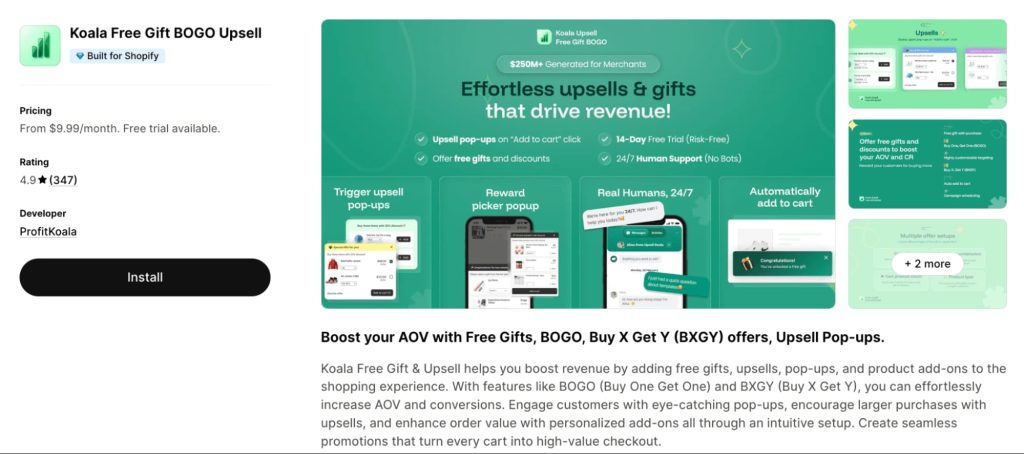
KOALA serves a very specific and highly valuable niche in the Shopify ecosystem. While most gifting tools ignore recurring orders, KOALA lets merchants trigger rewards for subscription-based products. It also excels at behavioral marketing, enabling you to show unique gift offers to shoppers based solely on their past purchase history or physical location.
Key GWP features:
- Automatically add gifts to the cart when specific targeted items are purchased.
- Set up rules to offer free gifts based on a customer’s previous purchase behavior.
- Trigger location-specific gift campaigns for regional sales events.
- Display highly customizable gift banners and pop-ups during the add-to-cart action.
| Pros | Cons |
| Essential for brands relying heavily on recurring subscription revenue | Does not appear to support staggered reward tiers for different spending levels |
| Executes regional marketing campaigns flawlessly through geolocation | Lacks a permanent free tier for newly launched stores |
| Lower entry price point compared to heavy-duty alternatives | Feature set leans heavily toward visual popups rather than complex cart logic |
Best practices for running a GWP offer
To maximize AOV impact, your gift-with-purchase strategy needs to balance strong psychological triggers with tight cost control and clear execution:
- Put a real deadline on the offer: A gift-with-purchase works best when customers know exactly when it ends. Use short windows, such as 48 hours, weekend campaigns, or launch periods, instead of running it continuously.
- Match the gift to the main purchase: The most effective gifts feel like a natural extension of what the customer is already buying, such as a skincare sample with a serum or an accessory that complements the main product.
- Make the offer impossible to miss: Reinforce the message across your store by showing it in the site banner for awareness, on product pages to influence intent, and in the cart to push conversion when shoppers are close to qualifying.
- Follow up after the purchase to drive repeat orders: Use post-purchase flows with product education, cross-sell suggestions, and a next-order incentive. Tools like Retainful are especially effective because they support automation, segmentation by order value, and repeat purchase campaigns in one place.
Conclusion
To wrap up, a good gift with a purchase offer does more than boost conversions for one campaign. It helps you increase cart value, improve the buying experience, and make the purchase feel more rewarding for the customer. If you set it up thoughtfully, it can become a reliable part of your growth strategy rather than just another short-term promo.
Frequently Asked Question
No, not by default. Shopify’s built-in version does not auto-add the free item, so customers often need to add it manually unless you customize the store or use an app.
A practical starting point is 30-50% above your current AOV. For example, if your AOV is $55, a threshold of $75-$80 is a common test range.
Keep it low relative to the order value. One guideline is to keep the gift cost at about 5 to 10 percent of the qualifying order value.
Yes, if your goal is a smoother checkout. Auto add removes friction, while manual claiming adds extra steps that can weaken the offer.
Yes. Post-purchase email flows can sustain the momentum with upsells, product tips, review requests, and next-order incentives after the gift campaign converts the first sale.