New year marketing ideas for 2026 focus on fresh starts, resolution-driven campaigns, and early-year momentum. The most effective New Year marketing ideas include countdown sales, goal-setting bundles, “New Year, New You” themes, exclusive January-only offers, and personalized customer re-engagement campaigns.
D2C brands that launch targeted new year marketing ideas within the first 72 hours of the year see a significant lift in January sales compared to those who wait.
Brands like Origins align their new year marketing ideas with popular resolutions, offering products that support wellness goals and seeing sustained engagement through January.
In the next 10 minutes, you’ll discover 7 proven New Year marketing ideas drawn from actual campaigns that helped brands thrive in 2026. Not abstract concepts, but practical approaches ready to adapt and implement now.
Why New Year marketing works: The psychology brands miss
Before we jump into tactics, let’s understand what makes January marketing fundamentally different.
December 26th, 11:23 PM. Marcus is lying in bed, half-watching some Netflix show, when it hits him:
“I did it again. Another year, same problems. Still 20 pounds more. disorganized. broke.”
You know what he does next?
He picks up his phone and searches: “best home workout equipment.”
Not because someone’s running ads. Not because there’s a sale.
Because his brain just flipped a switch psychologists call the “fresh start effect.”
Here’s what’s actually happening in your customers’ heads
January 1st isn’t just another day. It’s a mental reset button. A clean slate. The chance to become the person they should have been all along.
The data tells the story:
- Google searches for “New Year’s resolution” spike thousands of percent in the first week of January
- Millions of people make promises to themselves
- Most involve self-improvement—fitness, organization, learning, financial wellness
- By January 19th, 80% of those resolutions are already dying
Read that again.
You have exactly 18 days to capture customers at peak motivation before reality, excuses, and old habits drag them back down.
That’s your window.
And most brands completely waste it with generic “Happy New Year!” emails that say nothing, offer nothing, and convert nobody.
The real cost of getting January wrong
Let me tell you about a real ecommerce owner’s (sells supplements) first January.
Last year, they followed the standard playbook: one generic “New Year Sale – 20% Off!” email sent on January 2nd. Open rates were average. A handful of orders came through. Nothing to write home about.
They thought: See? January really is dead. Everyone was right.
Then, months later at a trade show, they met a customer named Jennifer.
“I bought your supplements back in January,” she said. “It changed everything for me.”
The owner was stunned. January had been their slowest month.
“I was on a mission,” Jennifer explained. “New Year’s resolution to finally get healthy. I searched high and low. Landed on your competitors first—their sites were just product lists. No guidance, no plan. Then I found your blog post about building a realistic wellness routine. You actually showed me how to start. So I bought from you.”
That single conversation revealed the truth.
Jennifer had been ready to commit to a 3-month supply. Instead, she bought just one bottle. One customer became hundreds of missed opportunities—not because the product was lacking, but because the brand treated January like any other month.
The lesson? The best new year marketing ideas aren’t about discounts alone. They’re about meeting people where they are: motivated, searching, and ready to invest in change.
This year, the same owner is using targeted new year marketing ideas—resolution-aligned bundles, timely guidance, and early-week launches—to turn January into their strongest month.
Because now they know:
January isn’t slow. The wrong approach is.
The 4-week resolution lifecycle (and when to strike)
Here’s what’s happening in your customers’ world right now—backed by real behavioral trends:
Week of January 1st:
- “This is it. This is MY year.”
- Energy: 10/10
- Willingness to spend: HIGH
- Looking for: The perfect solution to finally change
- Data: Google Trends shows searches for “New Year’s resolutions” and “how to start [fitness/wellness/habit]” spike 300–500% in the first week of January
8th of January :
- “Okay, this is harder than I thought.”
- Energy: 7/10
- Willingness to spend: MEDIUM
- Looking for: Support, guidance, proof it works
- Data: Studies show 25% of resolution-makers quit by day 7
15th of January :
- “Maybe I’m not cut out for this.”
- Energy: 4/10
- Willingness to spend: LOW
- Looking for: Motivation, community, reason to keep going
- Data: By week two, 80% of people have already faltered, per behavior change research
22nd of January :
- “I’ll try again next year.”
- Energy: 2/10
- Game over for most brands
- Data: Only 19% of resolution-makers are still going strong by February, according to the Journal of Clinical Psychology
Your three-phase strategy
Your job?
- Catch them in week one with new year marketing ideas that speak directly to their excitement
- Support them in week two with guidance, proof, and easy wins
- Save them in week three with community, encouragement, and real help
That’s not just smart new year marketing ideas—that’s being the brand that shows up when it matters most.
Because the data doesn’t lie:
People want to change. They just need someone to help them through the dip.
And when you do?
They don’t just buy once.
They become customers for life.
7 Real New Year marketing campaigns to steal in 2026
Now let’s break down actual campaigns from real brands—what they did, why it worked, and exactly how you can adapt their new year marketing ideas for your store.
AG1: Sell the transformation timeline (not just the product)
The brand: Athletic Greens (AG1) – premium supplement company
What they did:
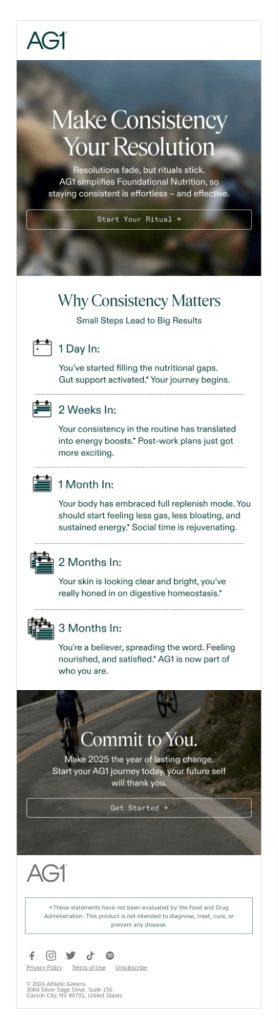
Created an email with the headline “Make Consistency Your Resolution” that sold the transformation timeline instead of just the product.
They showed specific milestones:
- 1 Day In: Journey begins, nutritional gaps filling
- 2 Weeks In: Energy boosts translating from consistency
- 1 Month In: Full replenish mode, less bloating, sustained energy
- 2 Months In: Clearer skin, improved digestion
- 3 Months In: You’re a believer, it’s part of who you are
Why it crushed:
They acknowledged the core problem: “Resolutions fade, but rituals stick.” Instead of promising overnight results, they showed a believable journey with specific, realistic milestones. The progression felt authentic—from starting out to becoming a believer over three months.
What you can steal:
Stop selling features. Sell the journey. Show customers exactly what happens at day 1, week 2, month 1, month 2. Make it real and specific so they can see themselves in that timeline.
Sayso: Launch on Dry January Day 1 with real reviews
The brand: Sayso – mocktail drink mix company
What they did:
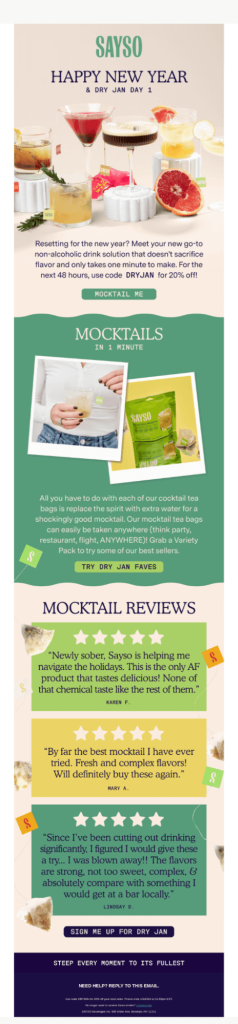
Capitalized on Dry January with an email launched on January 1st. The hook: “Resetting for the new year? Meet your new go-to non-alcoholic drink solution that doesn’t sacrifice flavor and only takes one minute to make.”
Code DRYJAN for 20% off (48 hours only).
Featured real customer reviews:
- “Newly sober. Sayso is helping me navigate the holidays. This is the only AF product that tastes delicious!”
- “By far the best mocktail I have ever tried. Fresh and complex flavors.”
- “Since I’ve been cutting back on drinking significantly… I was blown away! The flavors are strong, not too sweet, complex.”
Why it crushed:
Perfect timing on Day 1 when Dry January motivation peaks. Solved the immediate “what do I drink?” problem. Real customer stories from different use cases (newly sober, cutting back, quality seekers) built instant trust.
What you can steal:
Find the cultural movement that aligns with your products (Veganuary, Financial Fitness Month, declutter challenges). Launch on day one. Use real customer testimonials that show different reasons people choose your product.
Quince: Year-in-review email to re-engage loyal customers
The brand: Quince – sustainable premium fashion brand
What they did:
Visual year-in-review showcasing their product evolution. Featured their cashmere collection, premium denim line, new candles and home furniture, and customer favorites. The design was extremely clean and minimalist with high-quality photography and lots of white space.
Why it crushed:
Reminded customers of their full product range without being pushy. The premium design reinforced their positioning as investment pieces, not fast fashion. Made customers feel part of the brand’s journey and evolution.
what you can steal:
Show your product evolution throughout the year. Highlight customer favorites. Showcase new categories you’ve expanded into. Frame it as “You were part of this journey—now let’s make next year even better.”

eBay: Build a resolution Hub by goal type
The brand: eBay – marketplace
What they did:
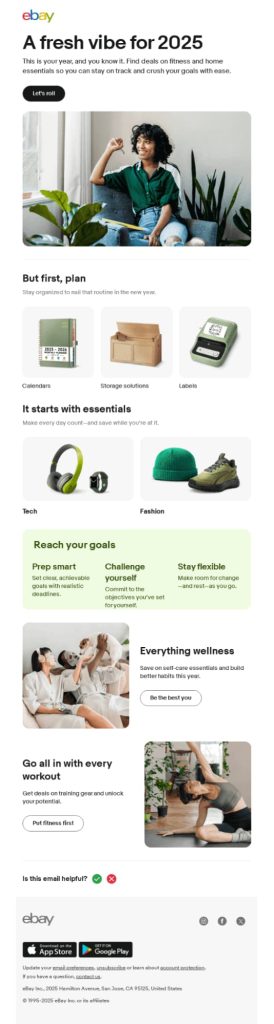
Built a resolution hub organized by goal type with five categories:
- “But first, plan” – Calendars, storage, organization tools
- “It starts with essentials” – Tech and fashion basics
- “Reach your goals” – Three approaches: Prep smart (realistic deadlines), Challenge yourself (commit to objectives), Stay flexible (room for change)
- “Everything wellness” – Self-care and health products
- “Go all in with every workout” – Fitness gear
Each section had clear product recommendations and helpful messaging.
Why It Crushed:
Let customers self-select based on their actual goals instead of forcing everyone into one bucket. The three-approach framework (Prep smart, Challenge yourself, Stay flexible) provided genuinely useful advice before selling anything.
What you can steal:
Create resolution categories that match your products. Let customers choose their path. Help first with frameworks or guidance, then show relevant products for that specific goal.
reMarkable: 100-Day trial for high-ticket New Year sales
The brand: reMarkable – digital paper tablet (premium product)
What they did:
Positioned their high-ticket tablet for serious goal-achievers with sophisticated copy: “Aiming to become a better organized and more productive version of yourself this year?”
Showed benefits as life improvements:
- “Harness the power of color” – opens new possibilities for organizing ideas
- “Work uninterrupted, from dawn till dusk” – no battery anxiety
- “Your best of mind on full” – capture ideas without digital distractions
Risk reversal: “Try risk-free for 100 days”
Why it crushed:
Premium buyers don’t need discounts—they need confidence. The 100-day trial removed all purchase risk. Sophisticated design and copy attracted the right customers who value quality over deals.
what you can steal:
For mid-to-high-ticket items, compete on certainty (trials, guarantees) not price. Frame your product as an investment in their future self. Use language like “upgrade” and “transform” rather than “sale” and “deal.”

Soundstripe: Use Data & Nostalgia to Fuel 2026 Momentum
The brand: Soundstripe – music licensing platform
What they did:
Combined reflection with forward momentum. Highlighted that “Hopeful” was their most popular mood tag, showed top tracks from 2024, and featured helpful blog posts (Game-Day Soundtracks, Chinese New Year music, TikTok Alternatives). Ended with “here’s to a harmonious 2026!”
Why it crushed:
Made subscribers feel part of something bigger. Used real data (the “Hopeful” mood) to create emotional connection that aligned perfectly with new year optimism. Provided actual value through content links, not just promotions.
What you can steal:
Celebrate what your community achieved together. Use real data if you have it. Provide valuable content alongside any promotional elements. Frame it as “Look what WE did together—now let’s make next year even better.”

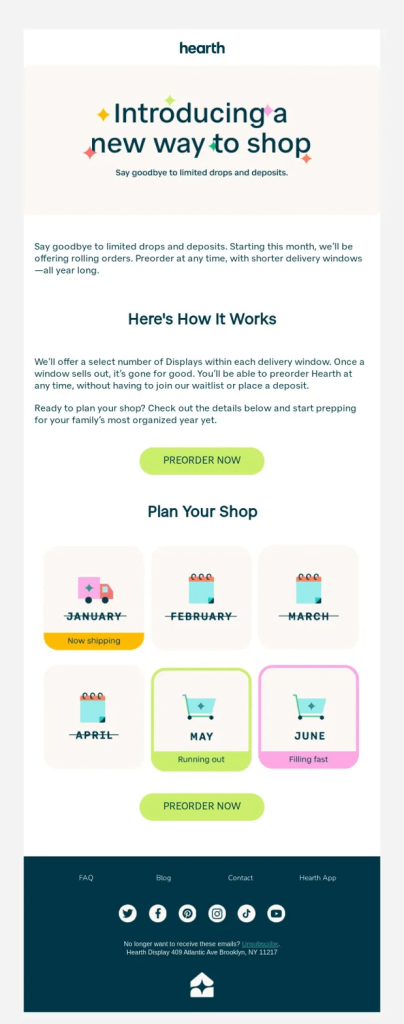
Hearth: Launch a new shopping model in January
The brand: Hearth – home display company
What they did:
Launched rolling orders (replacing limited drops and deposits) specifically in January. Hook: “Say goodbye to limited drops and deposits.”
Showed a visual calendar with each month’s status:
- January: “Now shipping”
- May: “Running out”
- June: “Filling fast”
Made it easy to plan ahead while creating urgency for the immediate months.
Why it crushed:
January = planning and organization. Perfectly timed for the “get organized” resolution crowd. The visual calendar made complex information instantly clear. Framed as solving a pain point, not just launching something new.
What you can steal:
If launching anything new (product, service, subscription model), January is the perfect time. People are open to “new ways” of doing things. Use visuals to make complex ideas simple. Position it around making their year more organized or easier.
Comparing All 7 New Year Marketing Ideas (At a Glance)
| Campaign Type | Best For | Complexity | Launch Timing | Key Element |
| Transformation Timeline (AG1) | Products with cumulative benefits | Medium | Jan 1-7 | Milestone mapping |
| Cultural Movement (Sayso) | Alignment with January trends | Low | Jan 1 (Day 1) | Real testimonials |
| Year-in-Review (Quince) | Established brands | Medium | Dec 28 – Jan 3 | Premium visuals |
| Resolution Hub (eBay) | Multi-category stores | High | Jan 1 | Self-selection paths |
| Premium Positioning (reMarkable) | High-ticket items ($100+) | Medium | Jan 1-14 | Risk removal |
| Data + Nostalgia (Soundstripe) | Community-driven brands | Medium | Jan 1-3 | Real metrics |
| New Model Launch (Hearth) | New offerings | High | Jan 1 | Visual simplicity |
Final takeaway: Make January Your Best Sales Month
January isn’t a recovery month. It’s a resolution economy—and new year marketing ideas done right turn fleeting motivation into annual revenue.
The brands that win don’t wait for February budgets.
They show up on January 1st with the exact tool someone swore they’d finally use this year.
Be that brand.
Launch fast.
Support longer.
Profit all year.
Now go steal those 72 hours.
Launch all New Year campaigns free with retainful
Send every sequence in this guide (Week 1 flashes, retention drips, resolution hubs) across email, SMS, and WhatsApp—unlimited contacts, zero cost.
Retainful’s forever-free plan includes:
- 150+ ready-made templates for newsletters, cart recovery, and seasonal promos—drag, drop, launch in minutes.
- Omnichannel automation for email/SMS/WhatsApp workflows: welcome series, win-backs, VIP nudges, and post-purchase upsells.
- Urgency & segmentation tools: timed reminders, exit-intent popups, behavior-based targeting (e.g., cart abandoners or resolution shoppers).
- Proven lifts: 30% cart recovery, 40% more repeats, 25% higher engagement—no credit card, no hassle.
Try Retainful free now → Set up your first campaign in 10 minutes.
Your customers are searching. Show up smarter.